Best EHR for Small Practices: Top 5 Picks for 2026

Running a small practice means wearing many hats. You are the clinician, the office manager, and often the billing department, sometimes all before lunch. Across the profession,
EHR adoption is now widespread, and a system that fits can quietly carry a large share of that load, while a poor fit only adds to it. That is why choosing an EHR for small practices deserves careful thought rather than a rushed decision.
This guide breaks down what a small-practice EHR actually is, why it matters, and five systems worth a closer look in 2026. If you are still sorting out the basics, it helps to understand
how EHRs differ from EMRs before you start comparing products, since the terms are often used loosely.
What is an EHR for small practices?
An electronic health record is the digital home for a patient’s medical history, from visit notes and medications to lab results and billing. An EHR for small medical practice use is built around a simple reality: a small team cannot afford software that is heavy, slow, or hard to learn.
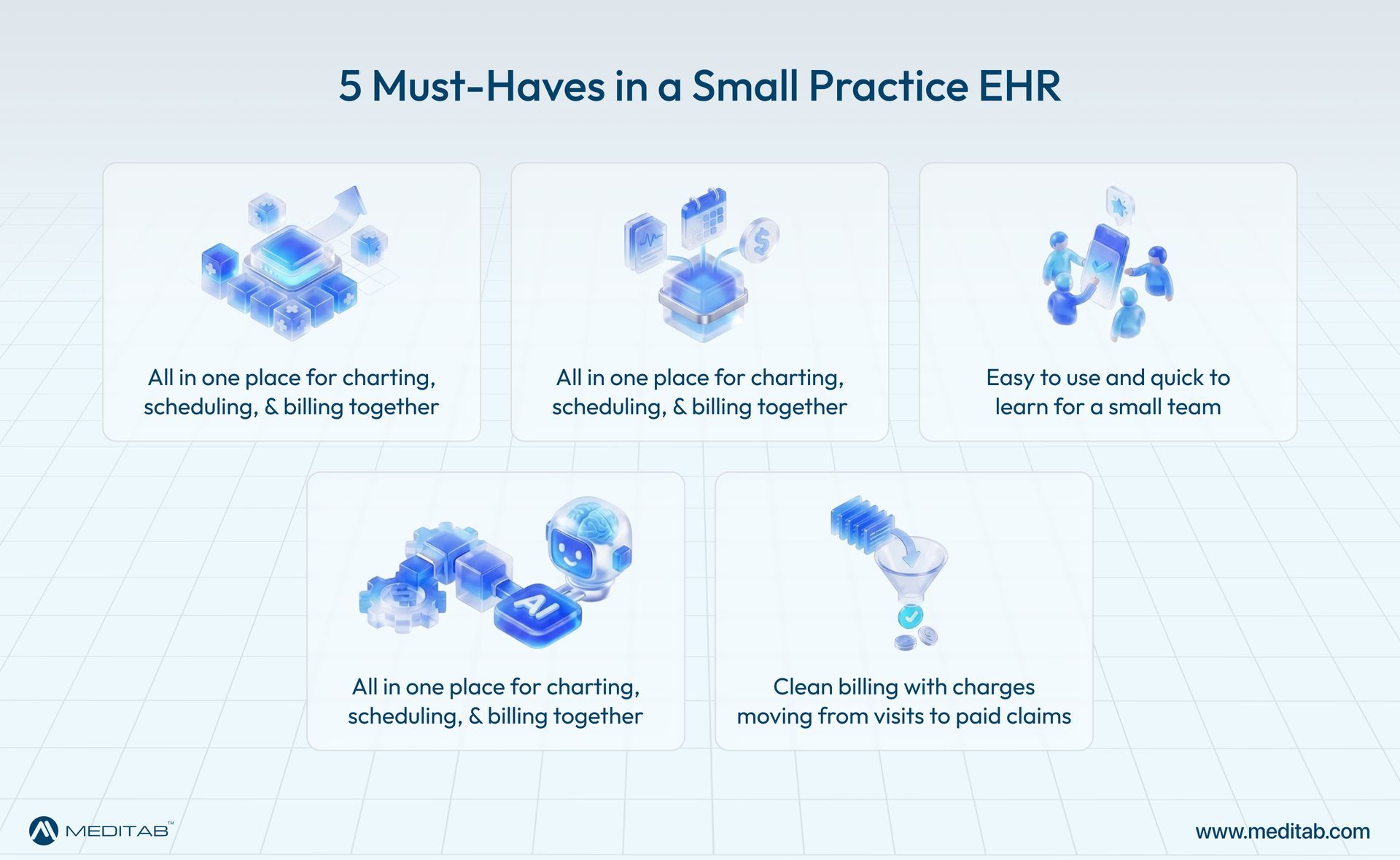
The best EHR systems for small practices bundle the essentials into one place, including charting, scheduling, e-prescribing, patient communication, and billing, rather than scattering them across separate tools. The goal is fewer logins, handoffs, and less time spent moving between screens.
It also helps to know the vocabulary before you shop. A quick look at
common EHR terms can make demos far easier to follow, since vendors tend to lean on acronyms. And because a small office has its own priorities, it is worth seeing what makes small-practice EHR needs distinct, so you can compare products on the features that matter to you.
Why does a small practice need an EHR?
Paper charts and disconnected tools slow a small team down in ways that are easy to underestimate. A well-matched EHR pays that time back. The
American Medical Association notes that a well-implemented EHR can improve the care physicians provide, especially when the system fits the way a practice actually works.
- Less time on paperwork
Notes, prescriptions, and orders move in a few clicks, so providers spend more time with patients and less on data entry. - Cleaner billing
Charges flow from the visit straight to the claim, which means fewer errors and faster payment. - A better patient experience
Online scheduling, reminders, and a patient portal keep people engaged between visits. - Simpler compliance
Built-in safeguards support HIPAA, e-prescribing rules, and quality reporting. - Room to grow
A system that scales lets a solo office add providers later without switching software.
There is also a financial case. A well-chosen EHR can lower administrative costs and lift collections over time. We walk through
EHR return on investment so you can put numbers to the decision instead of guessing.
Top 5 EHRs for small practices
There is no single best ambulatory EHR for small practices, since the best fit depends on your specialty, budget, and workflow. Still, a handful of systems consistently earn a place on the shortlist. Each one below is a capable system, so the question is less about which is good and more about which one fits your practice best. Here are five systems worth comparing in 2026.
1. Meditab’s IMS
Meditab’s Intelligent Medical Software (IMS) is built for ambulatory practices, bringing charting, practice management, and billing together in one system. It is a
certified electronic health records platform, tested under the ONC Health IT Certification Program. It is also an all-in-one EHR for independent practices, giving a small team enterprise capability without the complexity.
IMS stands out for its
specialty-specific workflows, with configurations tuned to more than forty specialties rather than a single generic template. Its AI can go a step further. As a value-added option, Meditab can tailor the AI to your specialty rather than use a generic model. So the tools align with how your team charts and decides. An AI scribe drafts visit notes as you work, and automation handles routine tasks like referral capture and payment posting.
The result is less data entry and more time for patients. Practices can also choose how they deploy it, in the cloud or on-premise, which makes it one of the best EHR solutions for small medical practices in the USA that value flexibility.
2. Tebra (formerly Kareo)
Tebra pairs clinical charting with strong billing and patient engagement tools, which makes it a natural fit for insurance-heavy small practices. Automated claims workflows and built-in reminders help a lean front office keep revenue moving.
3. DrChrono
DrChrono centers on a mobile, iPad-based interface, with charting and built-in billing. It can suit providers whose main priority is on-the-go documentation.
4. Elation Health
Elation is built around a clean, clinically focused workflow and is popular among independent and direct primary care practices. Integrated labs, orders, and patient communication keep the day-to-day simple.
5. AdvancedMD
AdvancedMD offers deep revenue cycle management and business intelligence dashboards, which suit practices that run billing in-house and want detailed reporting. It carries more features than a solo office may need, but it scales well as a practice grows.
In a nutshell
The best EHR for your practice is the one that matches how you actually work. A busy dermatology clinic, a solo family doctor, and a two-provider cardiology office will each weigh features differently. Every system on this list can serve a small practice well, so start with your must-haves, book a few demos, and notice how each one feels during a typical visit rather than only in a sales pitch.
For ambulatory practices that want charting, scheduling, and billing in one place, with workflows already tuned to their specialty, Meditab’s IMS offers that combination in a single platform. If that sounds like the direction you want,
schedule a live product demo and see how IMS handles your specialty and your day before you decide.
FAQs
What is the best EHR for a small medical practice?
There is no single winner. The best EHR for small medical practice use is the one that fits your specialty, budget, and workflow. All-in-one platforms like Meditab’s IMS suit teams that want charting, scheduling, and billing in one place, while lighter tools may suit a solo provider with simple needs.
How much does an EHR for small practices cost?
Pricing varies widely by vendor and by the modules you need, and many systems are billed per provider each month. Ask each vendor for a clear quote that includes setup, training, and support so that you can compare total cost rather than the headline price.
What features should EHR systems for small practices include?
At a minimum, look for charting, scheduling, e-prescribing, a patient portal, and integrated billing. EHR systems for small practices work best when these live in one platform, since that reduces double entry and manual handoffs.
Should a small practice choose a cloud or on-premise EHR?
Both can work. Cloud systems lower upfront cost and simplify maintenance, while on-premise options give a practice more direct control. Some platforms, including Meditab’s IMS, let you choose either model, so you are not locked into one.
What is the best ambulatory EHR for small practices?
For outpatient and office-based care, the best ambulatory EHR for small practices is one with specialty-specific templates and strong billing. Meditab’s IMS, Tebra, and DrChrono are all worth comparing depending on your priorities.
Share this post: