How to Measure Return on Investment (ROI) For Your EHR

An electronic health record is one of the largest technology decisions a practice makes, and, like any major investments, it deserves a clear answer to one question: what are we getting in return? Most practices can describe the benefits of their system in general terms: faster charting, cleaner claims, happier patients, but far fewer can put a number on them. That number is your EHR ROI, and measuring it turns a vague sense of value into a figure you can plan around.
As a peer-reviewed benchmark, a
Health Affairs study of solo and small-group practices found initial EHR costs averaging about $44,000 per full-time provider, with ongoing costs of roughly $8,500 per provider per year. In this article, we will walk you through why EHR ROI is tricky to pin down, a simple method to calculate it, the costs involved, what a system typically costs, and how to choose software that pays you back.
Why Measuring ROI in EHR Software Is Challenging
Return on investment sounds like a tidy formula, and the math is. The difficulty is that many of an EHR's biggest returns do not arrive as a single line on a bank statement. They show up as time given back to providers, fewer denied claims, and patients who stay because scheduling and communication are easier.
Several factors make the calculation harder than it first appears:
- Benefits are spread across departments, so the value shows up in billing, the front desk, and clinical time all at once.
- Some gains are indirect, such as reduced burnout or better retention, which take longer to surface.
- Costs continue after go-live, so an early snapshot understates the investment.
- Early productivity often dips during the learning curve before it climbs, which many of the
EHR implementation challenges and solutions worth planning for address directly.
None of this makes ROI unmeasurable. It just means you need a consistent method and a realistic time horizon.
Steps to Measure ROI of EHR Investments
The core formula is straightforward: ROI equals your net gain divided by your total cost, expressed as a percentage. The work is in defining each side honestly and tracking the same numbers over time.
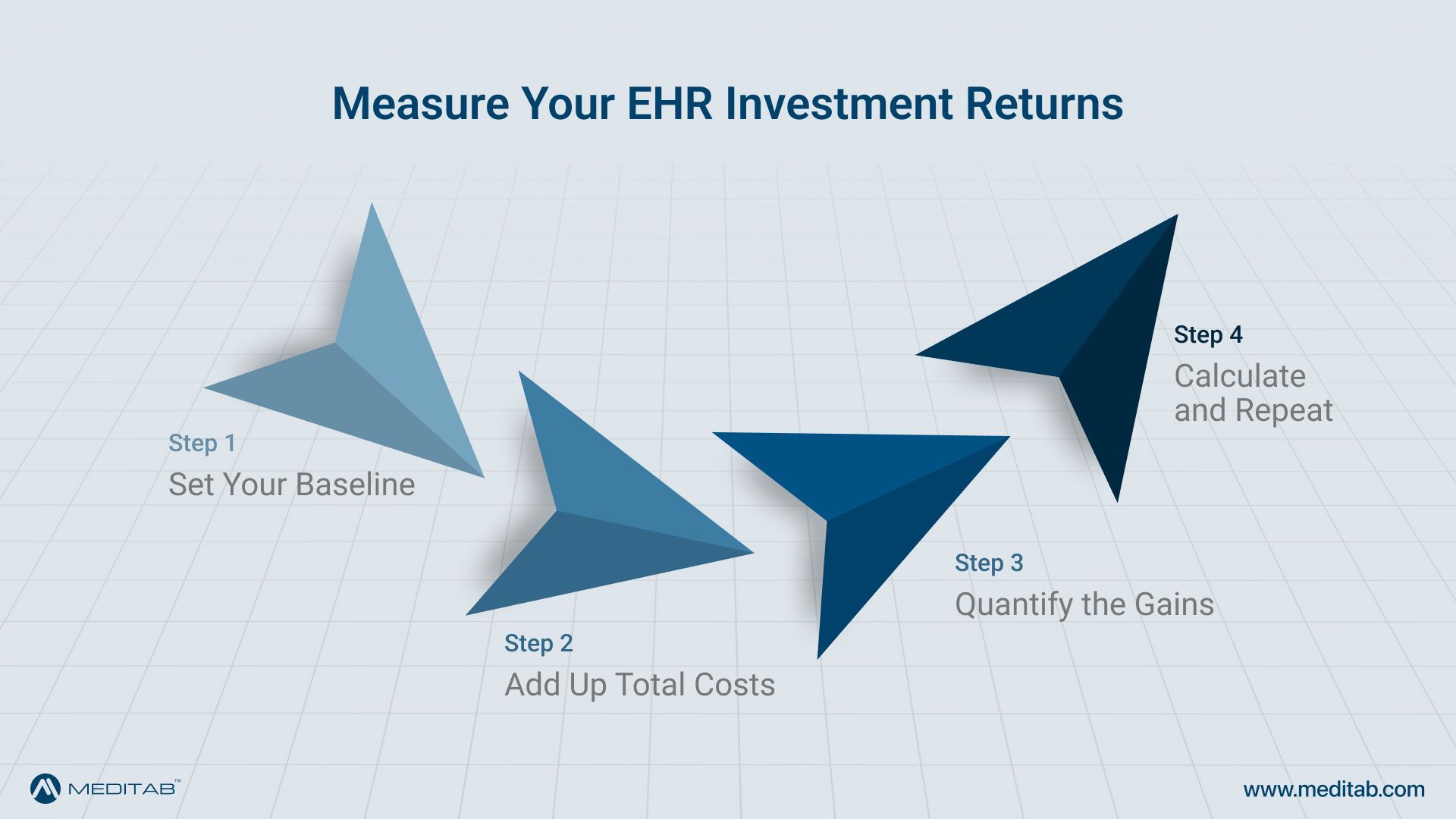
A practical sequence looks like this:
- Set a baseline:
Record where you stand today on claim denial rate, days in accounts receivable, no-show rate, and provider documentation time. - Add up total costs:
Include software, implementation, training, hardware, and ongoing fees (covered in the next section). - Quantify the gains:
Translate improvements into dollars: recovered revenue from cleaner claims, saved staff hours, and added visit capacity. - Calculate and repeat:
Apply the formula, then measure again at set intervals so the trend, not a single reading, guides you.
Deciding which numbers to track is half the battle. Our overview of the
key metrics to evaluate your revenue cycle management and the broader
healthcare KPIs every practice should track gives you a ready-made scorecard. If you prefer to model the outcome before you commit, an EHR ROI calculator lets you plug in your own baseline figures and project the return for your practice.
What Are the Costs Associated With an EHR?
Before you can measure a return, you need a full picture of the investment, and software licensing is only part of it. A credible ROI accounts for every category of spending across the first year and beyond.
The typical cost of implementing EHR includes:
- Software licensing or subscription fees, usually billed per provider or per user
- Implementation and data migration from your previous system
- Provider ad staff training
- Hardware and IT infrastructure, where needed
- Ongoing support, updates, and security
- The temporary productivity dip during the transition
For a category-by-category breakdown, Meditab’s
ultimate EHR cost guide lays out what to budget for at each stage. Counting these costs keeps your ROI defensible and prevents the unpleasant surprise of a return that looked better on paper than in practice.
What Is the Average Cost of an EHR System?
Costs vary widely by practice size, specialty, and deployment model, so treat published figures as a starting range rather than a quote. The good news is that return on investment is measurable once you know what to count on each side of the equation. If you are still mapping the fundamentals, our
complete guide on EHR software is a useful starting point.
For pricing matched to your practice rather than an industry average, the
Meditab EHR pricing page is the most accurate reference.
The ROI of EHR Implementation
Here is the encouraging part. When the costs are managed well, the returns tend to be substantial and measurable. In the same Health Affairs study, the average practice recovered its EHR costs in about 2.5 years and profited after that. An earlier cost-benefit analysis in the American Journal of Medicine estimated a net benefit of about $86,400 per provider over five years, driven by better charge capture, fewer billing errors, and improved test utilization.
The ROI of EHR implementation shows up in a few consistent places:
- Cleaner, faster billing
When documentation and billing share a single system, coding is more accurate, and claims move faster, as explained in "How Integrated EHR and Medical Billing Software Transform the Revenue Cycle." - Recovered staff and provider time
Automation removes repetitive work, an efficiency the Office of the National Coordinator for Health Information Technology (ONC) also attributes to well-implemented EHRs, and the best ways to enhance operational efficiency with AI-powered EHR show how that time adds up. - Added visit capacity
Time saved per encounter lets providers see more patients without a longer day. - Scale-appropriate returns
The value profile differs by practice size, a contrast covered in EHR for small practices vs large health systems.
The pattern is clear: the return grows as the system is used well, which is why the time horizon you choose matters as much as the formula.
Choose the Best EHR Software for Your Practice
The single largest factor in your return is fit. An EHR that matches your specialty and workflow earns its cost back quickly, while a poor fit drags on productivity no matter how capable it looks in a demo.
A few questions sharpen the decision:
- Does it fit your specialty and the way your team already works?
- Does it integrate clinical, billing, and scheduling into a single system so the returns compound?
- Will the vendor support you through implementation and beyond?
- Does it scale as you add providers, locations, or services?
Our guide on
how to choose the best EHR software walks through the evaluation step by step, and the critical questions to evaluate an AI-powered EHR help you separate genuine capability from marketing.
Where Meditab's IMS Fits
Meditab's IMS is an all-in-one EHR built to turn these ROI levers into everyday results. Because the clinical record, IMS Bbilling, scheduling, and patient engagement share a single platform; documentation flows directly into cleaner claims, staff spend less time rekeying information, and providers reclaim valuable time on every encounter. With configurable workflows for more than 40 specialties and AI-powered automation, IMS is designed to fit how your practice already works, so the return tends to show up sooner rather than later. That combination of accurate billing, recovered time, and added visit capacity is exactly what a strong EHR ROI is made of.
Conclusion
Measuring EHR ROI turns a large, sometimes uncertain purchase into a decision you can defend with numbers. Set a baseline, count every cost, translate the gains into dollars, and track the same figures over time. Do that, and the value of the correct system becomes obvious rather than assumed.
If you want to see those returns modeled for your own practice, book a demo with Meditab, and we will walk through the numbers with you.
FAQs
What is EHR ROI?
EHR ROI is the return on investment your practice earns from its electronic health record, measured as net gain divided by total cost. Net gain includes recovered revenue from cleaner claims, staff time saved, and additional visit capacity, while total cost includes software, implementation, training, and ongoing fees.
How do I use an EHR ROI calculator?
An EHR ROI calculator asks for your baseline figures, such as claim denial rate, days in accounts receivable, and staff hours spent on manual work, and then projects the dollar value of expected improvements relative to your total system cost. It is most accurate when you enter real numbers from your own practice rather than industry averages.
What is the cost of implementing an EHR?
The cost of implementing an EHR covers software licensing, data migration, training, any hardware, and ongoing support. A Health Affairs study of small practices found initial costs averaging about $44,000 per provider and ongoing costs near $8,500 per provider per year, though modern cloud subscriptions, your practice size, and deployment model all affect the total.
How long does it take to see ROI from an EHR implementation?
It varies by practice. A Health Affairs study found that the average small practice recovered its EHR costs in about 2.5 years and profited thereafter. A separate analysis in the American Journal of Medicine estimated a net benefit of about $86,400 per provider over five years. Returns usually grow after the initial learning curve, so measuring over time gives a truer picture than an early snapshot.
How can I improve my EHR ROI after implementation?
Improving your EHR ROI starts with optimizing how your system is used. Focus on staff training, workflow customization, and better use of automation features. Reducing claim denials, improving documentation accuracy, and using tools like an EHR ROI calculator to track performance over time can significantly increase the ROI of EHR implementation.
Share this post: