Cloud-Based vs On-Premise EHR: Which Is Best for You?

Adopting an electronic health record (EHR) system is a major technology decision for a practice. According to the Office of the National Coordinator for Health IT, 91% of office-based physicians used a certified EHR as of 2024.
So the real question is no longer whether to use an EHR. It is how to host one. That is the heart of the cloud-based vs on-premise EHR debate: two very different models with real trade-offs. This guide compares them and helps you decide.
If you are still mapping the landscape, start with our guide to
the types of EHR systems or our broader
guide to EHR software.
Cloud-Based EHR Solutions
A cloud-based EHR stores your data on secure, remote servers managed by your vendor. You reach it through a web browser or app, so there is no server to buy or maintain on-site. Cloud-based EHR solutions have become the default for new practices, and for good reason.
The benefits of a cloud-based EHR are practical. There is lower upfront cost, because there is no hardware to purchase. Updates and backups happen automatically. Your team can log in from anywhere, which supports remote work and multi-site care. And the system scales easily as you grow. Security is often stronger than people expect, because reputable vendors invest heavily in encryption, monitoring, and compliance.
Our article, "Healthcare Data Security and your EHR," explains what to look for. Cloud models also pair naturally with mobile and AI tools, as we cover in our article, "How Mobile EHR Solutions and AI are Transforming Patient Care."
The best cloud-based EHR solutions for multi-location clinics keep all locations on a single shared record, with no servers to replicate across locations. That same flexibility carries into scheduling and billing, which is why many teams also move to
cloud-based practice management systems.
On-Premise EHR Solutions
An on-premises EHR runs on servers you own and is maintained inside your facility. Your IT team controls the hardware, the data, and the update schedule. For some organizations, that control is the whole point.
An on-premises EHR appeals to practices that want direct ownership of their infrastructure, or that operate under strict internal policies. It can also integrate deeply with legacy systems already on-site. But the trade-offs are real.
There is a higher upfront cost for servers and licenses. Your team owns maintenance, security patches, and backups. Updates happen when you schedule and run them, not automatically. And if a server fails, recovery is on you. Understanding those true costs matters, which is why we built the
ultimate EHR cost guide.
Comparative Analysis: Cloud vs On-Premise EHR
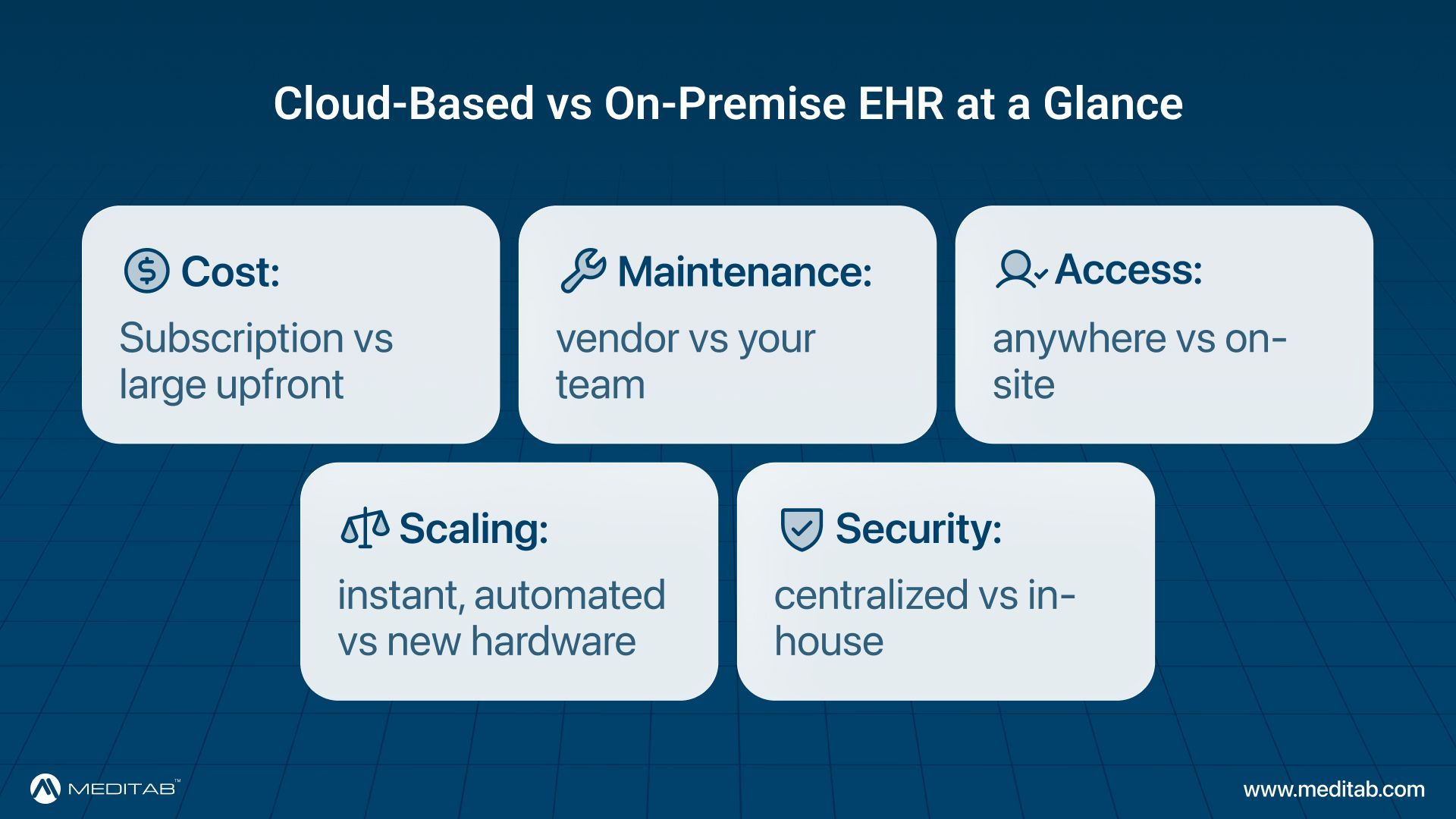
Here is how the two models compare on the factors that matter most.
- Cost -
A cloud-based EHR uses a predictable subscription with low upfront cost. An on-premises EHR requires a large initial investment and ongoing maintenance. For the full picture, weigh the return on your EHR investment. - Maintenance -
The vendor handles it in the cloud. Your team handles it on-premises. - Security -
Both can be secure. Cloud vendors centralize security and operate data centers that meet recognized standards such as SOC 2 and HIPAA. On-premises security depends on your internal resources. - Access -
Cloud wins for remote and multi-site use. On-premises is tied to your local network. - Scalability -
Cloud scales with a change in settings. On-premises scaling means buying and configuring more hardware. - Migration -
Moving to any new system takes planning. Our guide to stress-free EHR data migration with IMS shows how to do it without disruption.
Who Should Choose What
There is no single winner in the cloud-based vs. on-premises EHR debate. The right choice depends on your size, budget, and goals. A cloud-based EHR is usually the better fit for new practices, small to midsize clinics, groups with multiple locations, and any team that values mobility and low upfront cost. It is also the simpler path for practices without a dedicated IT department.
An on-premises EHR can suit large health systems with strong internal IT capabilities, strict data residency rules, or heavy investment in existing on-site infrastructure. Practice size shapes the decision whether it is a small practice or a large health system. When you are ready to compare specific systems, our guide,
How to Choose the Best EHR Software, walks you through the criteria.
Why Should You Choose Meditab’s IMS
Here is an advantage many vendors cannot match: with Meditab, you do not have to choose your software based on its hosting. Meditab’s IMS (Intelligent Medical Software) supports every deployment model, including on-premises EHR, cloud-based EHR, ASP, and SaaS. Whichever path fits your practice today, you get the same ONC-certified, all-in-one platform, and you can shift models as your needs change.
Meditab’s IMS unifies clinical charting, practice management, and integrated billing into a single source of truth. It is tailored to your specialty, with prebuilt templates and workflows across 40+ specialties.
It scales cleanly from a single office to a large group, which makes it one of the best cloud-based EHR solutions for multi-location clinics when you choose cloud hosting. Ambient AI scribing, automated reminders, and real-time eligibility checks cut the busywork that slows practices down.
And if you opt for the cloud, updates, backups, and HIPAA-compliant security are handled for you. Explore the
All-Iin-One EHR System to see how it fits your practice.
To Sum It Up
The cloud-based vs. on-premises EHR decision comes down to control versus convenience. On-premises gives you direct ownership at a higher cost and effort. A cloud-based EHR offers lower upfront costs, easier scaling, automatic updates, and anywhere access, which is why most practices now choose it. If you want one platform that covers clinical care, billing, and scheduling, and lets you choose how it is hosted, review
EHR pricing or
book a demo to see IMS in action.
FAQs
What is the main difference between cloud-based and on-premises EHR?
A cloud-based EHR is hosted and maintained by your vendor and accessed online. An on-premises EHR runs on servers you own and is managed inside your facility.
Is a cloud-based EHR secure?
Yes. Reputable cloud-based EHR solutions use strong encryption, continuous monitoring, and HIPAA-compliant safeguards, often exceeding what a single practice can maintain on its own.
What are the benefits of cloud-based EHR?
The benefits of cloud-based EHR include lower upfront cost, automatic updates and backups, access from anywhere, easier scaling, and simpler multi-location support.
Which is better for multi-location clinics?
For groups with several sites, the best cloud-based EHR solutions for multi-location clinics keep all locations on a single shared record, with no servers to maintain at each site.
Is a cloud-based EHR more affordable than on-premises?
Usually, yes. A cloud-based EHR replaces a large upfront hardware investment with a predictable subscription, though the total cost depends on your size and needs.
Share this post: