What is an Allergy EHR, and Does Your Practice Need One?

An allergy patient's chart must
contain the precise compound formula for their allergy immunotherapy.
Skin test results determine which allergens go into that patient's treatment vials, at what concentration, and in what dilution series. The vials are mixed in the clinic, labeled for that patient alone, and given an expiration date. A build-up schedule then tells a nurse what to draw up and how much to give, across dozens of visits over three to five years, adjusting every time for a missed appointment, a seasonal gap, or a reaction.
That chain has to stay intact through staff changes, vial reorders, and years of visits where a physician is not in the room. That is the practical reason allergy practices tend to outgrow general-purpose systems. According to CDC data released in January 2026, roughly three in ten US adults and children reported a seasonal allergy, eczema, or food allergy in 2024, with seasonal allergies alone affecting 25.2% of adults. Demand is high, panels are large, and the documentation attached to each patient is unusually long-lived.
This guide explains what allergy EHR software actually is, which capabilities separate it from a general system, what it costs, and how to evaluate vendors without relying on a demo script.
What is an Allergy EHR?
An allergy EHR is an electronic health record built specifically for allergy and immunology workflows. Vendors also market it as allergy EHR software or as an allergy and immunology EHR. It carries the same foundation as any certified record system, such as charting, orders, e-prescribing, results, billing, and patient communication. For the clinical modules, the allergy specialty depends on: skin test documentation, allergen extract and vial management, immunotherapy build-up schedules, injection administration records, reaction, and inventory tracking.
A general system stores an allergy patient's data. An allergy-specific electronic health record inherently recognizes the interconnectedness of its data points, so a change to a prescription set propagates to the schedule, the label, and the injection record without anyone retyping anything. If you are still working out how these systems are categorized, our explainer on
EHR vs. EMR differences is a useful starting point.
Why Allergy & Immunology Practices Need a Specialty-Focused EHR
The case for allergy EHR software begins with how the specialty actually delivers care. Most general EHRs were designed around an episodic model. Here, the patient who is present is assessed, treated, and the encounter closes. Allergy does not work that way. A single immunotherapy course can run three to five years, involve dozens of visits without a physician encounter attached, and require a treatment set that has to be reordered, relabeled, and re-dated on a fixed cycle.
Extract preparation is the clearest example. The
AAAAI Practice Management Resource Guide sets out the labeling, dilution, and expiration-tracking requirements for subcutaneous allergen immunotherapy in detail. Every vial needs its contents, concentration, patient identifier, and expiration recorded accurately, and the record has to be reproducible months later. A system with no concept of a vial cannot enforce any of that.
Key Features of an Allergy EHR
The features listed below are the modules that determine whether an allergy and immunology EHR fits the specialty, and they are worth testing individually during any demo. Our breakdown of specialty
EHR features for allergy practices goes deeper on several of them.
- Skin testing documentation
Percutaneous and intradermal results recorded on a structured grid with wheal and flare measurements, panel templates by season and region, and a reading that flows directly into the assessment.
- Allergen extract and vial management
Prescription sets built from test results, with dilution series, lot numbers, expiration dates, and printable labels generated by the system. Inventory should decrement as vials are prepared, and expiring extract should surface before a patient arrives for an injection.
- Immunotherapy scheduling and dose escalation
Build-up and maintenance schedules that adjust automatically for missed visits, seasonal gaps, and prior reactions. This is the single most valuable piece of automation in an allergy practice EHR, because it replaces a calculation that nurses would otherwise perform by hand many times a day.
- Injection administration and reaction tracking
A nurse-facing workflow for injection-only visits verifies identity and vial, records site, dose, and time. It has to be documented for any local or systemic reaction and apply the resulting dose adjustment to the next appointment. Our guide to allergy testing and treatment tracking covers how this closes the loop between testing and long-term treatment.
- Pulmonary function and biologics
Spirometry integration with trended results, plus support for the prior authorization, administration, and monitoring workflows that biologic therapies require.
- Practice management and revenue
Allergy billing has its own patterns, including multiple units of testing codes, injection codes tied to vial preparation, and payer rules that differ from primary care. Allergy practice management software should handle scheduling, eligibility, claims, and reporting in the same system that holds the clinical record.
Allergy EHR vs. General EHR: What Is the Difference?
Both EHRs are certified record systems. The difference between a general product and dedicated allergy EHR software is whether specialty logic is native or improvised.
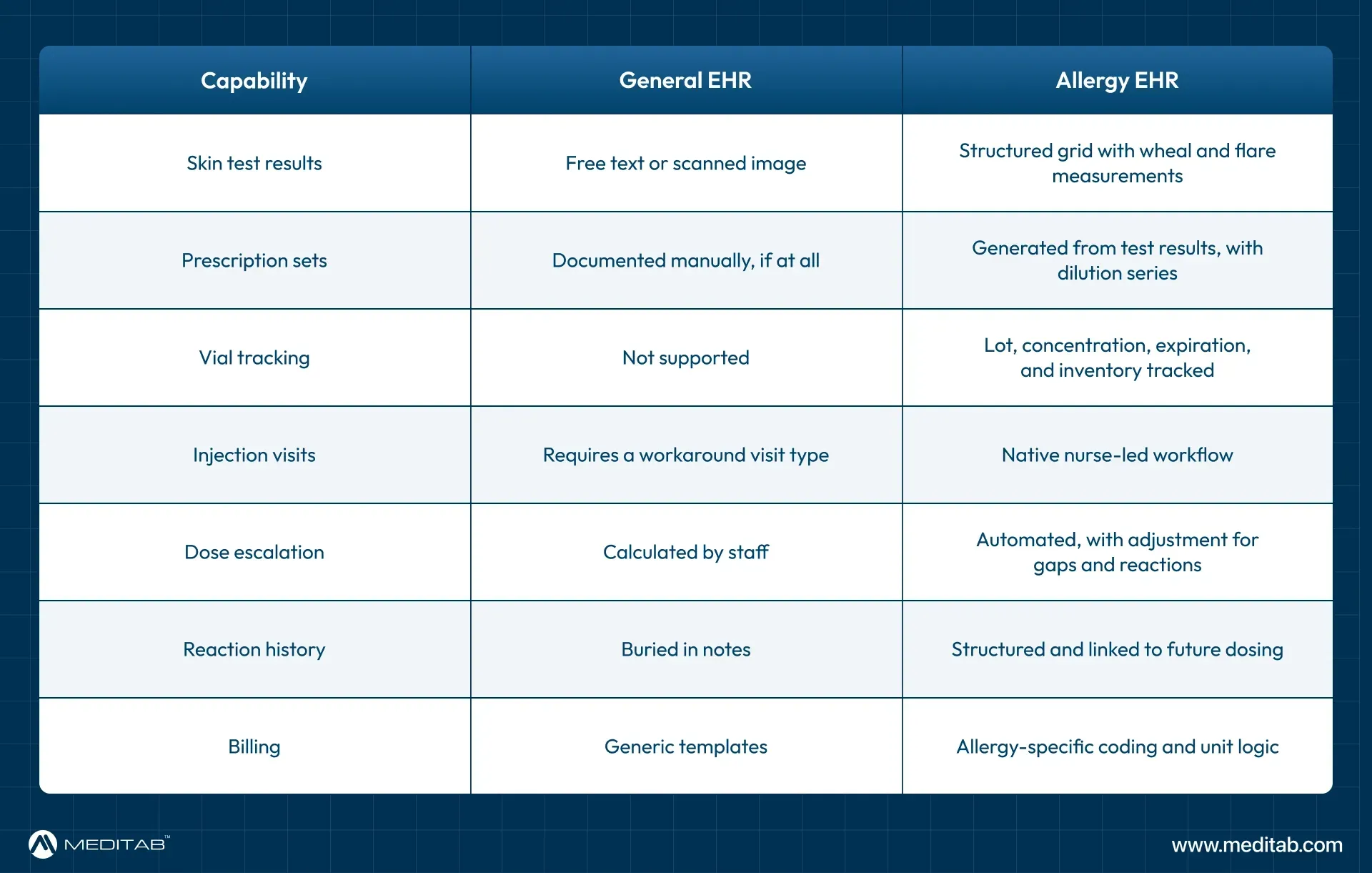
A general system can be configured to approximate some of this information, but the question is how much of the configuration does your practice have to build, maintain, and retrain staff on every time the vendor releases an update.
How an Allergy EHR Improves Efficiency and Outcomes
Documentation burden is a measurable problem across all of healthcare. The ONC's Strategy on reducing regulatory and administrative burden relating to the use of health IT and EHRs identifies clinical documentation as a leading source of clinician frustration. The report recommends reducing the effort required to record care. In allergy, much of that effort is repetitive calculation and transcription, precisely the work software should absorb.
Practices that move to allergy EHR software typically report gains in the following areas.
- Shorter injection visits - Vial verification and dose lookup happen on screen.
- Fewer dosing errors - Escalation logic and expiration alerts catch problems before the injection.
- Higher output on shot days - A nurse-facing workflow lets staff move through a queue without physician bottlenecks.
- Cleaner claims - Testing units and injection codes are captured at the point of service.
- Better continuity - A patient's full immunotherapy history stays legible when staff changes.
- Less after-hours charting
- Structured templates reduce the free text that accumulates into evening work.
These gains compound over a treatment course rather than appearing in a single visit. Our article on
allergy practice efficiency benefits
looks at where the time actually goes in a typical allergy clinic day
What to Look for When Choosing an Allergy EHR
Evaluating allergy EHR software starts with certification. The ONC Health IT Certification Program verifies that a product meets adopted standards for functionality, interoperability, and transparency; it requires vendors to disclose limitations and additional costs. Confirm certification first, then evaluate everything specific to your specialty.
Evaluation criteria that matter for allergy:
- Depth of the immunotherapy module: Does it handle mixing, labeling, inventory, and escalation, or only some of these?
- Configurability of test panels: Can your own panels be built without vendor involvement?
- Interoperability: Labs, spirometry devices, pharmacies, registries, and referring practices. Evaluate if these features are available when considering an allergy immunotherapy EHR.
- Reporting: Quality measures, immunotherapy adherence, no-show rates, and revenue by service line. Ensure the EHR has these capabilities prior to making your purchase decision.
- Support model: Determine if the people answering the phone understand allergy workflows.
- Migration path: Consider how historical immunotherapy records will be brought across into your new EHR.
Our general framework on how to
choose the best EHR software covers the procurement mechanics that apply regardless of specialty, including scoring, references, and contract review.
Specific points to address with an Allergy EHR Vendor
The quality of the answers tends to separate vendors who have implemented EHR software for allergists from those adapting a general product. The same points apply whether you are assessing an allergy practice EHR or a broader platform with a specialty module.
- Show me a patient moving from skin test through prescription set to first injection, without leaving the system.
- How does the schedule change when a patient misses six weeks of build-up?
- Where does vial expiration surface, and who sees it?
- How is a systemic reaction documented, and what does it change about the next dose?
- How many allergy practices are live on this product, and may we speak with two of them?
- What exactly transfers during migration, and what has to be re-entered manually?
- Which of these features are included, and which are separately licensed?
For a broader checklist covering contracts, uptime, security, and support, see our list of
questions to ask an EHR vendor.
How Much Does an Allergy EHR Cost?
Pricing for allergy EHR software varies by deployment model, practice size, and which modules are included.
HealthIT.gov's
cost guidance for EHR adoption puts initial purchase and installation in the range of $15,000 to $70,000 per provider, and breaks total cost into five categories such as hardware, software, implementation assistance, training, and ongoing maintenance and support.
For a specialty EHR for allergy practices, two additional variables matter. The first is whether immunotherapy modules are bundled or licensed separately, which can change the quoted figure substantially. The second is data migration, particularly the cost of bringing historical prescription sets and injection records across in structured form.
When comparing quotes for a specialty EHR for allergy practices, ask each vendor to price the same scope. Our
EHR cost guide breaks down the full ownership picture, including the indirect costs of reduced productivity during transition.
How to Implement an Allergy EHR Successfully
AHRQ's Workflow Assessment for Health IT Toolkit recommends mapping existing workflows before a system goes live, and allergy practices have a specific reason to take that advice seriously. Implementation failures here are usually traced to the same source where the immunotherapy data was treated as an afterthought. Everything else migrates reasonably well. Active treatment sets do not, because they are relational and time-sensitive.
- Look at the inventory of your active courses first. Every patient mid-build-up is a migration dependency with a clinical deadline.
- Decide what migrates as structured data and what migrates as documents. Historical encounters can be documents. Active prescription sets cannot.
- Build and validate panels before go-live. Test panels configured during go-live week could be wrong.
- Train by role. Injection nurses need a different training than providers and the front desk.
- Run a parallel shot clinic. One clinic day documented in both systems will expose more issues than a month of testing.
- Reduce schedule volume for the first two weeks. Protecting output during go-live protects revenue afterward.
Assign one clinical owner for immunotherapy data specifically. It is the part of the migration that requires someone who understands both the software and the treatment.
The Future of Allergy EHR Technology
The direction of travel in EHR for allergy and immunology is toward systems that reduce documentation work. Ambient documentation is beginning to handle the narrative portion of visits. Predictive tools are being applied to no-show risk and treatment adherence, both of which matter more in a specialty where a missed appointment changes the next dose.
Interoperability is the other axis on which allergy EHR software is advancing. FHIR-based exchange makes it more realistic for a patient's immunotherapy history to travel between practices intact, which is currently one of the specialty's most persistent friction points. Our piece on
AI and automation in allergy EHRs examines where these capabilities are useful today and where they are still developing.
How Meditab's IMS Supports Allergy & Immunology Practices
Meditab's IMS is an EHR for allergy practices built on three decades of healthcare specialty EHR development experience. Allergy-specific functionality is native, with structured skin testing, allergen extract and vial management. It also has the capability for tracking labeling and expiration, automated immunotherapy scheduling with dose adjustment, nurse-led injection workflows, reaction documentation linked to future dosing, and inventory management.
Clinical and practice management sits in one system, so testing units, injection codes, and biologics authorizations are captured where the care is documented. As an allergy electronic health record, IMS has additional AI functionality. This includes ambient documentation, patient no-show prediction, and AI-assisted document processing, with FHIR APIs available for third-party integration.
To Sum It Up
Allergy and immunology practices are unusually dependent on the accuracy and continuity of their records. A treatment plan that runs for years changes with every reaction. An allergy EHR software removes the manual calculation, the parallel spreadsheets, and the scanned grids, and puts the specialty's core workflows where they belong. Evaluate the immunotherapy module, insist on seeing a full patient journey, and plan the migration around your active treatment sets. These decisions determine most of the outcome.
Frequently Asked Questions
What is the difference between allergy EHR software and a general EHR?
Both are certified record systems, but an allergy EHR includes native modules for skin testing, allergen extract and vial management, immunotherapy scheduling, injection documentation, and inventory management. A general EHR stores this information; an allergy EHR understands the relationships between the pieces, so a change to a prescription set flows through to the schedule, the label, and the injection record.
Does a small allergy practice need specialty software?
Practice size matters less than immunotherapy volume when assessing whether you need an EHR for allergy and immunology. A two-provider practice running a busy shot clinic will feel the absence of vial tracking and automated dose escalation more acutely than a larger practice with a smaller immunotherapy panel.
Can immunotherapy records be migrated from an existing system?
Historical encounters usually migrate without difficulty. Active prescription sets and injection histories are difficult, because they are relational and time-sensitive. Ask any vendor precisely what transfers in structured form and what has to be re-entered, and treat that answer as a cost line rather than a technical detail.
How long does implementation take?
While most allergy practices expect a two to four-month implementation timeline, Meditab accelerates go-live with a structured process that reduces delays, even for immunotherapy-heavy workflows.
Is allergy practice management software separate from the EHR?
It can be, but integration is worth prioritizing. Allergy billing depends on clinical detail like testing units, vial preparation, and injection administration. So, separating the clinical and financial systems introduces reconciliation work that an integrated platform avoids.
What should we test during a vendor demo?
This is the clearest test of EHR software for allergists. Ask to see one patient move from skin test through prescription set, vial preparation, build-up schedule, and first injection, then introduce a missed appointment and a systemic reaction and watch what the system does. A product built for allergy handles that sequence without leaving the record.
Share this post: