What's the Difference Between an EHR and EMR?

Where plenty of practices still worked with paper charts only ten years ago, today you’d be hard-pressed to find a medical professional who hasn’t at least seen an EHR or EMR in action. “Electronic Health Records” and “Electronic Medical Records” are used almost interchangeably when referring to modern healthcare software, but there are definite, essential differences.
In 2014, the American Recovery and Reinvestment Act (ARRA) required healthcare organizations all over the country to adopt electronic systems. Even now, though, there is still plenty of confusion between what exactly EMR or EHR software entails.
Despite their similarities, knowing the difference can help you decide what practice software will give you the support you need.
What are Electronic Medical Records?

An Electronic Medical Record system (EMR) is a digital copy of a patient’s paper chart. It contains the patient’s medical data, history, and the treatments conducted by a particular provider.
While EMRs are significantly better than using paper records, EMRs have trouble sharing records with other healthcare settings. In the case of a patient switching providers, the patient’s record might still need to be printed out and delivered by mail to the new practice.
What are Electronic Health Records?
EHRs satisfy all of the functions of EMRs and significantly more. Electronic Health Records (EHRs) are also a digital copy of a patient’s chart, but they also provide a more comprehensive report on a patient’s overall health. They contain information from all the clinicians involved in the patient’s care.
EHRs can share medical information with other providers and other healthcare organizations such as laboratories, imaging facilities, and pharmacies.
What’s the Difference Between EMRs and EHRs?
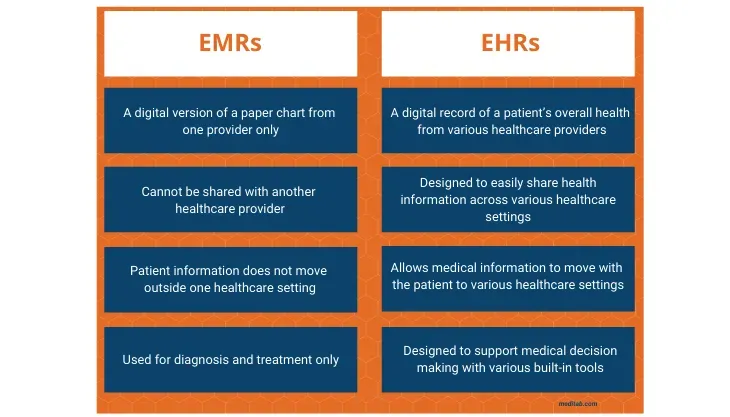
The two significant differences between EMRs and EHRs are the medical data they contain and that data's shareability.
EHR software companies build their systems to share information and provide access for all the people involved in the patient’s care, including the patient themselves. An electronic health records system allows medical information to move with the patient across specialties, labs, imaging facilities, pharmacies, and across different states. An electronic medical records system does not.
Take the example of referring a patient to a specialist. Your staff would need to send the patient’s medical information to that specialist, but because EMRs are for internal use by a single provider, your team would need to print out the patient’s chart and mail it. EHRs can digitally share patient data.
Electronic Health Record software has more tools and features that provide a larger picture of a patient’s medical history than EMRs, which are often limited. Additionally, EHRs provide more in-depth clinical decision tools like drug interaction checking.
The ability to send and receive diagnostic, lab, and imaging results, and built-in patient engagement tools, set them apart even more.
EHRs also have built-in analytical tools that help you improve patient care, as well as reporting capabilities for government-mandated reporting programs like MIPS.
An easy way to remember the difference between EMRs and EHRs is by thinking about the terms “medical” and “health.” EMRs provide a limited view of a patient’s medical history, while EHRs offer a comprehensive view of a patient’s overall health.
An EHR That Adapts to Your Workflow
Any modern healthcare practice needs some form of electronic records that meet their daily and administrative needs. However, if you want to focus on your patient’s overall health and prioritize continuity of care, you would need an EHR.
Meditab’s practice software, IMS, is just one example of what modern EHRs can bring to a practice.
Along with built-in decision support, IMS also includes features like mobile and remote capabilities and modules devoted to office management. Combining these tools, along with the capabilities to adapt to your practice's specialty, makes an EHR system like IMS go beyond records management and begins to lessen the burden on you and your staff.
Share this post: