Why Integrated Medical Billing Elevates Your EHR Software
Ambulatory practices today operate in an environment where efficiency, accuracy, and speed directly impact revenue and patient satisfaction. Managing clinical care and financial operations separately often leads to inefficiencies, errors, and delayed reimbursements. This is where EHR integration becomes essential. According to David Lehman, “Digital technology can ultimately enhance the patient experience.”
By integrating medical billing within your EHR system, practices can eliminate data silos, reduce front-desk burden, and create a seamless workflow from patient visit to payment collection. In this blog, we explore how medical billing integrated with
Meditab's EHR software, IMS, can transform practice operations and why it has become a necessity rather than an option.
What is an EHR Integration?
EHR integration, in the context of revenue cycle management, refers to the deep, bidirectional connection between a practice’s clinical records and its financial systems. Instead of exporting files or re-entering data, integrating medical billing with your EHR ensures that every diagnosis, procedure code, and patient demographic captured during a visit is instantly available for claim generation.
For ambulatory practices, from solo practitioners to multi-specialty groups, this creates a "single source of truth." When we talk about integrated EHR systems, we mean a unified platform where scheduling, clinical charting, and billing automation in healthcare work together in real-time.
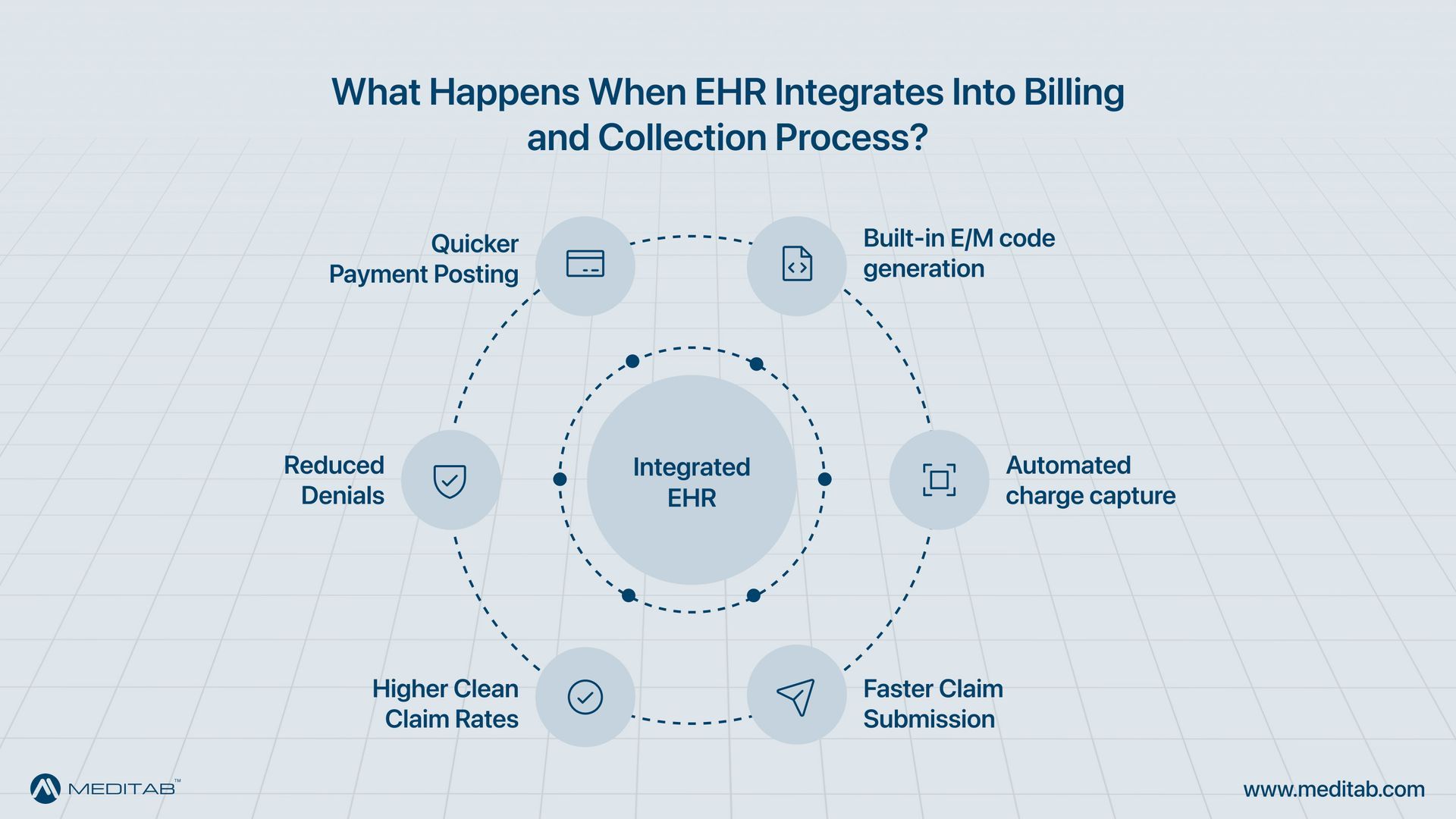
How EHR Integration Improves the Billing and Collection Process
An integrated system combines clinical documentation, practice management, scheduling, coding, charge capture, and billing into a single, unified platform, eliminating the need for separate EHR and billing software. One of the biggest advantages of integrating medical billing into your EHR is the dramatic improvement in revenue cycle efficiency.
- Built-in E/M code generation:
The 2021 E/M algorithm built into the EHR automates code selection based on medical decision-making data - Automated charge capture:
Clinical documentation immediately triggers billing codes; reduces missed charges. - Faster Claim Submission:
Charges are captured at the point of care to populate claims, reducing lag time between service delivery and billing. - Higher Clean Claim Rates:
Integrated systems perform real-time validation, flagging missing information or coding inconsistencies before claims are submitted. - Reduced Denials:
Because documentation travels with the claim, practices experience fewer denials related to insufficient records or mismatched codes. - Quicker Payment Posting:
Electronic remittance advice (ERA) can be automatically reconciled with patient accounts, accelerating accounts receivable (A/R) cycles.
Practices using fully integrated EHR systems often see the number of days in A/R drop significantly, improving cash flow and reducing the administrative burden on billing staff. This billing automation in healthcare minimizes human error and ensures compliance with evolving payer requirements.
Additional Benefits of Using Integrated Medical Billing Software
Beyond billing efficiency, an integrated solution delivers several operational and clinical advantages for ambulatory practices:
- Improved Accuracy and Compliance:
Real-time synchronization between clinical notes and billing reduces the risk of coding errors and supports accurate risk adjustment and quality reporting. - Enhanced Provider Experience:
Physicians spend less time on administrative tasks and more time with patients. In IMS, features such as automated charge capture and coding suggestions help a lot with documentation, saving even more time for them. - Optimized Patient Experience:
Integrated systems support smoother eligibility verification, more accurate estimates, and faster billing, leading to higher patient satisfaction and fewer billing-related complaints. - Organized Workflows:
From scheduling to check-out and follow-up, every step is connected on one platform. This is particularly beneficial when combined with patient portals and telehealth solutions.
- Actionable Insights:
Unified data enables powerful reporting on revenue performance, denial trends, and productivity metrics, helping practice leaders make more informed decisions.
For growing practices, integrated healthcare solutions offer scalability without the complexity of managing multiple disconnected systems.
Why Providers Need Integrated Medical Billing Software
The healthcare landscape is evolving rapidly, and ambulatory practices must keep up with increasing administrative workload and patient expectations. Here’s why EHR integration is more important than ever:
Mounting Administrative Burden
The manual process of updating slows down operations and increases the risk of errors. Integrating medical billing significantly reduces this burden.
Increasing Denial Rates
Payers are becoming more stringent. Without medical billing and EHR software integration, practices face higher denial rates and delayed reimbursements.
Demand for Faster Payments
Cash flow is critical. Integrated systems accelerate billing cycles and improve revenue predictability.
Growth of Value-Based Care
Accurate documentation and reporting are essential. Integrated EHR systems ensure that clinical and financial data align easily.
Need for Scalable Solutions
As practices grow, disconnected systems become difficult to manage. A fully integrated EHR provides scalability without adding complexity.
Technology-Driven Patient Expectations
Patients expect digital convenience, including online payments, real-time updates, and transparent billing. Integrated healthcare solutions make this possible.
For practice planning and implementation, understanding the process is crucial. We have a blog on
EHR Implementation that can help you out.
How Meditab Supports Integrated Healthcare Workflows
Meditab’s medical billing and EHR software is designed specifically for ambulatory practices, combining clinical, administrative, and financial workflows into a single platform. Here’s how we drive value within your daily workflows:
- Unified system for clinical documentation and billing
- Advanced billing automation in healthcare to reduce time-consuming work
- Quick eligibility verification and claim tracking
- Structured integration with telehealth and patient engagement tools
- Customizable workflows tailored to specialty-specific needs
- Smart code pre-linking of CPT and diagnosis codes directly to clinical documentation. This significantly reduces documentation time while ensuring charges are never missed, leading to improved revenue capture and cleaner claims.
Explore
Meditab’s medical billing solution for more.
With Meditab, practices benefit from medical billing and EHR software Integration, enabling them to operate more efficiently while improving both patient care and financial outcomes.
In a Nutshell
In a modern ambulatory setting, keeping clinical and billing data separate is a recipe for inefficiency. By choosing a platform that prioritizes medical billing and EHR software integration, practices move away from reactive firefighting and toward proactive financial management.
From billing automation in healthcare that scrubs claims before submission to unified patient records that improve care coordination, the benefits are undeniable. When evaluating
integrated healthcare solutions, look for a vendor like Meditab that offers true native integration, not just a patchwork of Application Programming Interfaces (APIs).
Integrating medical billing into your daily clinical workflow is the single most effective step an independent practice can take to secure its revenue cycle, reduce administrative headaches, and allow clinicians to focus on delivering patient care and benefitting from a perfect work-life balance.
Frequently Asked Questions
What is EHR integration with medical billing?
A standalone system requires manual data entry or a complex "bridge" to transfer information from the clinical record to the billing office, which often leads to missed revenue coding and errors. An integrated system allows clinical and financial data to live on a single platform, enabling real-time communication, automated charge capture, and a unified patient record.
How does integrating medical billing reduce claim denials?
When medical billing and EHR software integration is in place, clinical documentation automatically populates billing fields without manual re-entry. Coding prompts are built into the documentation workflow, and payer-specific rules are applied before a claim is ever submitted. The result is fewer errors reaching the payer, directly improving your clean claim rate and reducing the volume of denials your team manages.
What are the main benefits of Medical Billing and EHR Software Integration?
The primary benefits include faster claims processing, higher clean claim rates, fewer denials, improved cash flow, and reduced clinical and administrative workloads. It also ensures coding accuracy and compliance while allowing providers to spend more time on patient care.
Share this post: