How Solo Nurse Practitioners Can Document in Multiple Languages

It’s 7:40 p.m., and one visit is still open on your screen. The patient started in English, moved to Spanish when the symptoms became difficult to describe, and her daughter added a few details along the way. You remember most of it. Now you have to get it into the chart accurately, in your own clinical voice, before you can go home.
For a solo nurse practitioner, that evening is familiar. An AI scribe for nurse practitioners can draft the note while you stay in the conversation, and some scribes now work across multiple languages. This guide explores how it works, what the research does and doesn’t show, and what to check before you turn one on.
What Is an AI Scribe for Nurse Practitioners?
An AI scribe listens to a visit through a phone, tablet, or room microphone, turns the conversation into a structured draft note, and hands it to you for review. You read it, correct it, and sign it. The clinical judgment stays with you.
For NPs, the draft usually follows the format you already use, such as SOAP notes. Some tools also suggest diagnosis codes, referrals, prescriptions, and lab orders from what was said. The Ambient AI scribe in Meditab IMS works for in-person and Telehealth encounters and can identify ICD-10 codes, referrals, prescriptions, and labs. However, the final review and edit is left to the clinician before anything is saved.
That review step is the point. AI documentation for nurse practitioners is a drafting aid, not an autopilot.
Why Documentation Falls Heavier on Solo Nurse Practitioners
In a larger group, charting workload is shared with scribes, medical assistants, and coders. In a solo practice, most of this work lands on one person. You see the patient, place the orders, answer portal messages, and write the clinical note, often between visits or after the last patient.
Language differences add another layer to this workload. When a visit moves between languages or runs through an interpreter, the note has to capture what the patient said, not an approximation. Typing in real time pulls you away from the patient. Rebuilding your visit from memory at 7:40 p.m. invites small misses, like a symptom detail or a medication name.
That’s why an AI scribe for solo practices is worth a look. When there is no team to share the workload, charting time shapes the whole day.
How a Multilingual AI Scribe Works
A multilingual AI scribe generally works in three steps:
Speech recognition turns audio into text:
This is where language matters most. The system has to recognize which languages are being spoken, along with accents, medical terms, and background noise.
Organizing text into a clinical note:
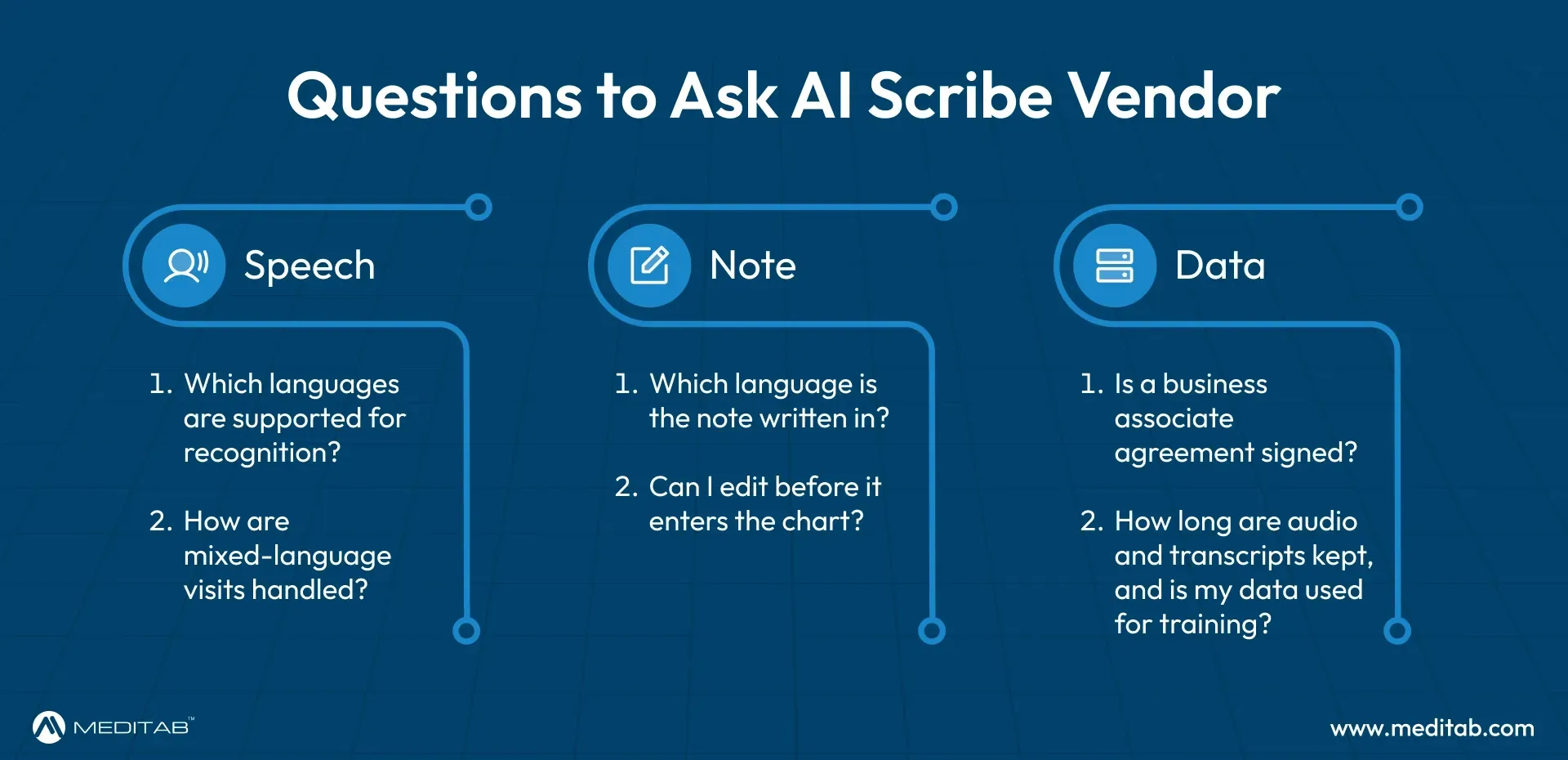
This filters out small talk and sorts details into the sections you use. Tools differentiate which language the note is written in, so ask before you commit.
Review of the draft:
The final step is for you to review it against what you heard, edit it, and sign off. Mixed-language visits are the hard part. Patients and clinicians often switch languages mid-sentence, and an interpreter adds a second voice that repeats, shortens, or reshapes what was said. Support for multilingual clinical documentation varies by product, so treat any language list as a starting point for testing, not proof.
What the Evidence Says About Benefits
The best data so far covers ambient scribes in general, not multilingual use specifically. In a study of 263 clinicians using an ambient AI scribe for 30 days, burnout decreased from 51.9% to 38.8%. Participants also reported less after-hours documentation. The study had no control group and relied on self-reported surveys, so it shows promise rather than proof.
For a solo NP, the gains worth testing are fewer evenings spent finishing notes, more eye contact with patients during visits, and a draft that captures details while they’re fresh. Whether you get all of the details or not depends on how much editing each draft needs. With multilingual clinical documentation, that edit load is the number to watch.
What to Check Beforehand
Accuracy across languages:
A 2026 simulation study ran two ambient scribes through scripted English and Spanish visits that contained 20 deliberate interpreter errors. Both scribes carried interpreter errors into the notes, including an unsupported symptom denial the patient was never asked about.
It was small and simulated, but the lesson holds: a scribe records what it hears, mistakes included. Therefore, clinicians must review interpreter-mediated visits with extra care, and test any tool on your own patient mix.
Consent and notice:
Because an AI scribe records audio, state recording and notice laws can apply in addition to HIPAA, and those laws can vary by state. Tell patients before you record, let them decline, and document the conversation. Ask your attorney or malpractice carrier what your state requires.
Language access:
Under HHS’s 2024 Section 1557 rule, covered entities must take reasonable steps to give people with limited English proficiency meaningful access. Language help must come from qualified interpreters, translators, or bilingual staff.
Clinicians’ offices that receive federal financial assistance may be covered. For machine translation, a qualified human translator must
review it when accuracy is critical. An AI scribe is not an interpreter. Confirm with counsel how the rule applies to your practice.
Privacy and ownership
Confirm with the vendor that a business associate agreement is in place, ask how long audio and transcripts are kept, and check whether patient data trains models. You sign the note, so review medications, doses, allergies, and negations like “denies chest pain” every time.
How to Choose an AI Scribe for a Solo Practice
Looking for an AI scribe for solo practice use? Start with your own visits, not a feature list. Run a trial on a real clinic day with patients who’ve agreed. Include a visit that switches languages and one that uses an interpreter, and count how many edits each note needs. Ask vendors which languages are supported for speech recognition and for the note itself, and how mixed-language visits are handled. Then check the practical pieces: where the note lands in the chart, security documentation, data retention, and the price for a single provider.
Meditab IMS has its own Ambient AI Scribe. Additionally,
FHIR APIs are built to bring in the AI solutions you choose, so providers and practices can also select from leading market options such as Nabla, Suki, and Medora. Language coverage differs from product to product, so ask for the supported-language list of whichever scribe you evaluate. Our
AI-powered EHR page shows how these pieces fit together, and the
AI for clinical documentation blog covers efficiency and compliance.
Where Multilingual Clinical Documentation Is Heading
Expect better testing and tougher questions. Early studies are now probing how ambient tools handle mixed-language and interpreter-mediated visits, and they show work remains. For vendors, that likely means clearer disclosure of which languages are supported and how well. For practices, the near-term win is less about full automation and more about a dependable first draft you can verify quickly.
Conclusion
An AI scribe won’t erase a solo practice’s documentation load, and in multilingual visits it won’t replace your ear for what the patient said.
What it can do is hand you a draft while the visit is still fresh, so you spend your time only checking and signing. Test it on your own patients, in your own languages, and keep clinician review non-negotiable. For more insights, we’re just a phone call away.
Ambient AI scribe in Meditab IMS
Frequently Asked Questions
Can an AI scribe for nurse practitioners work in a solo practice?
Individual clinicians can use it. What determines the fit is your EHR, the languages your patients speak, and the price for one provider, so try it on a normal clinic day before you commit.
Does a multilingual AI scribe replace an interpreter?
No. Patients with limited English proficiency may be entitled to a qualified interpreter, and a scribe only records what it hears. Keep your interpreter process in place and review those notes carefully.
Do I need patient consent to use an AI scribe?
Often, yes. Recording and notice rules differ by state, so tell patients, document their choice, and check requirements with your attorney or malpractice carrier.
Does Meditab IMS offer an AI scribe?
Yes. Meditab offers an Ambient AI Scribe for both in-person and telehealth visit types. Furthermore, with Meditab's AI Scribe, practices are able to choose from multiple market options such as Nabla, Suki, and Medora.
Share this post: