Should Your Practice Pass Healthcare Credit Card Processing Fees to Patients?
A patient hands over a credit card at checkout, settles a $200 balance, and heads out the door. Nobody gives it a second thought. Behind that smooth process, though, your practice just paid roughly $6 to make it happen. Multiply that by every card payment taken at the front desk or through the portal in a month, and healthcare credit card processing fees become a line item worth a closer look.
Deciding what to do about them is delicate, because patients are already watching what they spend on care.
KFF's Health Care Debt Survey found that 41% of U.S. adults currently carry some form of health care debt. Any change to how you collect payments lands on people who feel that pressure. This guide covers where healthcare payment processing costs come from, how patients tend to react, what the rules say, and how to explain any change so trust stays intact.
What are Healthcare Payment Processing Fees?
Every time a patient pays by card, the companies that move the money take a small cut. Those cuts add up to the credit card processing fees for healthcare practices pay, and they usually run from about 1.5% to 3.5% of the payment plus a flat fee of 25 to 30 cents. Card-on-file and online payments often cost more than a swipe at the front desk.
Here's what that looks like in real numbers. A $200 balance paid at 2.9% plus 30 cents costs the practice about $6.10. A practice that collects $50,000 a month by card pays around $1,450 a month in percentage fees alone.
Those costs come with the territory when you offer modern payment options. Patients expect to pay online and set up autopay. A
healthcare payment processing solution built into your EHR makes both simple. It also gathers your medical billing payment processing fees in one place, so you can see what you actually pay.
Why Some Practices Choose to Pass Credit Card Fees to Patients
Cards have become the default payment method for Americans. The Federal Reserve Payments Study found that cards made up 79% of noncash payments by number in 2024. As more patients pay by card, fees grow.
That's why some practices consider a pass-through fee. A surcharge adds a percentage, such as 2.5%, to card payments. A convenience fee is a flat charge tied to a specific payment channel. Either one shifts medical practice credit card fees from the practice to the patient.
The motivation is usually sustainability. Margins are tight, and practices that want to keep visit rates steady look for savings everywhere. Strong
revenue cycle management strategies can recover revenue across the billing cycle, so it's worth exploring them before adding anything to a patient's bill.
The Patient Perspective
Patients rarely push back on a fee because of the dollar amount. They push back because it feels like a surprise. How you explain patient payment-processing fees will determine whether a patient sees a fair policy or a nickel-and-dime move.
Research points the same way. A study in
Plastic and Reconstructive Surgery Global Open found that sharing prices up front tends to leave patients happier, and most patients said their final cost matched or beat the estimate they received beforehand.
Context matters, too. Many patients juggle high deductibles, and for some, a card is the only way to spread a bill over time. A new line item on that payment can feel like a penalty for paying the only way that works for them. That's why tone and timing count as much as the policy itself.
Clear communication tools help here, and
patient engagement software lets you share payment policies and send balance reminders before the visit. This helps patients know what to expect long before they reach the front desk.
Legal and Compliance Considerations
Before adding anything to a patient's bill, check three layers of rules. Start with the card networks, then look at state law, then read your payer contracts.
Card networks come first. Visa's merchant surcharge guidance says surcharges apply only to credit cards, never debit or prepaid cards, and they can't exceed 3%. Merchants also give advance notice, usually 30 days, and clearly disclose the fee at checkout and on receipts.
Then look at state law. Connecticut and Massachusetts ban credit card surcharges outright, while others set caps or disclosure rules. These laws change, so your state attorney general's office is the best place to confirm what applies.
Finally, read your payer contracts. Some agreements limit what a practice can collect from patients, and a fee on a copay or deductible payment could conflict with them. If you use integrated card processing, confirm you meet PCI standards, since they apply to anyone who handles cardholder data.
One more detail: calling a charge a convenience fee doesn't automatically change how the card networks treat it. This article is general information, not legal advice, so ask your legal counsel to confirm what applies to your practice.
Communicating with Patients About Fees
If your practice does adopt a fee, the rollout is where trust is won or lost. Put the policy in your intake paperwork and on every payment screen, and give patients notice before it starts. Even when medical practice credit card fees are modest, patients who hear about them at the register feel ambushed. Automated balance messages that show the exact amount due before payment also leave less room for surprises.
Neutral, plain wording works best. For example: "To help cover rising administrative costs, card payments include a [X]% processing fee. There is no fee for payments made by ACH or bank transfer."
Your front desk needs a short script as well. Smooth checkout helps
streamline medical billing, so give your team two kind sentences that explain the policy and point patients to no-fee options.
Alternatives to Passing Credit Card Fees to Patients
A surcharge isn't the only lever. Good healthcare payment processing starts with giving patients choices, and several of them protect your margins without adding a line item.
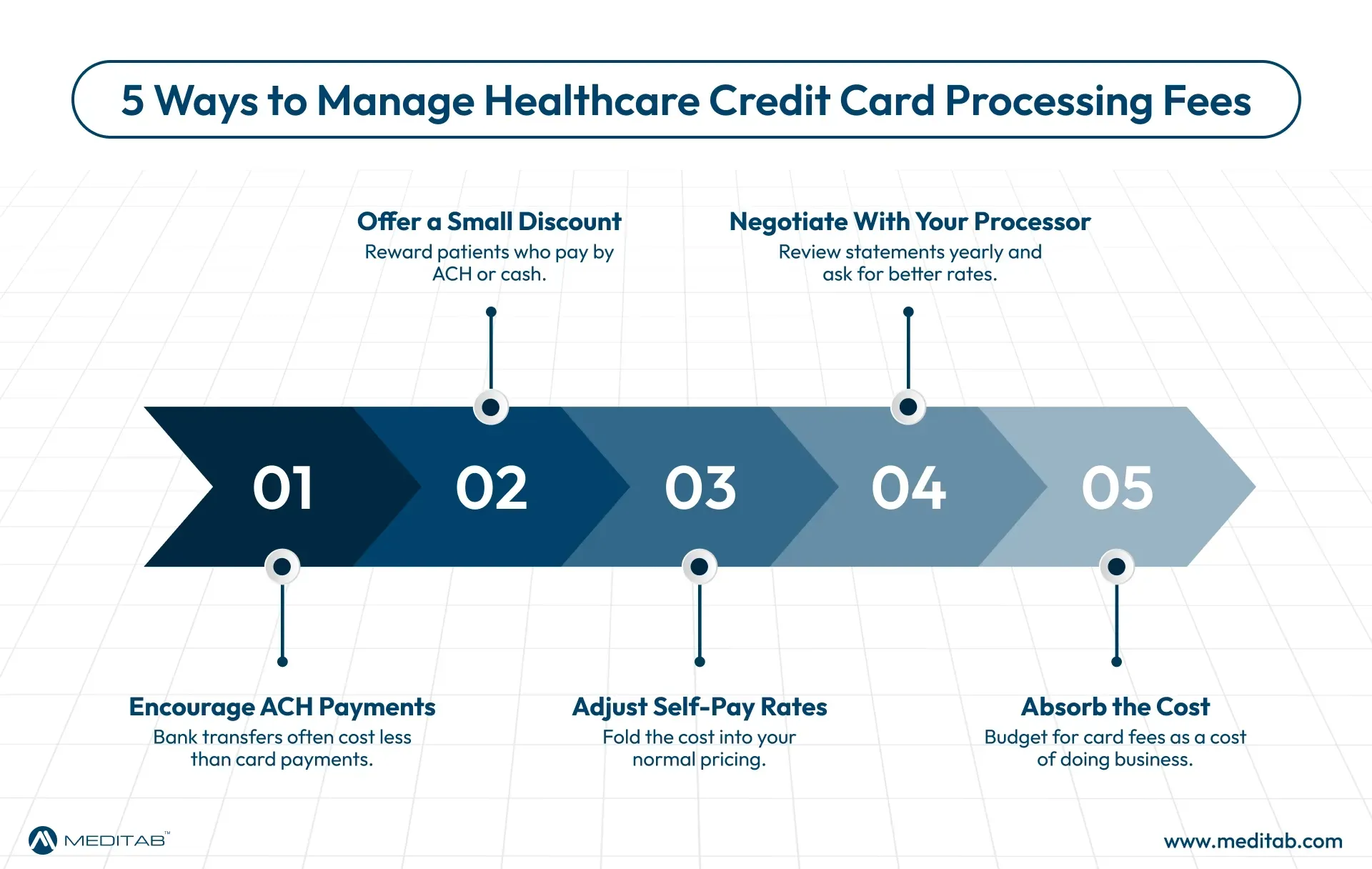
Encourage ACH payments. Nacha's guide to how ACH works explains that ACH moves money directly between bank accounts, which many practices find less costly than accepting cards.
Offer a small discount. Rewarding patients who pay by ACH or cash lands better than penalizing those who use a card. In states that restrict surcharges, discounts are often treated differently, so confirm the details with counsel.
Adjust your self-pay rates. A modest change that folds the cost into your normal pricing is often easier for patients to accept than a separate fee.
Negotiate with your processor. Review your statements every year and ask about better rates, especially as your volume grows.
Absorb the cost. Some practices treat card fees as a cost of doing business and budget for them. That can be the simplest and friendliest choice.
What Practices Can Consider
There's no one-size-fits-all answer. A few questions can guide the decision. What share of your patients pay by card? Would a fee change your collection rate or patient satisfaction? Do patients have an easy no-fee option? Does your EHR support more than one payment method?
Run the numbers for a full quarter before you decide. Real totals make the trade-offs much clearer.
If the answers point to offering more choices,
IMS payment processing is worth considering. Meditab IMS is built with Global Payments Integrated and lets patients pay by card or ACH through the Patient Care Portal on the web or mobile app, so your team can offer options without leaving the EHR.
How Meditab IMS Text to Pay Simplifies Patient Collections
Processing fees are only part of the payment picture. Staff time spent on unpaid balances is the other. Many front desks still email patients one by one to request payment. This process is slow, hard to keep up with, and raises collection costs. Meditab IMS users raised this challenge. Our team developed a solution and introduced Text to Pay in a recent IMS release. Now, when IMS generates a patient statement, it automatically sends the patient a text or email. Each message includes a Pay Link and an Amount Due tag. The patient experience is simple:
- The Amount Due tag shows the patient’s outstanding balance.
- The Pay Link opens the Patient Care Portal in a web browser or the mobile app.
- After logging in, patients land on the Pay Bill screen with “Pay Full Amount” preselected.
For practices, the main benefit is time. Payment requests go out automatically, so staff can focus on patients. Patients also see their balance and payment options in advance. This makes conversations about medical billing payment processing fees clearer and more transparent.
Text to Pay reflects how Meditab builds IMS. A new IMS build is released every quarter. Many enhancements come directly from client feedback, and that input shapes the product roadmap. Regular updates also keep IMS current with payer rules, regulations, and patient expectations. Your practice always works with up-to-date technology.
In a Nutshell
Managing healthcare credit card processing fees is really about trust. Patients accept policies they understand, and they remember how a practice made them feel at checkout. The practices that handle this well choose an approach that fits their finances, follow the rules that apply, and explain the change in plain language.
Whether you absorb the cost or add a compliant fee, the goal stays the same: steady margins and patients who feel respected. Thoughtful healthcare payment processing makes that balance easier to hold. Backed by 27+ years in healthcare technology, Meditab IMS helps ambulatory practices offer simple payment options, from card and ACH payments to automated Text to Pay requests, that patients appreciate.
Frequently Asked Questions
What are healthcare credit card processing fees?
They are the charges a practice pays each time a patient pays by card. They typically combine a percentage of the payment with a small flat fee.
Can a practice pass medical practice credit card fees to patients?
Sometimes. Card network rules and state laws both apply, and some states ban surcharges outright, so check before adding any fee. Surcharges can only apply to credit cards.
How much can a practice charge as a credit card surcharge?
Under Visa's rules, a credit card surcharge can't exceed 3% or the practice's actual cost of accepting the card, whichever is lower. You can't surcharge debit and prepaid cards at all.
Are there ways to lower patient payment processing fees without charging patients?
Yes. Practices can encourage ACH payments, offer a small discount for lower-cost methods, negotiate with their processor, or simply absorb the cost as part of their budget.
How should a practice tell patients about a new fee?
Give advance notice, place the policy in intake forms and on payment screens, use neutral wording, and always offer a no-fee option. A short script helps front-desk staff explain it kindly.
Share this post: