AI for Clinical Documentation for Efficiency & Compliance
Clinical documentation is the written record of every patient encounter. It captures the history, exam findings, assessments, orders, and plans that guide care, support billing, and protect the practice during audits. A time-and-motion study in the Annals of Internal Medicine found that physicians spent nearly two hours on EHR and desk work for every hour of direct clinical face time with patients.
That imbalance is why healthcare leaders are looking closely at AI for clinical documentation. Used well, it can
reduce documentation burden, improve note quality, and strengthen clinical documentation compliance at the same time. This blueprint explains what AI clinical documentation is, where it delivers value, how to evaluate vendors, and how to measure results, so practice owners, administrators, and clinical leaders can decide with confidence.
What is AI for Clinical Documentation?
AI for clinical documentation refers to software that uses speech recognition, natural language processing (NLP), and large language models to capture, organize, and draft clinical notes. Instead of typing or clicking through templates during or after a visit, the provider talks with the patient while the system listens, transcribes the conversation, and turns it into a structured draft. The provider then reviews, edits, and signs the note.
The most familiar form is the AI medical scribe, sometimes called an ambient scribe. It works in the background of the visit and produces a draft note in a format such as SOAP. Other AI documentation tools for healthcare focus on narrower tasks, such as suggesting diagnosis codes, flagging missing elements, summarizing prior records, or converting dictation into text.
Why Clinical Documentation Matters in the First Place
AI does not change why documentation matters. Accurate records support patients and practices at every stage of care:
- Before care, documentation gives providers a clear view of history, medications, allergies, and prior results, so visits start with context.
- During care, it keeps the care team working from the same information and supports safe, coordinated decisions.
- After care, it supports referrals, follow-ups, quality reporting, and accurate reimbursement, and it serves as the legal record of what happened.
AI medical documentation is valuable only when it protects these outcomes. Speed without accuracy simply moves the problem downstream.
The Role of Clinical Documentation Integrity
Clinical documentation integrity (CDI) is the practice of making sure records are complete, accurate, and specific enough to reflect the patient's true condition. In many organizations, CDI specialists and coders review notes, query providers when details are unclear, and confirm that diagnoses are supported. As code sets grow more detailed, including the move toward ICD-11 in many countries, that review work only increases.
Smaller practices often face two barriers here. Many lack in-house CDI specialists, and documentation habits vary from one provider to the next. AI-powered clinical documentation can help close both gaps by applying consistent structure and checks to every note.
How AI Improves Clinical Documentation Efficiency
The strongest evidence for AI clinical documentation comes from time savings at scale. In a large rollout reported in NEJM Catalyst, The Permanente Medical Group found that ambient AI scribes saved an estimated 1,794 working days over one year across about 2.5 million encounters. Most physicians in the program reported that the scribes improved their patient interactions and work satisfaction.
Those gains come from a few practical changes. Providers spend less time typing during visits, so they can face the patient. They draft notes within moments of the encounter, shortening the gap between the visit and a signed chart. Less after-hours charting also matters for retention, and it is one of the most direct ways to help providers avoid physician burnout.
Efficiency extends beyond the provider. Staff spend less time chasing unsigned notes. Coders receive more complete documentation. Billing teams see fewer claims held for missing details. For leaders, AI medical documentation is as much an operational lever as a clinical one.
AI and Clinical Documentation Compliance
Faster notes matter only if they withstand scrutiny. Clinical documentation compliance means every record meets payer, regulatory, and legal standards. Weak documentation remains a common cause of payment errors, and CMS tracks insufficient documentation as a key driver of improper Medicare payments in its improper payments reporting.
AI for clinical documentation can support compliance in several ways. It can prompt providers for elements payers expect, such as duration, severity, laterality, or details of medical decision-making. It can apply consistent templates across providers. It can also suggest codes that match the documented assessment, which the provider or coder then confirms. The
AI medical scribe in IMS is designed around this review step, so the clinician always approves what goes into the chart.
Privacy and Security Obligations
Any AI system that listens to visits or processes notes handles protected health information. That means it must meet the safeguards required by the
HIPAA Security Rule, including access controls, encryption, audit logs, and risk analysis. Leaders should know where audio is stored, how long it is kept, and who can access it. Also ask how the vendor explains the logic behind its suggestions, since transparency is quickly becoming a regulatory expectation for AI in health IT.
AI Readiness Checklist
Before choosing a tool, confirm that the organization is ready to use it well. Use this checklist as a starting point:
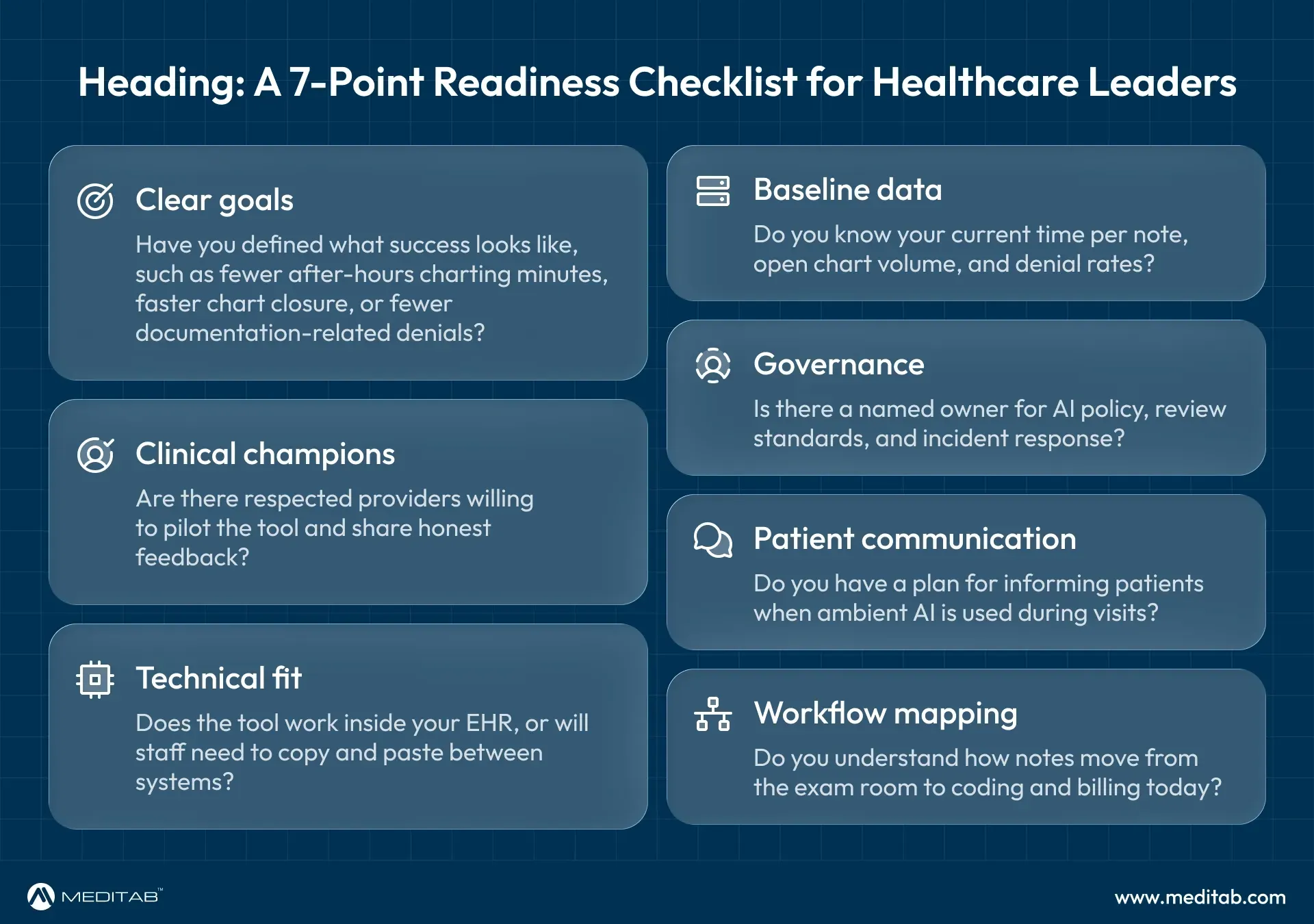
If several of these items are unclear, address them first. A good tool rolled out into an unprepared environment rarely delivers its full value.
Key Features of AI-Powered Clinical Documentation
AI documentation tools for healthcare list many features below that save time. Many build on long-standing EHR strengths that have long improved documentation quality.
Ambient Capture and Structured Drafts
The tool should capture natural conversation without forcing providers to speak in commands, then organize it into structured sections that match the specialty.
AI transcription in IMSGo turns conversation into a usable draft rather than a raw transcript.
Structured Templates and Standardized Terminology
Structured templates guide providers through required elements, while standardized terminology keeps diagnoses, problems, and procedures consistent. Together, they make AI-powered clinical documentation easier to code, search, and report on.
Built-In Validation Checks
Look for real-time checks that flag missing elements, conflicting information, or diagnoses that are not supported by the note. These checks act as a constant layer of CDI review.
Coding Support
Tie suggested ICD-10 and CPT codes to specific note language so providers and coders can see why a code was suggested before accepting it.
Native EHR Integration and Interoperability
The best results come when AI medical documentation lives inside the EHR, with drafts landing directly in the chart. Interoperability also matters, so that information can be shared with labs, referrals, and other systems without retyping.
Provider Review and Edit Controls
Every draft should be easy to edit, and nothing should be finalized without the provider's approval. This keeps clinical accountability where it belongs.
Training and Ongoing Support
Even an intuitive tool needs onboarding, specialty-specific tuning, and responsive support. Ask how the vendor trains new providers and handles feedback after go-live.
Risks and Challenges of AI Clinical Documentation
AI clinical documentation is powerful, but it is not risk-free. Leaders should plan for these challenges from the start:
- Accuracy errors: AI can mishear terms, misattribute statements, or include details that were not discussed. Provider review is essential.
- Over-reliance: Busy providers may sign drafts without reading them closely. Policies and spot audits help prevent this.
- Privacy concerns: Patients may be uncomfortable with recording. Clear consent and communication build trust.
- Specialty fit: General models may struggle with specialty vocabulary unless they are tuned for it.
- Workflow disruption: A tool that sits outside the EHR can add steps instead of removing them.
- Change resistance: Some providers prefer their current habits and need time and evidence before they adopt something new.
None of these risks is a reason to avoid AI for clinical documentation. They are reasons to choose carefully and implement with structure. Frameworks such as the
NIST AI Risk Management Framework offer a practical way to organize governance, testing, and monitoring around these risks.
How to Implement AI for Clinical Documentation
Many lessons from
EHR implementation challenges also apply to AI rollouts. A phased approach works best for most practices:
- Start with a pilot - Choose a small group of providers across a few visit types and run the tool for several weeks.
- Measure against your baseline - Compare time per note, chart closure speed, and note quality before and after.
- Set review standards - Define what providers must check before signing, and audit a sample of AI-assisted notes each month.
- Train with real cases - Use the practice's own visit types and templates during training.
- Collect feedback - Hold short check-ins with pilot providers and share improvements with the vendor.
- Expand in waves - Add providers and specialties in stages, adjusting templates and workflows as you go.
- Keep governance active - Regularly review accuracy, privacy, and usage reports.
Measuring the ROI of AI Medical Documentation
Measure ROI in time, quality, and revenue. Administrative work is costly. A
JAMA study found that billing and insurance-related activities account for a meaningful share of professional revenue, and documentation quality feeds directly into that work. Useful metrics to track include:
- Documentation time per encounter and after-hours EHR time
- Average time from visit to signed note
- Number of open or delinquent charts
- Documentation-related denials and coder queries
- Provider satisfaction and retention
- Patient visit capacity, where providers choose to add appointments
Track these at baseline and at regular intervals after rollout. Some benefits, such as reduced burnout, take longer to show up in the numbers, so review results over several months instead of weeks.
Questions to Ask AI Documentation Vendors
Choosing the right partner matters as much as choosing the right feature set. Our guide to
questions to ask an EHR software company is a strong foundation, and these AI-specific questions add to it:
- How accurate is the tool for our specialty, and how do you measure that accuracy?
- Does the AI work natively inside our EHR, or as a separate application?
- Can providers review and edit every section before the note is finalized?
- How are code suggestions generated, and can we see the supporting text?
- Where is audio stored, for how long, and is it used to train models?
- Will you sign a business associate agreement that covers all AI processing?
- What training, support, and ongoing tuning are included?
- What reporting will we receive on usage, accuracy, and time savings?
- Is there a trial period so we can test the tool with our own providers?
The Future of AI for Clinical Documentation
AI medical documentation is moving quickly from transcription toward assistance across the full encounter. Upcoming tools are expected to prepare pre-visit summaries, draft orders and referrals for provider approval, generate patient-friendly visit summaries, and surface care gaps in real time. Documentation, coding, and quality reporting are likely to become more closely connected.
You can explore more about the future of AI in healthcare and how it is already shaping everyday practice.
For leaders, the direction is clear. AI will increasingly be built into the core EHR, and governance will become a standard part of clinical operations. Regulators are moving in the same direction. The ONC
HTI-1 final rule introduced transparency requirements for AI and other predictive algorithms in certified health IT, so buyers can expect clearer information on how these tools are built, tested, and monitored.
How IMS Supports AI-Powered Clinical Documentation
The blueprint above works best when the AI lives inside the system your providers already use. IMS is an ONC-certified, all-in-one EHR and practice management system serving more than 40 specialties. It puts AI-powered clinical documentation to work without adding another screen.
- AI medical scribe built into the patient chart: IMS's AI medical scribe listens to the visit and drafts a structured note. The provider reviews, edits, and signs it before finalizing anything.
- Coding suggestions tied to the note: IMS suggests ICD-10 codes based on the documented assessment, so providers and coders can confirm them quickly.
- Specialty-specific templates: Structured templates and standardized terminology keep notes consistent across providers and specialties.
- Built-in validation checks: IMS flags missing or conflicting details before a note is signed, which supports clinical documentation compliance.
- AI transcription on the go: For providers who work across locations, AI transcription in IMSGo turns conversations into usable drafts.
- One connected system: Documentation, coding, and billing live in one place, so a complete note moves straight into the revenue cycle.
For practice leaders, this means fewer after-hours charting minutes, more consistent records and a clear audit trail, without stitching together separate tools.
In a Nutshell
AI for clinical documentation gives healthcare leaders a chance to improve efficiency and compliance at the same time. It can give providers back hours each week and strengthen the records that support billing and audits. The key is a deliberate approach: clear goals, careful vendor selection, provider review, and ongoing measurement. To see how IMS brings these pieces together for your practice, explore our AI-powered EHR software and
schedule a personalized demo.
Frequently Asked Questions
What is AI for clinical documentation?
AI for clinical documentation uses speech recognition, natural language processing, and large language models to capture patient encounters and draft structured clinical notes for provider review and approval.
How does an AI medical scribe work?
An AI medical scribe listens to the conversation between provider and patient, transcribes it, and organizes it into a draft note, often in SOAP format. The provider then reviews, edits, and signs the note.
Is AI clinical documentation HIPAA compliant?
It can be, but compliance depends on the vendor. Look for a signed business associate agreement, encryption, access controls, audit logs, and clear policies on how audio and data are stored and used.
Can AI improve clinical documentation compliance?
Yes. AI-powered clinical documentation can prompt for missing elements, apply consistent templates, and suggest codes tied to the note. Provider review remains essential to make sure every record is accurate.
What are the best AI documentation tools for healthcare?
The best tools work natively inside your EHR, support your specialty, keep the provider in control of every note, and offer strong security, training, and reporting.
Share this post: