How to Overcome EHR Implementation Barriers
Implementing an electronic health record (EHR) system is one of the most important decisions an ambulatory practice can make. While EHRs promise better documentation, improved patient care, and improved workflows, the journey to successful adoption is not always simple.
Many practices face multiple EHR implementation challenges that can delay progress, increase costs, and frustrate staff. In a
report, it was noted by Rotenstein and colleagues, “The interspecialty differences we have identified are important given the known associations between administrative burden and clinician burnout. Further investigation should seek to characterize the reasons underlying the differences and identify interventions that reduce the EHR burden.”
For many medical groups, navigating the deep technical, operational, and cultural shifts associated with a system rollout introduces critical bottlenecks. Clinicians frequently experience documentation fatigue when forced into rigid, non-intuitive platforms. This comprehensive guide breaks down the primary EHR implementation challenges, uncovers the underlying structural hurdles, and highlights how deploying Meditab’s automated
all-in-one EHR system, IMS, ensures a successful transition while minimizing practice downtime and revenue loss.
Why Effective EHR Implementation is Crucial in Healthcare
A successful EHR rollout is more than just installing software. It directly impacts clinical efficiency, patient safety, revenue cycle performance, and provider satisfaction. Poor implementation can result in:
- Increased documentation time and provider burnout
- Disrupted patient flow and scheduling issues
- Revenue loss from billing and coding errors
- Compliance and security vulnerabilities
For growing ambulatory practices, a well-executed EHR implementation becomes a foundation for long-term success and scalability.
Understanding the Barriers to Implementing an EHR System
Before diving into technical issues, it’s important to understand the broader barriers to implementing an EHR system. These challenges often stem from people, processes, and organizational readiness, not just technology.
Staff Resistance and Change Fatigue
Nurses, Medical assistants, front-desk coordinators, and practicing providers are highly protective of their daily operational routines. If leadership introduces a new system without clearly communicating the underlying rationale, the staff frequently pushes back. This cultural resistance can lead to inconsistent platform use, manual workarounds, and reduced operational morale.
Inadequate Training Budgets
Many independent clinics allocate their entire budget toward initial licensing and hardware procurement, leaving very little margin for structured education. A quick corporate software demonstration is not enough to train a multi-provider care team. Without personalized, multimodal training programs, users will only harness a tiny fraction of the platform’s full functionality.
Underestimating Workflow Disruption
A common mistake during software rollouts is expecting providers to maintain their standard patient volumes during the initial go-live weeks. A temporary productivity dip of 10% to 20% is normal as clinicians learn a new user interface. Failing to budget for this adjustment period creates severe scheduling friction and administrative strain. Learning how to choose the best EHR software involves looking beyond simple feature lists and thoroughly auditing a vendor’s onboarding framework.
Ways to Overcome EHR Implementation Barriers
- Involve staff early in the decision-making process
- Provide role-based training and continuous support
- Set realistic expectations for the transition period
- Work with experienced partners offering client implementation services
- Clearly communicate long-term benefits
Addressing these barriers early helps reduce friction and prepares your team for a smoother rollout.
Technical Challenges in EHR Implementation
Some of the most difficult challenges in implementing EHR systems are technical. These issues can affect data quality, interoperability, and day-to-day usability if they are not handled properly.
1. Data Migration and Legacy Debt
One of the most critical and potentially risky phases of EHR implementation is data migration. When not appropriately mapped, data migration in healthcare increases the risk of data integrity issues. Incomplete or incorrect patient histories can compromise the quality of patient care and increase liability risk. The best practices for data migration include:
- Agree on Data Scope:
Decide on the type and scope of data to be transferred. Converting everything is rarely the best strategy; consider migrating one to three years of recent data and archiving the rest. - Request a Test Environment:
Before a full migration, use a test environment to review and verify data accuracy. Check patient demographics, clinical data, and dates of service. - Assign Department Points of Contact:
Involve clinicians, billers, and front-desk staff to verify data accuracy from their respective areas.
2. Integration Complications
An independent practice cannot operate efficiently as an isolated digital island. To deliver high-quality patient care, your primary platform must achieve flawless bidirectional data exchange with external reference laboratories, diagnostic imaging systems, state immunization registries, and clearinghouses. Achieving this level of fluid connectivity remains one of the biggest EHR challenges in modern healthcare information networks. Organizations frequently encounter rigid vendor restrictions and fragile middleware connections that drive up administrative overhead.
3. Lack of Proper Planning and Communication
A lack of strategic planning is a primary reason why EHR implementations fail. This is more than just a technology upgrade; it's a shift in workplace culture that requires commitment from the entire organization. A comprehensive EHR implementation guide can help structure this process. The ONC-recommended steps for planning include:
- Map Out Your Current State
- Plan Your Future State
- Plan for Contingencies
- Build an EHR Implementation Plan
- Plan for Chart Migration
- Understand Data Elements
- Start Thinking About Privacy and Security
Effective communication between your practice and your EHR vendor is also essential. As training progresses, your staff will have questions and workflow concerns. Choose an EHR software company, such as
Meditab, that provides prompt, ongoing support.
4. Interoperability Gaps
A modern EHR should be able to exchange data efficiently with outside systems. Without strong interoperability, practices may struggle to access complete patient histories or share information across care settings. Resources like our article on
HL7 FHIR API and interoperability can help practices understand why data exchange matters so much.
5. Workflow Disruptions
Every practice has unique workflows. A poorly configured system can create inefficiencies instead of solving them. The challenges of EHR implementation include:
- Increased documentation time
- Confusion around new processes
- Misalignment with specialty workflows
You can learn more about this in discussions on
common EHR integration challenges. To resolve workflow disruptions, the following steps will be helpful:
6. Customize Templates and Workflows
- Conduct workflow mapping before implementation
- Test real-life scenarios before going live
7. Payer Policy and Revenue Cycle Disconnection
If clinical workflows do not connect natively to back-office billing systems, substantial financial loss occurs. Many generic platforms fail to apply real-time claim scrubbing or precise modifier logic at the point of care. This structural disconnect results in missing charges, delayed payment posting, and climbing denial rates, making revenue cycle fragmentation one of the most immediate challenges of EHR implementation today.
8. Choosing the Wrong EHR Vendor
A new EHR software can sometimes feel like shopping for clothes online. It looks great and has positive reviews, but when you finally try it on, it doesn't fit. A system that isn't tailored to your practice's specific needs will only create new problems. Selecting one of the best EHR software companies that understands the unique needs of ambulatory practices is crucial. A vendor offering an all-in-one EHR system, such as
Meditab, can help avoid the pitfalls of integrating multiple disconnected solutions.
9. Compliance and Security Concerns
Maintaining compliance is a critical part of any EHR system. Security gaps can lead to serious risks. The key concerns can arise in data privacy issues, unauthorized access, or non-compliance with regulatory requirements. Using an EHR compliance checklist ensures your system meets all necessary standards. The primary solutions include
- Implementing role-based access controls
- Regularly auditing system usage
- Ensuring encryption and secure data storage
Effective Strategies to Implement EHR Software
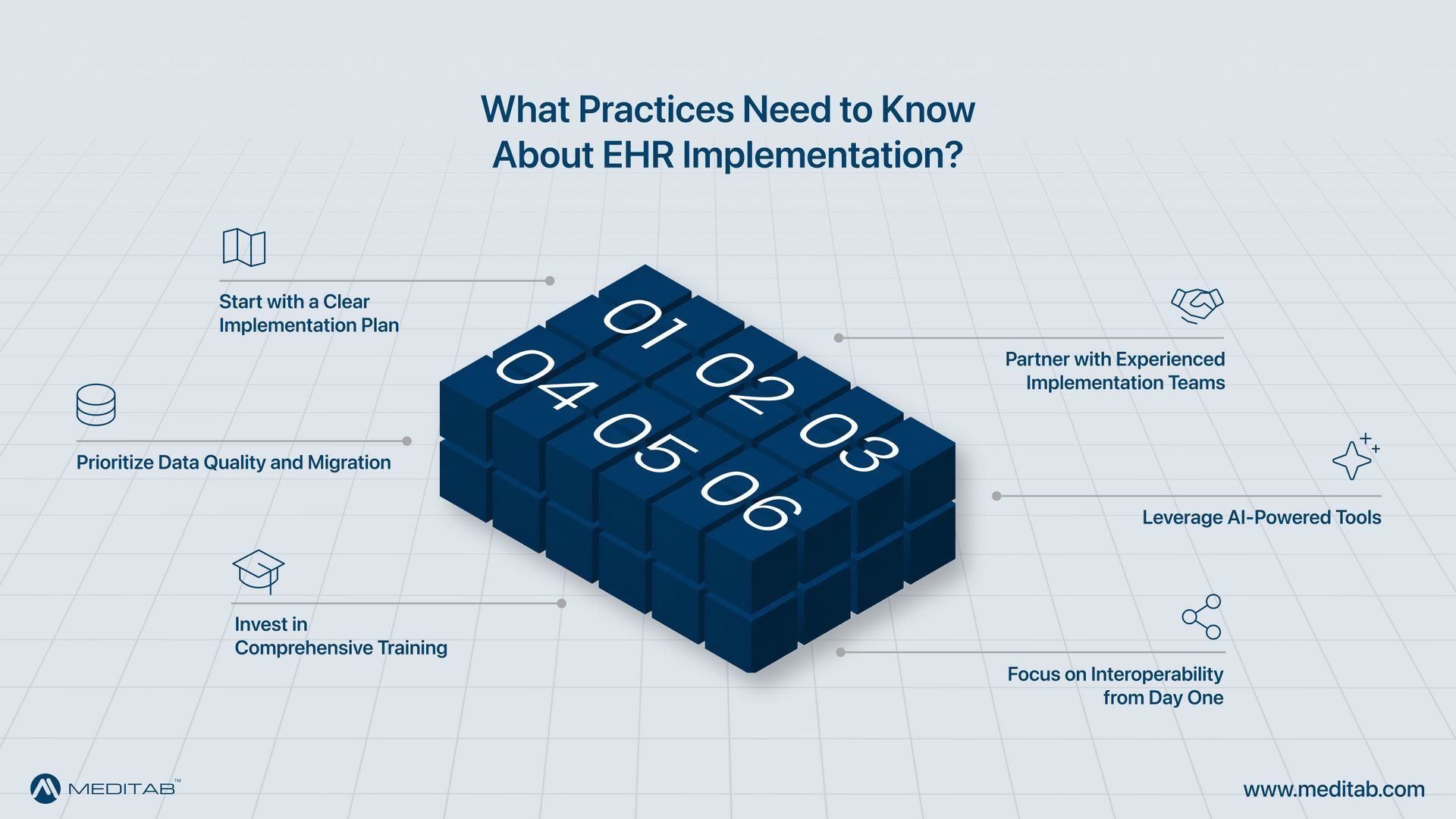
Here’s how ambulatory practices successfully overcome EHR implementation challenges:
- Start with a Clear Implementation Plan:
Follow a proven EHR implementation guide that includes timeline setting, stakeholder alignment, and phased rollouts. - Prioritize Data Quality and Migration:
Clean legacy data before migration. A structured approach prevents costly rework later. - Invest in Comprehensive Training:
Provide role-specific training sessions and ongoing support to boost user adoption. - Focus on Interoperability from Day One:
Choose a system with strong HL7 FHIR API interoperability capabilities to ensure fast data exchange. - Leverage AI-Powered Tools:
Modern AI-powered EHR features can reduce documentation burden and improve accuracy. - Partner with Experienced Implementation Teams:
Meditab’s client implementation services provide expert guidance throughout the entire journey.
Technical Features Built to Overcome Implementation Gaps
Modern health IT suites, such as
Meditab's Intelligent Medical Software (IMS), incorporate next-generation technical features that natively eliminate traditional deployment bottlenecks.
Native HL7 and FHIR Architecture
Rather than relying on fragile, third-party middleware integrations that break during software updates, modern systems leverage high-speed web standards to manage concurrent data requests smoothly. This advanced connectivity turns a common EHR integration challenge into an effortless operational gain.
AI-Powered Documentation Modules
Advanced systems resolve clinician charting burnout through next-generation AI-powered EHR features. Built-in ambient clinical scribes listen to natural provider-patient conversations and automatically draft structured encounter notes instantly into the patient chart, eliminating "click fatigue."
Unified Clinical and Billing Workflows
By choosing an all-in-one EHR system, ambulatory groups eliminate data silos. Every procedure code, ICD-10 indicator, and clinical modifier logged during a visit instantly populates the revenue cycle interface and automatically validates medical necessity before claim submission.
In A Nutshell
EHR implementation doesn’t have to be overwhelming. By understanding common EHR implementation challenges, planning strategically, and choosing the right all-in-one EHR system, ambulatory practices can avoid costly pitfalls and unlock the full potential of digital transformation. At Meditab, we’ve helped countless independent clinics successfully implement our IMS platform with minimal disruption and maximum results. Let’s talk about how we can support your practice.
FAQs
What are the biggest EHR challenges?
The most common challenges include unexpected costs, staff resistance to change, productivity loss during training, poorly executed data migrations that lead to data integrity issues, lack of proper planning and communication, and choosing the wrong EHR vendor for your specific practice needs.
How can an EHR reduce medical errors?
Through real-time alerts, standardized documentation, and automated checks that minimize human mistakes.
What are the main barriers to implementing an EHR system?
The main barriers to implementing an EHR system are cost, training, technical setup, data migration, and staff readiness.
How can I reduce staff resistance when implementing a new EHR?
To reduce staff resistance, involve practice leaders early in the selection process so they can champion the new system. Communicate your vision clearly, address staff concerns directly, and highlight how the EHR will expedite their day-to-day tasks in the long run.
How long does a standard ambulatory EHR implementation take?
For most ambulatory practices, a well-planned implementation takes 3 to 6 months, depending on practice size and complexity. Some of Meditab’s clients typically reach full go-live early, including billing, within 12 weeks. When billing is phased in later, some go live in as little as 4 weeks. Longer timelines, often 12 weeks or more, are usually driven by clearinghouse and enrollment dependencies, as well as client readiness and availability.
Share this post: