EHR Regulatory Compliance Checklist for CIO/Owner
EHR compliance is more than a checkbox; it’s an ongoing program that protects patient privacy, ensures data integrity, and keeps ambulatory practices running smoothly. According to Modor Intelligence, the ONC HTI-1 rule and the CMS prior authorization framework both favor platforms that can deliver FHIR-based exchange as a routine product function instead of a major local project. This gives cloud vendors a practical advantage when buyers weigh compliance risk against aging technology debt.
As Chief Information Officer (CIO) for an outpatient or ambulatory organization, you’re responsible for aligning technology, policies, and people to meet evolving EHR regulations. This guide gives a practical EHR compliance checklist for CIOs and explains how to spot common EHR compliance gaps, evaluate vendors, and maintain ongoing readiness in 2026 with Meditab’s IMS (Intelligent Medical Software).
What Does EHR Compliance Mean in 2026?
Back in the day, EHR compliance meant one thing: HIPAA. And sure, HIPAA is still the big brother watching. But in 2026, EHR regulatory compliance has expanded to include interoperability rules, patient data access mandates, MACRA, MIPS, HEDIS, and state-specific privacy laws that seem to multiply like rabbits. For ambulatory practices, compliance now means proving daily that your electronic health record (EHR) systems are:
- Secure from breaches
- Transparent with patients
- Actually interoperable (not just theoretically)
- Continuously monitored for gaps
In short, it means that compliance is no longer a once-a-year fire drill. It’s a way of life. Read more about
HITECH Compliance.
Core EHR Regulations To Comply With For Every CIO/Owner
For ambulatory practices, focus on these core regulatory frameworks:
- HIPAA Privacy and Security Rules: Safeguard protected health information (PHI) at rest and in transit.
- HITECH Act Provisions: Breach notification, meaningful use lineage, and higher audit focus.
- State Privacy and Breach Notification Laws: Many states add requirements beyond federal rules.
- CMS Program Rules: They were applicable (for payment/reporting programs such as MIPS & MACRA).
- Regulatory Guidance on AI and Automation: It applies to documentation and clinical decision support.
Use the EHR compliance essentials to map which controls apply to your practice and to maintain up-to-date policies aligned with each regulation. Learn more about
MIPS and MACRA compliance requirements.
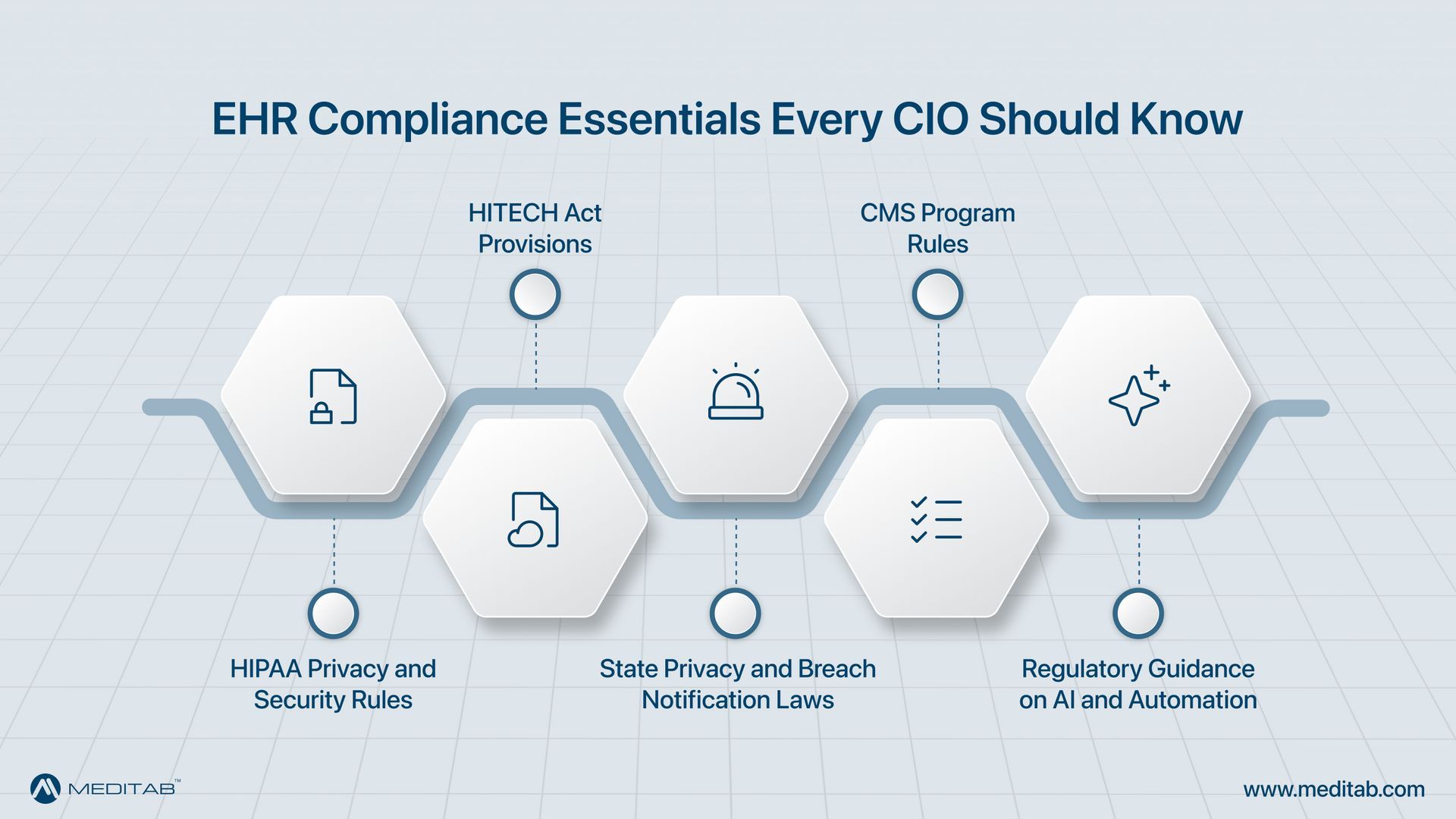
EHR Compliance Essentials Every CIO/Owner Should Know
- HIPAA Privacy and Security Rules
- HITECH Act Provisions
- State Privacy and Breach Notification Laws
- CMS Program Rules
- Regulatory Guidance on AI and Automation
Ultimate EHR Compliance Checklist for CIO/Owners
Security & Access
- Are user access logs reviewed weekly?
- Is role-based access enforced for every clinical staff member?
- Are terminated employees immediately deactivated from your electronic health record (EHR) systems?
- Is multi-factor authentication active for all remote access?
Data Integrity & Backup
- Are automated backups running daily?
- Have you tested a full system restore in the last 90 days?
- Is audit trail logging enabled and immutable?
Privacy & Patient Rights
- Can patients request their full record electronically within 30 days?
- Is your Notice of Privacy Practices updated for 2026?
- Are you tracking every disclosure of PHI?
Clinical & Operational
- Are clinical decision support alerts up to date?
- Is medication reconciliation actively used in every encounter?
- Is e-prescribing compliant with EPCS rules?
Reporting & Quality Measures
- Are MIPS quality measures being captured automatically?
- Is your HEDIS data submission error-free?
- Are you using a HIPAA-compliant EHR system that generates audit-friendly reports?
Vendor & Contract Management
- Does your EHR vendor for compliance provide signed Business Associate Agreements (BAAs)?
- Have you reviewed your vendor’s SOC 2 Type II report?
- Is your vendor proactively updating you on regulatory changes?
Read more about how Meditab supports
HEDIS Compliance.
Common EHR Compliance Gaps That CIOs/Owners Overlook
Even the most meticulous IT leaders/Owners can fall victim to hidden EHR compliance gaps. Recognizing these common oversight areas can help you secure your infrastructure before an official audit occurs:
- Unmonitored Mobile Access
While mobile EHR access dramatically increases clinician flexibility, allowing staff to view charts on unencrypted, personal smartphones creates a massive security leak. Ensure biometric locks back mobile apps and do not store local copies of patient records on the device.
- Fragmented Third-Party Plug-ins
Patching a legacy system with uncertified billing add-ons, separate telehealth software, or external intake portals compromises your entire data loop. Every system add-on represents a potential vulnerability if it is not fully integrated into a unified software environment.
- Inadequate Software Updates
Using an outdated system build exposes your practice to patch gaps and missing regulatory logic. Legacy software systems struggle to keep pace with evolving federal mandates, creating data risks and leaving your practice vulnerable to claim rejections.
Here’s how, at Meditab, we keep these EHR compliance gaps in mind and approach
EHR implementation differently.
How To Evaluate an EHR Vendor for Compliance Readiness
When you’re evaluating an EHR vendor for compliance, ask these five simple questions:
1. “How do you handle regulatory updates in real time?”
If the vendor says, “We send a quarterly newsletter,” run.
2. “Can you provide a signed BAA with your subcontractors?”
Silence is a red flag.
3. “Is your audit log immutable and time-stamped?”
The answer must be yes. No hesitation.
4. “Do you support automated MIPS and HEDIS reporting?”
Manual reporting is so 2015. Meditab’s EHR software does this natively.
A great vendor doesn’t just sell software. They become your partner in healthcare compliance functions.
Compliance Is a Continuous Process
EHR regulatory compliance is ongoing. CIO/Owners should treat the checklist as a living document that adapts to new threats, vendor changes, and regulatory updates. Regularly:
- Reassess risks after major changes (new modules, third-party integrations, or AI deployments).
- Update training and policies to reflect regulatory guidance and lessons from incidents.
- Engage clinical leaders in governance to align workflow efficiency with compliance requirements.
Meditab’s resources on navigating
EHR selection tips can help integrate compliance into everyday operations and governance.
Conclusion
Navigating the complexities of healthcare IT demands a system that matches engineering precision with clinical context. By applying this comprehensive EHR compliance essentials checklist, ambulatory CIO/owners can isolate operational vulnerabilities, eliminate data bottlenecks, and protect their revenue pipeline.
Stop patching together disconnected vendor systems. Empower your clinician teams and secure your data infrastructure with an all-in-one, intelligently automated platform built to keep your practice ahead of regulatory change.
Frequently Asked Questions
What is EHR compliance?
EHR compliance refers to meeting regulatory, security, and operational standards required for managing patient data within electronic health record systems.
What is the first step in building an EHR compliance program?
Conduct a baseline risk assessment to map existing controls, gaps, and priorities.
What is the difference between an EHR being HIPAA-compliant versus ONC-certified?
HIPAA compliance focuses on administrative policies and data security protocols that protect patient privacy. ONC certification means the system has been tested and proven to meet specific federal technical standards, such as interoperability formats and secure API data transmission capabilities.
What is the most overlooked item in an EHR compliance checklist for CIO/Owners?
Terminated user access. Most practices deactivate immediately, but forget to check for shared generic logins. Audit those.
Why is an EHR Compliance Checklist important for CIO/Owners?
An EHR Compliance Checklist helps CIO/Owners systematically evaluate security controls, documentation practices, and reporting capabilities to reduce audit risks, avoid costly penalties, and support smooth practice operations.
Share this post: