AI-Powered Digital Transformation for Ambulatory Practices
Artificial intelligence is transforming how ambulatory practices manage patient data, clinical workflows, and daily operations. According to Deepti Pandita, MD, FACP, FAMIA, “It can help
patients better understand their health information, but my worry is misuse or overreliance on the use of these tools.” AI in Electronic Health Records is moving from experimental technology to a practical tool that helps providers save time, reduce burnout, and improve patient experiences and outcomes.
For independent clinics and specialty practices, AI-powered EHRs offer a significant opportunity to streamline EHR management, improve clinical documentation, and enhance overall practice efficiency. This blog explores the growing role of AI in healthcare, the key differences between traditional and AI-enhanced EHR systems, as well as practical considerations for ambulatory practices considering AI adoption with Meditab’s IMS.
Market Overview and Role of AI
The growth of AI in healthcare is no longer a speculative trend. According to an AMA survey, physician enthusiasm for AI's role in health care continues to increase, driving a global shift. With a market value soaring into the billions, healthcare AI is being integrated into every facet of the medical experience. In the ambulatory setting, AI is primarily used to reduce the manual documentation that providers must complete to manage patient care.
As practices navigate EHR management, AI serves as the engine for AI-powered digital transformation. It isn't just about adding new features; it is about fundamentally changing how data is captured, analyzed, and utilized to improve patient outcomes. The AMA's 2024 follow-up survey (n=1,183 physicians) reveals rapidly growing enthusiasm:
| Metric | 2023 | 2024 |
|---|---|---|
| Physicians using AI in practice | 38% | 66% |
| Enthusiasm exceeds concerns | 30% | 35% |
| Concerns exceed enthusiasm | 29% | 25% |
| See definite/some advantage to AI tools | 68% | 65% |
Top opportunity identified by physicians: 57% cited "addressing administrative burden through automation" as the biggest area of opportunity for AI. The top needs for increased adoption are -
- Designated feedback channel (88%)
- Data privacy assurances (87%)
- EHR integration (84%)
Unlocking the Potential of AI in Electronic Health Records
Traditional EHR systems were built to store information. AI-powered EHRs are built to use that information to maximum capacity. Here's what that distinction looks like in practice:
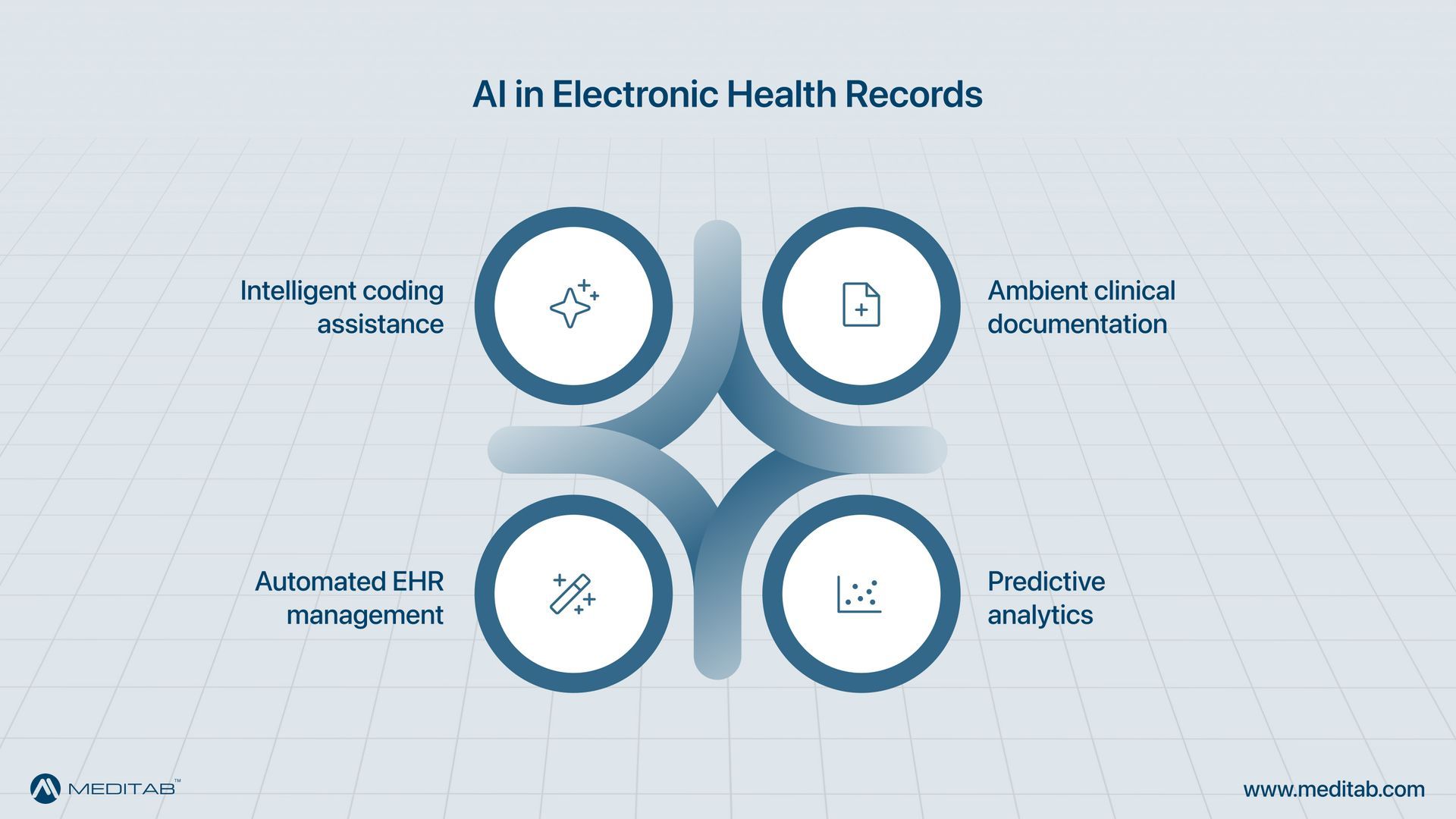
1. Ambient clinical documentation
AI listens to provider-patient conversations and automatically generates structured clinical notes in their preferred format. Providers review, approve, and move on—no typing during the visit or post-encounter charting marathon.
2. Predictive analytics
AI surfaces patterns in patient data that humans might miss. It flags patients overdue for screenings, identifies those at elevated risk of chronic disease progression, or highlights documentation gaps before a claim is submitted.
3. Intelligent coding assistance
AI cross-references clinical documentation against current coding standards, suggesting the most accurate ICD-10 and CPT codes and reducing both undercoding and compliance risk.
4. Automated EHR management
Routine tasks like prior authorization tracking, referral follow-ups, and lab result routing can be automated, freeing staff to focus on patient-facing work. The potential of AI in electronic health records isn't a single feature. It's a compounding set of capabilities that, when implemented thoughtfully, can transform how a practice operates from the inside out.
AI vs Traditional EHR: What’s the Difference?
Traditional EHR systems mainly act as digital storage systems. They rely heavily on manual processes and provide limited insights. In contrast,
AI-powered EHRs are designed to be intelligent and proactive.
Traditional EHR
- Non-automated data entry
- Static records
- Limited automation
AI in EHR systems
- Automated clinical documentation
- Predictive insights and alerts
- Real-time decision support
- Workflow automation
This shift makes AI in EHR solutions far more efficient and valuable for ambulatory practices.
Benefits of AI in EHR Systems
Integrating healthcare AI into your ambulatory practice offers measurable benefits across clinical, operational, and financial domains.
1. Smooth Clinical Documentation
The most immediate benefit is the reduction of "pajama time." An AI Medical Scribe listens to patient encounters and generates structured notes in real time. This not only saves hours each day but also improves the quality and completeness of notes.
2. Enhanced Revenue Cycle Management
When AI in Electronic Health Records is integrated with your
medical billing software, claim denials drop significantly. AI scrubs coding errors, verifies medical necessity, and ensures that every billed service is supported by clinical documentation.
3. Reduced Physician Burnout
By automating prior authorizations, prescription refills, and result follow-ups, AI-powered EHRs free your clinical staff to focus on high-value tasks.
4. Improved Patient Engagement
AI-driven insights enable personalized outreach. As an example, your EHR Software can automatically identify diabetic patients due for foot exams or hypertensive patients needing medication adjustments, triggering automated reminders.
Overcoming Challenges and Ensuring Success in AI Implementation
AI Implementation comes with several challenges of its own. Practices must address data privacy, integration complexity, staff training, and algorithm transparency. The metrics of success depend on:
- Choosing an EHR partner with strong AI in EHR solutions experience
- Starting with high-impact use cases like ambient scribing
- Ensuring robust data governance and HIPAA compliance
- Providing proper training and change management
A thoughtful EHR Implementation plan that includes AI readiness is essential for long-term success.
How Much Does a Custom AI-Based EHR Cost?
The cost of
AI in EHR solutions varies depending on the level of integration. While "custom" builds can be expensive, most ambulatory practices benefit from "Product-Based" AI, where the features are already built into the platform. Generally, practices should consider Return on Investment (ROI) rather than just the price tag. An AI-powered EHR that saves a provider hours of documentation each day often pays for itself within the first few months through increased patient volume and reduced administrative overhead.
Start with Expert Guidance for Your AI-Powered EHR
Transitioning to an AI-enhanced system requires careful planning. At Meditab, we combine deep EHR expertise with practical AI capabilities designed specifically for ambulatory practices. Whether you are exploring your first AI in EHR solution or upgrading your current system, our team can help you choose the best path. Explore our EHR software platform or learn more about selecting the optimal EHR software for your needs.
Conclusion
The future of healthcare lies in intelligent systems, and AI in Electronic Health Records is leading that change. By combining automation, analytics, and real-time insights, AI-powered EHRs help practices improve efficiency, improve reimbursement outcomes, and deliver better patient care. For ambulatory practices, adopting AI in EHR systems is a strategic step toward sustainable growth and improved outcomes.
Frequently Asked Questions
Is AI in EHRs only for large practices?
Not at all. AI in Electronic Health Records is highly scalable, making it accessible for solo practitioners and small clinics without requiring enterprise-level investment. In fact, tools like AI Medical Scribes and automated coding not only reduce administrative burden but also help providers see more patients in a day. This improves their efficiency and increases revenue potential.
What is AI in Electronic Health Records?
AI in electronic health records refers to the integration of artificial intelligence, including machine learning, natural language processing, and predictive analytics, into EHR platforms. It automates clinical documentation, improves coding accuracy, surfaces clinical insights, and structures EHR management across ambulatory practice workflows. Additionally, by improving these processes, AI can help increase the number of patients seen per day, thereby generating additional revenue for the practice.
How does AI improve clinical documentation?
AI-powered ambient transcription listens to provider-patient conversations and automatically generates structured clinical notes in real time. This eliminates repetitive data-entry tasks during visits and dramatically reduces post-encounter documentation time, a leading contributor to provider burnout in ambulatory care.
Share this post: