EHR Advantages vs. Disadvantages: Reference for Ambulatory Practices

EHRs have become universal in US ambulatory settings. According to the Office of the National Coordinator for Health Information Technology (ONC), nearly 88% of office-based physicians have adopted an EHR system. Yet evidence on their impact in outpatient care reveals a complex picture. There have been meaningful benefits, but there are also significant workflow and burnout challenges specific to ambulatory practices.
Like any major technology shift, EHRs come with both significant benefits and real challenges. Understanding the advantages and disadvantages of EHRs helps practice owners make informed decisions when choosing or upgrading their system.
At Meditab, we’ve helped hundreds of ambulatory practices successfully implement and optimize their EHR. In this blog, we break down the pros and cons of electronic health records and show how the right solution can help you maximize the benefits while minimizing the drawbacks.
The Evolution of Clinical Documentation
Before diving into the specifics, it is important to distinguish between a simple digital record and a comprehensive system (EMR vs EHR). While an EMR (Electronic Medical Record) is a digital version of a paper chart within a single practice, an EHR is built to share information across multiple providers and locations. For an ambulatory practice, upgraded EHR software serves as the central nervous system, connecting clinical data to administrative and financial workflows.
What Are Electronic Health Records?
An electronic health record (EHR) is a digital version of a patient's medical history, maintained by the provider over time. Unlike an electronic medical record (EMR), which is typically limited to a single practice's clinical data, EHRs are designed to share information across multiple care settings. This gives a more complete picture of a patient's health journey. For a deeper look at how these systems work,
Meditab's complete guide on EHR software is a great starting point.
Advantages of EHRs
When implemented correctly, the advantages of EHRs extend far beyond simply replacing a paper folder. For ambulatory practices, these tools are the engine of revenue cycle management, patient engagement, and clinical accuracy.
1. Improved Patient Care and Safety
Instant access to patient records enables faster and more accurate decision-making. Reports suggest that
81% of physicians with EHRs can easily access patient charts remotely. This reduces test and procedure duplication and supports better coordination among care providers. One of the biggest advantages of EHR systems is the ability to provide a complete, real-time view of a patient’s medical history.
2. Enhanced Financial Performance
While there is an EHR implementation cost involved, the benefits of deployment include faster billing cycles. Automated medical coding and direct claim submission mean fewer denials and quicker reimbursements. For ambulatory practices operating on thin margins, this efficiency is a lifeline. Integrated billing and coding tools reduce claim errors and speed up reimbursements. Practices using advanced EHR systems often see improved first-pass acceptance rates and fewer denials.
3. Better Workflow Efficiency
Automated workflows reduce manual tasks. The templates and voice tools in the EHR allow for faster documentation. Additionally, due to digital workflows, there is reduced dependence on paperwork and a minimized clinical and administrative burden. As reported by 62% of physicians, EHR alerted them about critical lab values and helped them provide recommended care. All of these EHR advantages allow providers to focus more on patient care and less on time-consuming processes.
4. Streamlined Patient Engagement
Modern EHRs come with
patient portals. This allows patients to view lab results, request refills, and pre-fill intake forms before arriving. This self-service aspect reduces front-desk workload, and it is a massive EHR advantage often overlooked.
5. Reduced Errors
An electronic health record in place essentially benefits states that require prescribers for prescribing controlled medications. Additionally, there are minimal handwriting errors. It standardizes data entry and improves consistency across the entire practice. An e-prescribing software with built-in alerts is designed to help in avoiding medication and allergy conflicts.
6. Stronger Analytics and Reporting
EHR systems provide valuable insights into practice performance, population health trends, and quality measures. This data helps ambulatory practices make smarter operational and clinical decisions.
7. Easier Compliance and Documentation
From
MIPS reporting to HIPAA requirements, a good EHR simplifies regulatory compliance and creates a clear audit trail for every patient encounter. This is one of the most critical benefits of EHR deployment, especially for practices aiming to improve safety and compliance.
8. Proactive Health Maintenance & Preventive Care Tracking
A key advantage of modern EHR systems is the ability for clinicians to configure automated health maintenance reminders. Providers can set up alerts for essential preventive care activities such as annual foot exams for diabetic patients, routine bloodwork, screenings, and follow-ups. This ensures that no critical aspect of patient care is overlooked, supports better chronic disease management, and helps practices deliver consistent, guideline-driven care while improving patient outcomes.
Disadvantages of EHRs in Ambulatory Practice
Despite the clear clinical benefits, there are legitimate EHR disadvantages that practice managers must address to prevent
provider burnout and financial strain.
1. High Initial Costs
The initial investment for EHR software, including licensing, hardware, training, and data migration, can be substantial, particularly for smaller practices. This is one of the most frequently cited EHR disadvantages among independent ambulatory providers.
2. Learning Curve and Training Requirements
During the initial benefits of the EHR deployment, it is common to see a temporary decrease in patient volume. Learning a new interface takes time, and if the system is not intuitive, it can lead to "click fatigue" among clinicians.
3. Interoperability Issues
While EHRs are theoretically designed for data sharing, interoperability across systems remains inconsistent in practice. Information silos between practices, labs, imaging centers, and pharmacies can limit the effectiveness of care coordination.
4. Data Security and Privacy Concerns
Moving patient data to a digital format introduces cybersecurity risks. Ambulatory practices must invest in certified EHR software that meets strict HIPAA standards to protect sensitive patient information from breaches.
Minimize the Risk Associated With Electronic Health Records
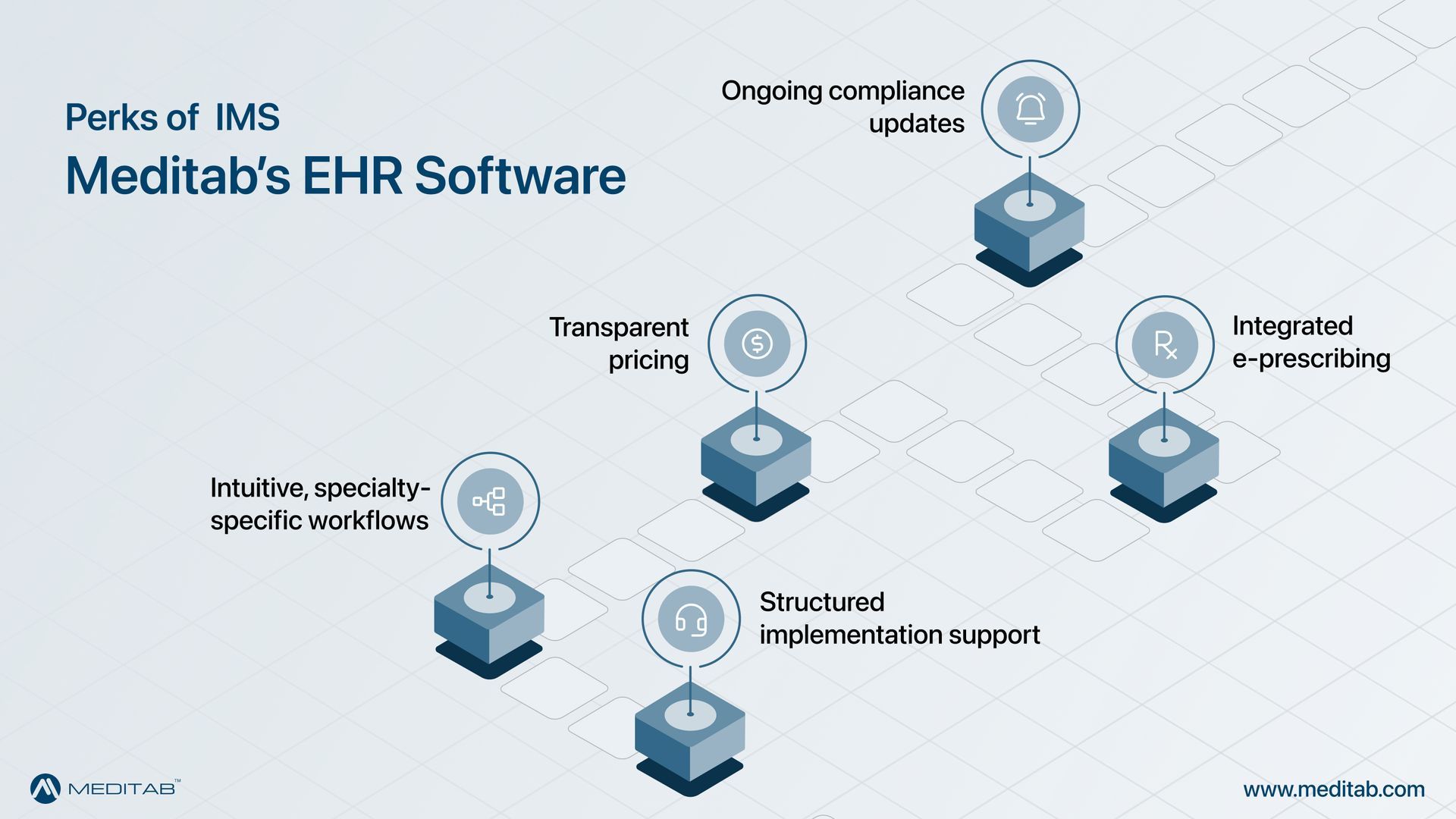
Meditab's certified EHR software, IMS, is tailor-made for ambulatory practices. Here's how it addresses the most common EHR disadvantages head-on:
Intuitive, specialty-specific workflows:
Meditab's EHR, IMS, is designed around how ambulatory clinicians actually work, not how administrators imagine they do. The specialty-specific templates reduce unnecessary clicks and documentation time, helping combat provider burnout.
Structured implementation support:
Meditab provides dedicated implementation planning and onboarding resources, along with training, to minimize disruption during the transition. A structured rollout process means your team gets up to speed faster with less downtime.
Transparent pricing:
Meditab provides upfront, clear guidance on EHR costs, so practices can budget accurately and understand the total investment before signing anything.
Integrated e-prescribing:
With built-in e-prescribing capabilities through IMS Hub Rx, Meditab connects providers directly to pharmacies and prescription drug monitoring programs, supporting safer prescribing decisions at the point of care.
Ongoing compliance updates:
As regulatory requirements evolve, Meditab's certified EHR software is updated to keep practices current, without adding extra burden to your team.
In Short
The advantages and disadvantages of EHRs are important to understand before making a decision. While there are some challenges, the overall benefits of electronic health records, from improved patient care to better operational efficiency, make them an essential tool for modern practices. By carefully evaluating the pros and cons of EHR systems and choosing the right partner,
Meditab, practices can unlock the full potential of digital healthcare. With the right approach, the advantages of EHR far outweigh the drawbacks, leading to better outcomes for both providers and patients.
Share this post: