IMS Build 43: Intelligent, Connected, and Automated Healthcare Workflows

Every IMS build is a conversation between our teams and the providers, clinicians, billing staff, and front-desk teams who use IMS every single day. Build 43 is that conversation at its most productive. From AI that writes notes for you, to patient portal security that gives patients peace of mind, to fertility reporting that finally pulls records the way your clinic thinks, this one's packed. Here's everything new in IMS Build 43.
Two-Factor Authentication (2FA): Fortifying Patient Portals
With the rise in digital health access, protecting patient information is paramount. IMS Build 43 introduces Two-Factor Authentication (2FA) for the
IMS Care Web and App. Patients will now receive a one-time verification code via their preferred method (email or SMS) after entering their username and password. Previously, a single password was the only barrier to sensitive health data. 2FA adds a critical extra layer, ensuring that even if a password is compromised, accounts remain secure.
- Patient control:
Users can configure their 2FA method, enable “remember this device,” and remotely log out of all active sessions. - Compliance ready:
This feature provides a robust audit trail, helping clinics meet stringent data protection standards.
Going forward, please assure patients that their private medical records are protected by the same modern security standards used in banking and e-commerce.
Fertility Teams, Rejoice, Your Reports Just Got Superpowers
If you’ve ever tried to pull specific
fertility data and felt like you needed a PhD in spreadsheet sorcery, we hear you. We’ve completely upgraded the “Fertility by All Options” report with four shiny new filters and two extra columns:
- Pay Date → Perfect for billing teams tracking actual payments
- LMP Date → Finally makes FET cycle retrieval accurate
- Transfer Date & Oocyte Retrieval Date → Because these dates matter
- Pt. Provider Column → Shows both DOR and attending provider
You can now schedule this report to auto-generate through the Event Scheduler. Set it and (almost) forget it. Your fertility coordinators just got upgraded from overwhelmed to overjoyed.
AI-Powered Personalization For Clinical Documentation
The biggest headline in Build 43 is the significant leap forward in IMS AI Scribe experience inside
IMSGo. Here's the thing about AI-generated clinical documentation: it's only as good as how well it understands you. Every provider has a style. Every specialty has a structure. Providers can now apply custom instructions and formatting styles, such as auto, bullets, or paragraphs, to specific sections of the note. So if you prefer your HPI in bullet points and your Assessment in paragraphs, the AI learns that and delivers accordingly.
- General Medicine and Cardiology:
Providers can access advanced HPI structuring with "Level of Detail" and "Split by Problem" controls. Complex, multi-problem encounters no longer collapse into a single narrative. Each problem gets its own structured breakdown, which means more accurate documentation, better coding specificity, and stronger continuity of care. - AI-generated transcript drafts:
Use them directly within the checkout workflow so providers can review, finalize, and sign off on notes exactly where it makes sense, without backtracking through the chart. Build 43 aims to reduce reformatting and screen time after hours, allowing more time with patients.
Real-Time Interoperability with FHIR Enhancements
To keep IMS at the forefront of healthcare technology, Build 43 includes significant interoperability upgrades that position the platform as AI-ready and future-proof.
- Expanded Write Capabilities:
The expansion of IMS FHIR R4 APIs now supports additional "write" resources for patients, appointments, procedures, and conditions. This enables deeper integration with external Al Reception and AI Scribe vendors. It supports instant scheduling and automated write-back of clinical documentation. - Compliance with USCDI v3 Standards:
Build 43 upgrades the system to support USCDI v3 data elements, meeting the latest HTI-1 certification requirements. This update introduces over 20 new data elements, including sexual orientation and gender identity. It ensures the collection of more comprehensive clinical and demographic data. - Reminder Workflow & Stimsheet Improvements:
This update is backed by user feedback. If your clinical team uses the reminder module, Build 43 brings meaningful quality-of-life improvements that save time and reduce back-and-forth. The linked record access is now available directly from the reminder task window. So, there is no more navigating away to find the full record a reminder is tied to. Click the icon, see the details, stay in context. - Auto-Fetch for Lab Result Reminders:
This is based on the office and provider configured in the lab result window. So, the correct task is pre-selected automatically. No manual selection required every time. And for practices that need accountability in their reminder notes, a new timestamp feature records who added each note and exactly when. Accountability is built right into the workflow.
Copy from Previous Visit Note” Available in IMS OnArrival & IMSGo
Raise your hand if a patient has completed the same social history form for three consecutive visits. Build 43 introduces "Copy from Previous Visit Note" functionality for Quick Note in both
IMS OnArrival and IMSGo. Pre-configured question templates now auto-populate from the prior-visit note, allowing patients and clinical staff to review and confirm rather than starting from scratch each time. If something changes, updated information flows directly into the visit note. If nothing changes, it's already there. Either way, everyone moves more quickly.
Workflow Automation That Saves Time
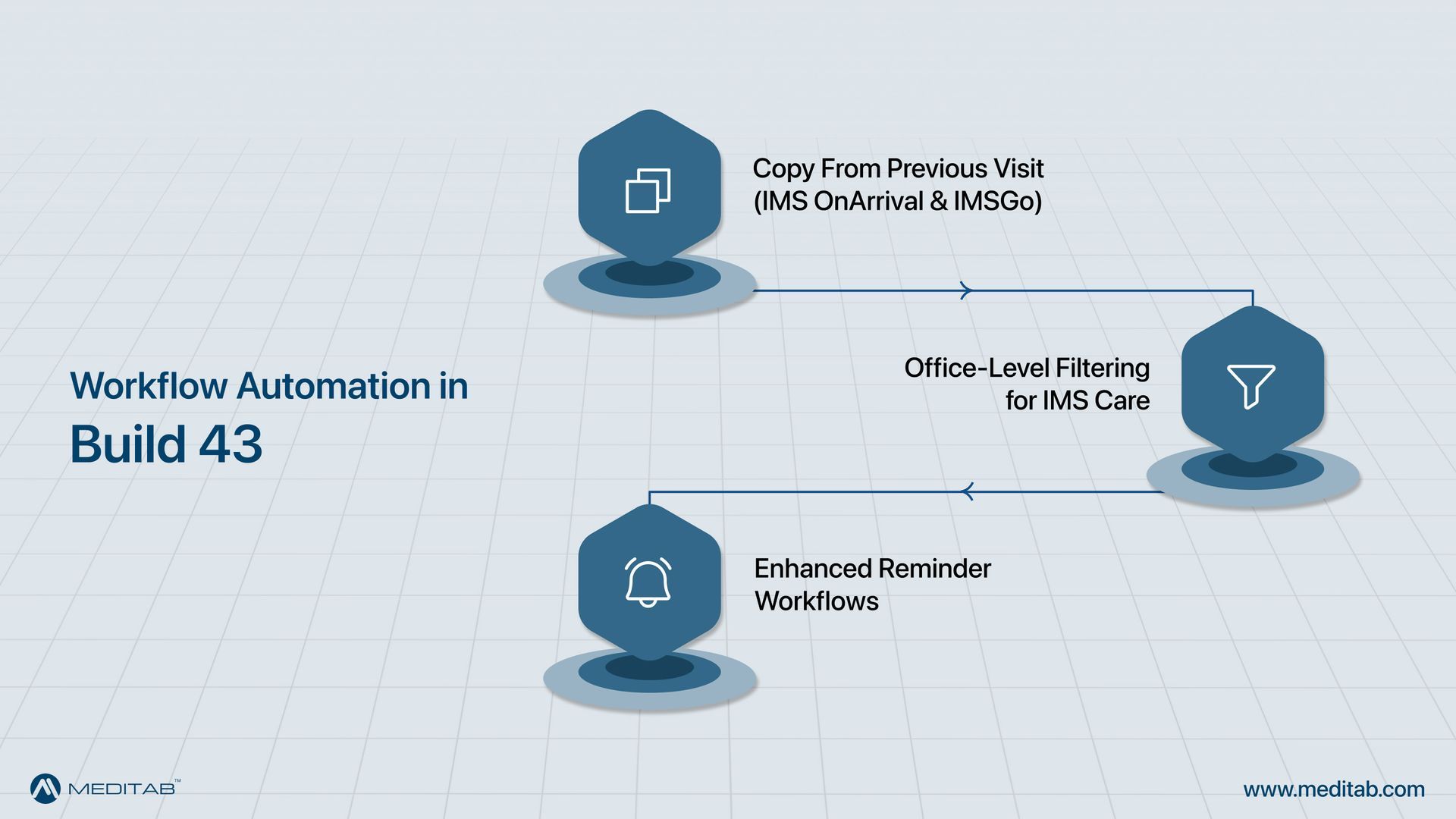
Efficiency is at the heart of Build 43, with several general enhancements aimed at reducing manual data entry and administrative friction.
- Copy From Previous Visit (IMS OnArrival & IMSGo):
Clinical staff can now auto-populate Quick Note templates from a patient’s previous visit. This feature is especially beneficial for information that rarely changes, such as social history, significantly accelerating the charting process. - Office-Level Filtering for IMS Care:
Practices with multiple locations or brands can now customize the patient experience by filtering IMS Care modules based on the patient's specific office. Patients will only see the services and modules relevant to the branch they are visiting. - Enhanced Reminder Workflows:
Users can now access details of linked records (bills, lab results, documents) directly via icons within the reminder task window. Furthermore, a new timestamp feature for reminder notes automatically documents who added a note and exactly when it was entered, improving accountability and audit trails.
Why Upgrade to IMS Build 43?
Build 43 is about making complex things feel simple. For running a busy fertility clinic, managing multiple office locations, or just being tired of repetitive documentation, there’s something here that will make your day smoother. Let’s upgrade your experience to Build 43. Log in to your IMS portal and check out the latest features, or
reach out to us for a quick walkthrough. We build so that your practice can thrive!
Share this post: