EHR Statistics 2027: What Every Practice Leader Should Know

Stats can reveal what's hiding in plain sight. For providers, they can also highlight current trends and how they apply to their practice.
For example: Roughly nine in ten office-based physicians now use a certified EHR. Yet 34% of family physicians still log three or more hours of after-hours documentation a day. Both facts are true, and the resulting stalemate explains much of where practices feel the friction.
This guide gathers the EHR statistics that matter most right now, drawn from credible and recent sources. Use it to test your own workflows, build a budget case, or settle the next debate in a partner meeting.
Why EHR Statistics Matter
Numbers cut through opinion. If a physician says charting has gotten out of hand, a benchmark shows whether that’s a local problem or an industry-wide one. If an owner wonders whether AI deserves a pilot, peer data shows who has already tried it.
Reliable EHR statistics also keep vendor pitches honest, because you can hold any promise up against market trends. The most useful EHR usage statistics don’t just describe the market. They show where your workflows should be tighter, and a few EHR stats tracked in your practice will quickly tell you whether a change is working.
EHR Adoption Statistics
- About nine in ten office-based physicians reported using a certified EHR in 2024.
- ONC’s June 2026 adoption brief calls adoption “nearly ubiquitous” and describes itself as ONC’s final formal report on physician adoption.
What it means: These EHR adoption statistics point to a settled market. The live questions now are usability, AI, and how well your system connects with everyone else’s.
AI in EHR Statistics
- 81% of physicians use AI professionally, versus 38% in 2023, according to a 2026 survey of 1,692 physicians.
- The average physician now has 2.3 AI use cases, up from 1.1.
- 30% use AI for discharge instructions, care plans, or progress notes, and 28% use it for billing codes, charts, or visit notes.
- Seven in ten see AI as a way to automate tasks that contribute to burnout, and 85% want a say in adoption decisions.
- Real-world results are meaningful but modest. A multi-site study of 8,581 clinicians linked AI scribes to about 10% less documentation time.
What it means: Involve clinicians before you buy, and favor tools that draft documentation while leaving final review with the physician.
Physician Burnout and Documentation Statistics
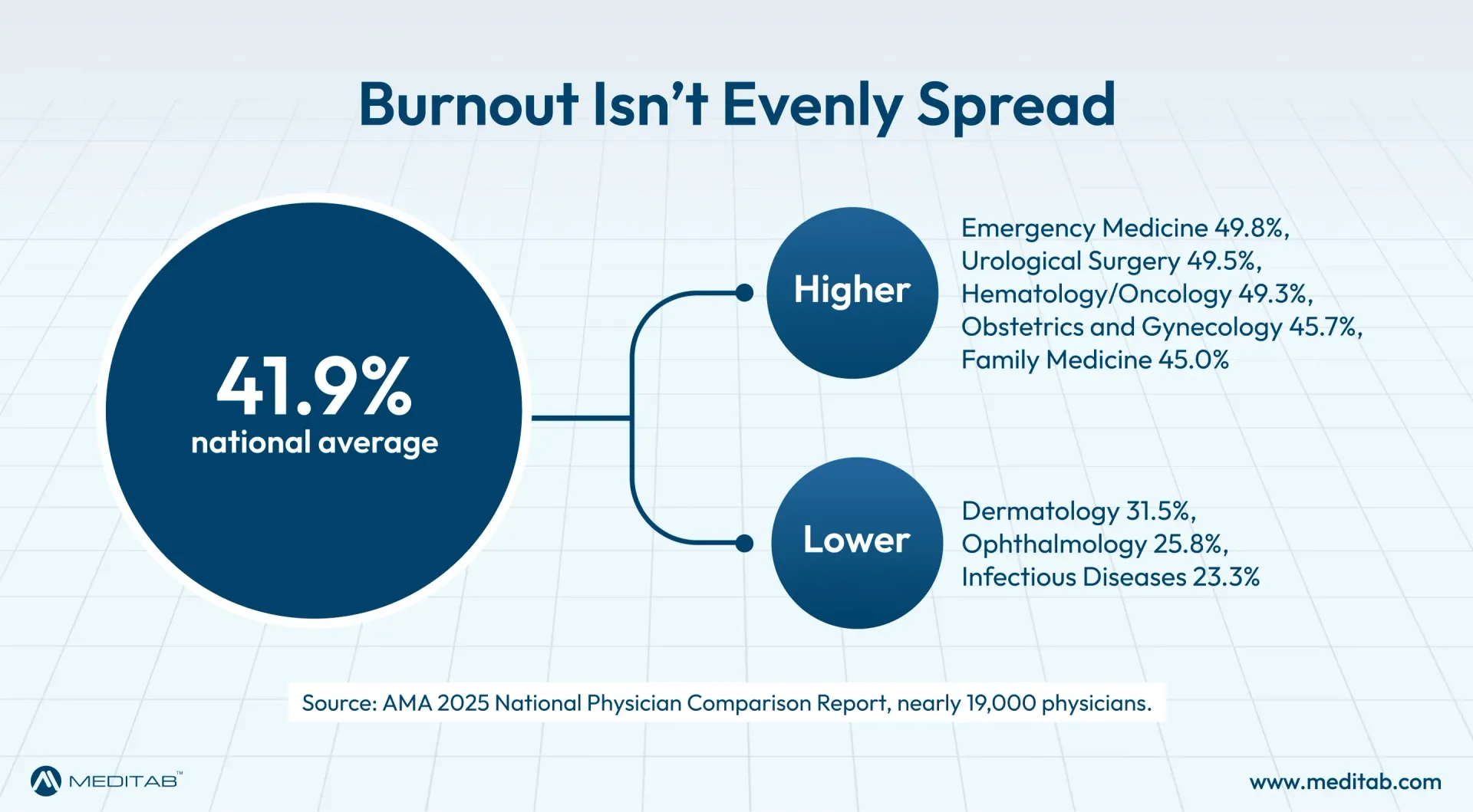
- 41.9% of physicians reported at least one burnout symptom in 2025, down from 43.2% in 2024 and 48.2% in 2023 (Nearly 19,000 responses).
- Among family physicians, substantial after-hours “pajama time” (three or more hours a day) fell from 41% in 2024 to 34% in 2026.
- 94% of physicians say prior authorization contributes to burnout, and it consumes about 13 hours of physician and staff time each week.
What it means: Progress is real, but paperwork still drives the strain. Fix the workload before assuming the problem is the people.
Healthcare Interoperability Statistics
- HHS reported in June 2026 that TEFCA record exchange grew from 10 million to more than 1 billion in under a year.
- Among Family Physicians, the share reporting a substantial burden tracking down outside health information slipped from
43% in 2024 to 38% in 2026.
What it means: Exchange is scaling, but daily friction hasn’t vanished. Ask any vendor how it handles HIE, FHIR APIs, and incoming records.
Patient Engagement Statistics
- In 2024, 77% of individuals were offered online access to their records, up from 73% in 2022, and 65% accessed them, up from 57%.
- Frequent users, meaning six or more logins a year, reached 34% in 2024, more than double 2019’s 15%.
- Portal users mostly view lab results (90%) and clinical notes (80%), message providers (79%), and schedule appointments (77%).
- Proxy or caregiver access climbed from
24% in 2020 to 51% in 2024.
What it means: Patients expect to get real work done in a portal. A weak portal pushes that work back onto your front desk.
Revenue Cycle and Financial Statistics
- CAQH estimates U.S. Healthcare avoided $258 billion in administrative costs in 2024 through electronic transactions, a 17% increase, with another $21 billion within reach through full automation.
- 95% of physicians say prior authorization delays necessary care, and 79% report patients abandoning treatment because of it.
- 40% of physicians have staff who work exclusively on prior authorization.
What it means: Automation clearly pays off. Manual claims and authorization work is where the remaining waste sits.
Healthcare Data and Analytics Statistics
- More than half of health plans and 25% of provider organizations use AI tools in administrative workflows.
- Medical administrative spending fell 9%.
- 86% of physicians call data privacy critical to broader
AI adoption, and 88% say the same of robust safety and efficacy validation.
What it means: Data only helps if you trust it and can see it. Dashboards built on your own numbers beat national averages.
How Meditab IMS Helps Practices Stay Ahead
IMS (Intelligent Medical Software) is an EHR offered by Meditab. Several of its tools align with the trends above.
- Documentation: The ambient AI Scribe listens to in-person or televisit conversations, drafts structured notes, and flags ICD-10 codes, referrals, prescriptions, and labs. The clinician reviews and edits before saving anything.
- Interoperability: Meditab IMS HIE sends and receives PHI in CCDA format through the Surescripts network, and FHIR APIs support third-party integrations.
- Patient engagement: IMS Care pairs a patient portal with a mobile app where patients can manage payments, request refills, and book appointments.
- Revenue cycle and analytics: Medical Billing includes claims scrubbing, Availity Essential Pros clearinghouse integration, as well as denial and rejection management, while Practice Analytics adds customizable dashboards, including one for MIPS.
Pair any of these with a number from this guide to get a measurable target, such as after-hours charting, record-retrieval time, portal activation, or denial rates.
Conclusion
Combined, these figures tell a single story.. EHRs are everywhere, AI is arriving fast, and the stubborn costs live in paperwork, prior authorization, and information that doesn’t travel.
Pick two or three stats that match your own pain points, track them in your practice for a month, then let them steer your next technology decision. Benchmarks show where to look, and your data shows what to fix. That said, we’re always a phone call away if you need niche insights for your practice and workflows.
Meditab IMS Fits Your Specialty and Workflow
Frequently Asked Questions
Are EHR adoption statistics still rising?
Adoption is already close to universal. About nine in ten office-based physicians reported using a certified EHR in 2024, and ONC calls adoption “nearly ubiquitous.” Its June 2026 brief is its final formal report on physician adoption, so attention has shifted to usability, interoperability, and AI.
How many physicians use AI in their practice?
The AMA’s 2026 survey found 81% use AI professionally, up from 38% in 2023. Summarizing medical research leads at 39%, followed by discharge instructions, care plans, and progress notes at 30%.
Is an AI scribe worth considering for a small practice?
It can be, if you set a clear goal, such as less after-hours charting, and keep physician review in place. Since 85% of physicians want input on AI decisions, involve your clinicians in any pilot.
Where can I find reliable EHR usage statistics?
Start with primary sources such as ASTP/ONC at healthit.gov, the AMA’s physician surveys, and the CAQH Index. Check the publication year each time, because these figures are updated annually.
Share this post: