Why One EHR Doesn’t Fit All: Clinics vs Large Health Practices
A six-provider clinic and a 400-provider multi-state group both need an EHR. They will not need the same one, and the reasons have almost nothing to do with budget. Scale changes what software has to do. It changes who configures it, how long it takes to go live, and what happens when something breaks on a Tuesday afternoon. The adoption data shows the split clearly. According to ONC figures for office-based physicians, 86.1% of solo physicians use an EHR, compared with 99.1% of those in practices of 51 or more, and the certified-EHR gap is still wider.
This piece explains where the two genuinely differ, what each side gains and struggles with, and how to decide which EHR software model fits for healthcare organizations. Choosing the incorrect system size is the most expensive mistake in this category. Read more in our blog below regarding how you can prevent this error in your practice.
What is EHR Software?
An EHR is the system of record for patient care. It holds charts, orders, results, prescriptions, and documentation, and in most systems it also connects to scheduling and billing. Our complete guide on EHR software covers the full picture if you are starting from scratch.
One clarification worth making early, because it shapes every later decision. An EMR is a digital chart inside one organization. An EHR is built to move information between organizations, which is why the terms aren't interchangeable. Find out more about these differences through this article (insert link/title)
Ambulatory Practice or Large Health System: Which Are You?
An ambulatory practice delivers care to outpatients. Think a single-specialty clinic, a group practice with a handful of locations, or an independent physician-owned organization. Here, physician-owners and practice managers make software decisions and also run the day-to-day IT department An EHR for ambulatory practices is built around that reality.
A large health system operates at a different order of magnitude. Dozens or hundreds of sites, encompassing many specialties, thousands of users, and a governance structure where clinical, IT, finance, and compliance all hold a vote. The software serving that environment is usually described as enterprise EHR systems, and the category behaves differently from a small practice EHR.
Key Differences Between EHR for Ambulatory Practices vs Large Health Systems
The honest EHR comparison comes down to six things. Everything else follows from them.
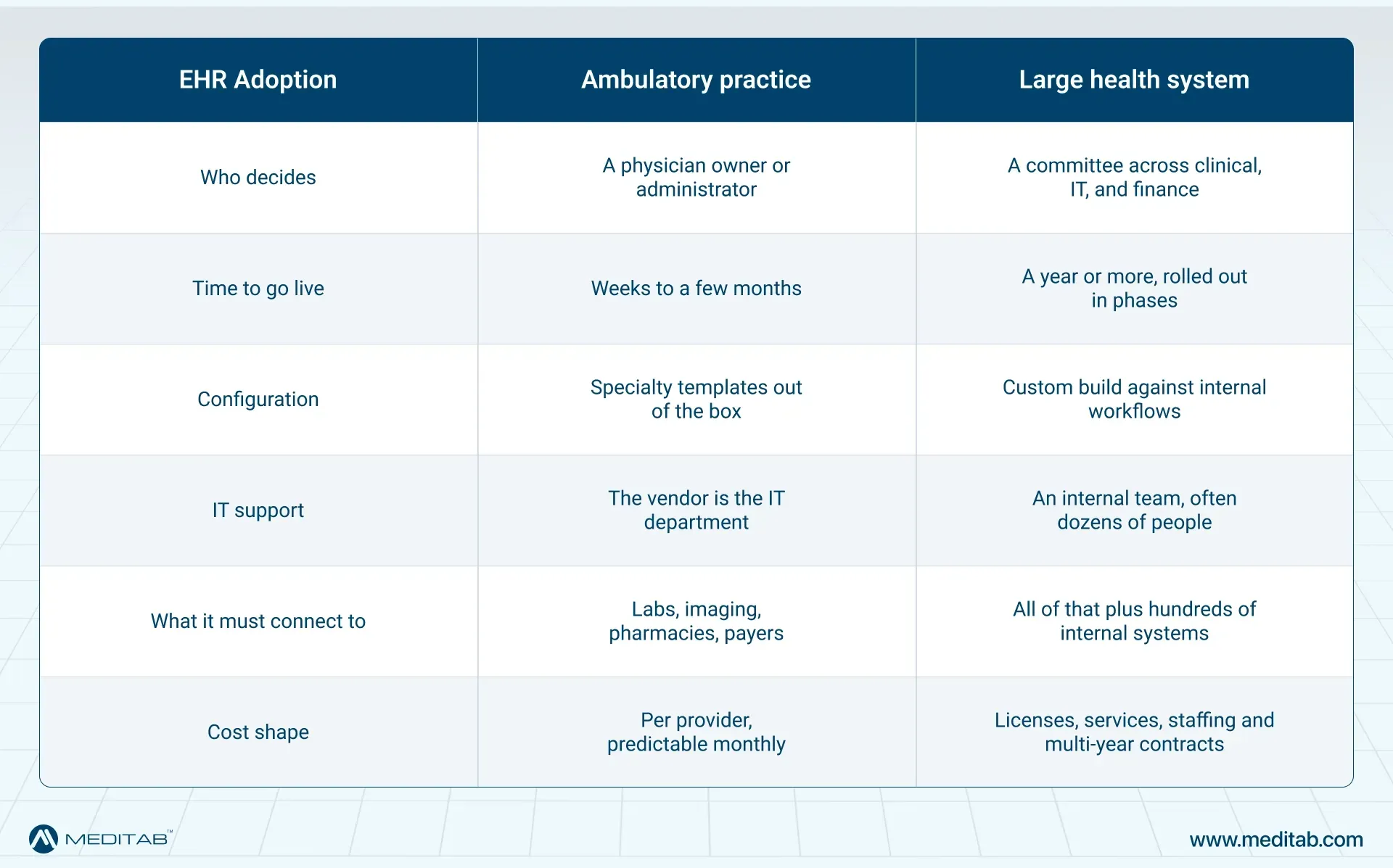
Notice that none of those rows is about feature count. Both categories can chart a visit and send a claim. What separates them is who does the configuring, how long the organization can tolerate disruption, and whether the software arrives ready for a specialty or waiting to be told what one is.
What Ambulatory Practices Gain From a Compatible EHR
For a clinic, the value of an EHR for ambulatory practices shows up in the ordinary week rather than in a strategic plan.
- Specialty templates that already match how the practice documents.
- A single vendor for charting, scheduling, and billing, so problems have one owner.
- Go-live measured in weeks, with the practice still seeing patients throughout.
- Predictable per-provider pricing that a practice administrator can forecast.
- Support that answers without an internal help desk sitting in between.
Usability matters more here than anything else, because there is no informatics team to absorb a clumsy interface. A
JAMA Network Open study of 2,067 family physicians found that satisfaction with the EHR was associated with lower burnout, with workflow alignment and ease of finding information among the strongest drivers. In a six-person clinic, those things are the difference between finishing your work day at five and finishing at seven.
What Large Health Systems Gain From Enterprise EHR Systems
An EHR for large health systems is solving a coordination problem rather than a documentation issues. When a patient moves between eleven locations and four specialties, the chart has to follow without anyone rekeying it.
- One record across every site and service line, with a shared patient index behind it.
- Configuration deep enough to encode rules that differ by region, service line, or contract.
- Analytics across the whole population, which is what value-based contracts are scored on.
- Governance and audit controls built for thousands of users with different permissions.
- Integration capacity for the hundreds of systems a large organization accumulates.
That last point is doing quiet work. Moving data smoothly between systems is the whole game at this scale, and it is worth understanding before signing anything. Our information on
healthcare interoperability covers why it is harder than vendors make it sound.
Where Ambulatory Practices Struggle
The recurring problem is not money. It is that nobody owns the software. The front office coordinator who understands it best also runs the schedule, and when that person leaves, the institutional knowledge goes with them.
Three patterns come up repeatedly. Practices buy a system built for a different specialty and spend years working around the templates. They underestimate how much staff time training will consume, so adoption stalls halfway, with staff using only a fraction of the system's features. And they treat data migration as a formality when it is often the most difficult part of the entire switch of the project.
These three mistakes are avoidable with some forewarning. We have documented the mistakes small practices make when choosing an EHR, and most of them are decisions made in month one that only become visible in month eighteen.
Where Large Health Systems Struggle
At the other end, an EHR for a large health system runs into the inverse problem. Resources are not the constraint, but speed is. A change that takes a clinic an afternoon takes an enterprise a governance cycle. Customization intended to fit local workflows becomes technical debt that makes the next upgrade difficult. Departments quietly adopt their own tools, and the single record starts fragmenting at the edges. And training thousands of users on a phased rollout means some sites are running old workflows while others have moved on.
None of this is a reason to avoid enterprise software, but it does explain why these projects take years. Our piece on EHR implementation challenges and solutions goes into what actually derails them.
How to Choose the Best EHR for Your Clinic Size
Start with an uncomfortable question. Who at your organization will own this system after go-live, and what else is on that person's plate? The answer tells you more about which category fits than any feature matrix will.
Then work through four things. How many locations and specialties does the record need to span today, and in three years? Does your specialty have workflows a generic system would have to be taught, such as immunotherapy dosing or ART cycle management? How much disruption can you absorb, given that a phased enterprise rollout assumes you can run two ways of working at once? And who fixes it at 4:00 PM on a Friday?
A structured process helps more than a long requirements document. Our guide on choosing the best EHR software lays out the questions in order. Budget deserves its own look, because the sticker price is rarely the real number. Implementation, data migration, training, and lost productivity during transition all belong in the comparison. Our EHR software cost breakdown covers what to expect at each size.
Payment pressure is part of this calculation too. The
CY 2027 Medicare Physician Fee Schedule proposed rule would lower the conversion factor again, which means the efficiency your software does or does not deliver shows up directly in the margin.
Cloud-Based or On-Premise?
For most ambulatory organizations, this question is settled. Cloud removes the server, patching, and disaster recovery plan, and turns a capital purchase into an operating cost. Large systems sometimes still run on-premises or hybrid for data residency for integration reasons, and they have the staff to justify it.
The practical difference is who carries the maintenance burden. Our overview of the benefits of cloud-based practice management systems covers the trade-offs without the usual hand-waving.
Where Meditab’s IMS Fits
Meditab has been building for the ambulatory side of the individual specialties since 1998. IMS is an all-in-one EHR system covering charting, practice management, and billing in one platform. It is ONC-certified and running in practices across all 50 states. IMS delivers with purpose-built modules and templates for more than 40 specialties, so an allergy clinic gets immunotherapy dosing and a fertility practice gets ART cycle management, to name a couple of specialties, without a build project standing between them and go-live. That is the difference between software that arrives knowing your specialty and software waiting to be told what one is.
In a Nutshell
Enterprise software is designed to coordinate an organization too large to coordinate itself, and it accepts complexity and long timelines as the price. Ambulatory software is designed to get a clinic working well quickly, and it accepts narrower scope as the price. The costly mistake is buying the wrong software. A clinic running enterprise software configures forever and never quite finishes. A growing group on a system that cannot span locations outgrows it and pays for a second migration.
If you want to see what that looks like against your own workflows, you can book a demo, and we will walk through your specialty rather than a generic one.
Frequently Asked Questions
What is the main difference between an EHR for ambulatory practices and enterprise systems?
Scope and ownership are the main differences. Ambulatory software starts with built-in specialty content, and the vendor tailors it to the practice and supports it after go-live. Enterprise EHR systems are built to span many sites and service lines, and they assume an internal team to configure and maintain them. The EHR comparison that decides it is not feature lists; it is who carries the configuration work.
Can a small clinic use enterprise software?
Small clinics can use enterprise systems, and some do. But the configuration work, the timeline, and the internal support that enterprise software assumptions rarely exist in a clinic. Most practices end up paying for capacity they never use while waiting on changes a smaller vendor could potentially make the same week.
How much does a small practice EHR cost in comparison with an enterprise system?
Both come with licensing, implementation, and ongoing support. A small practice usually pays per provider, with setup and support included in or quoted alongside the subscription, so the total is easier to predict. Enterprise contracts are negotiated over multiple years, can run far higher, and add the cost of the internal IT team that builds and maintains the system. Our EHR pricing page shows where Meditab sits.
Do ambulatory systems handle interoperability as well as enterprise systems?
A certified ambulatory system exchanges data with labs, imaging centers, pharmacies, payers, and other providers using the same standards. What differs is internal integration volume. A large organization is connecting hundreds of internal systems as well, which is where enterprise architecture earns its complexity.
Does practice size affect EHR adoption?
Measurably. ONC quick stats put adoption at 86.1% among solo physicians and 99.1% among those in practices of 51 or more. Smaller practices have less internal IT capacity, which is precisely why EHR systems for clinics need to work without one.
Share this post: