Top EHR Trends in 2027 Every Specialty Practice Should Know
In late October, HHS finalized a rule that trims the federal health IT certification program. Payers face a January 1, 2027 deadline for new prior authorization APIs. And providers are probably already using AI at work, whether or not your EHR was built for it. That’s a lot of change landing at once.
This guide walks through the EHR trends most likely to affect specialty practices in 2027, what each one means for daily work, and how to plan without overspending on hype. If you run a practice or manage its clinical and admin teams, start here.
Why EHR Trends Matter in 2027
Most practices already have an EHR, so the 2027 question isn’t whether to use one; it’s whether yours keeps pace. Rules are shifting, patients expect digital options, and AI is changing how providers and staff spend their day.
Tracking trends in electronic health record systems helps you separate what deserves budget consideration now as opposed to what can wait. It also equips you to ask your vendor more targeted questions for your vendor upon renewal. If you followed EHR software trends in 2026, you saw plenty of AI pilots. This year is about making those tools dependable, connected, and easy to govern. For a small specialty practice, that shift matters even more now. If you don’t have an IT department to untangle a poor rollout, then the most important questions up front save real time and money later.
10 EHR Trends Reshaping Practices in 2027
Here are the EHR software trends worth your attention.
1. Ambient AI documentation becomes routine
A
2026 survey found that more than 80 percent of physicians now use AI professionally, up from 38 percent in 2023.
Ambient AI scribes fit naturally here. They listen to the visit, draft the note, and let the clinician review it before signing. Meditab IMS offers an Ambient AI Scribe in IMSGo and IMS Care for in-person visits and telehealth visits.
2. AI reaches the front desk and billing office
Documentation isn’t the only paperwork AI can touch. Meditab IMS includes patient no-show prediction, AI document processing that sorts and summarizes inbound faxes, and RCM intelligence that flags coding errors and drafts appeal letters.
Your team still makes the calls; the AI just clears the pile first. For a busy front desk, that can mean fewer hours spent sorting faxes and more time helping patients, while billers spend less time hunting for the errors that trigger denials.
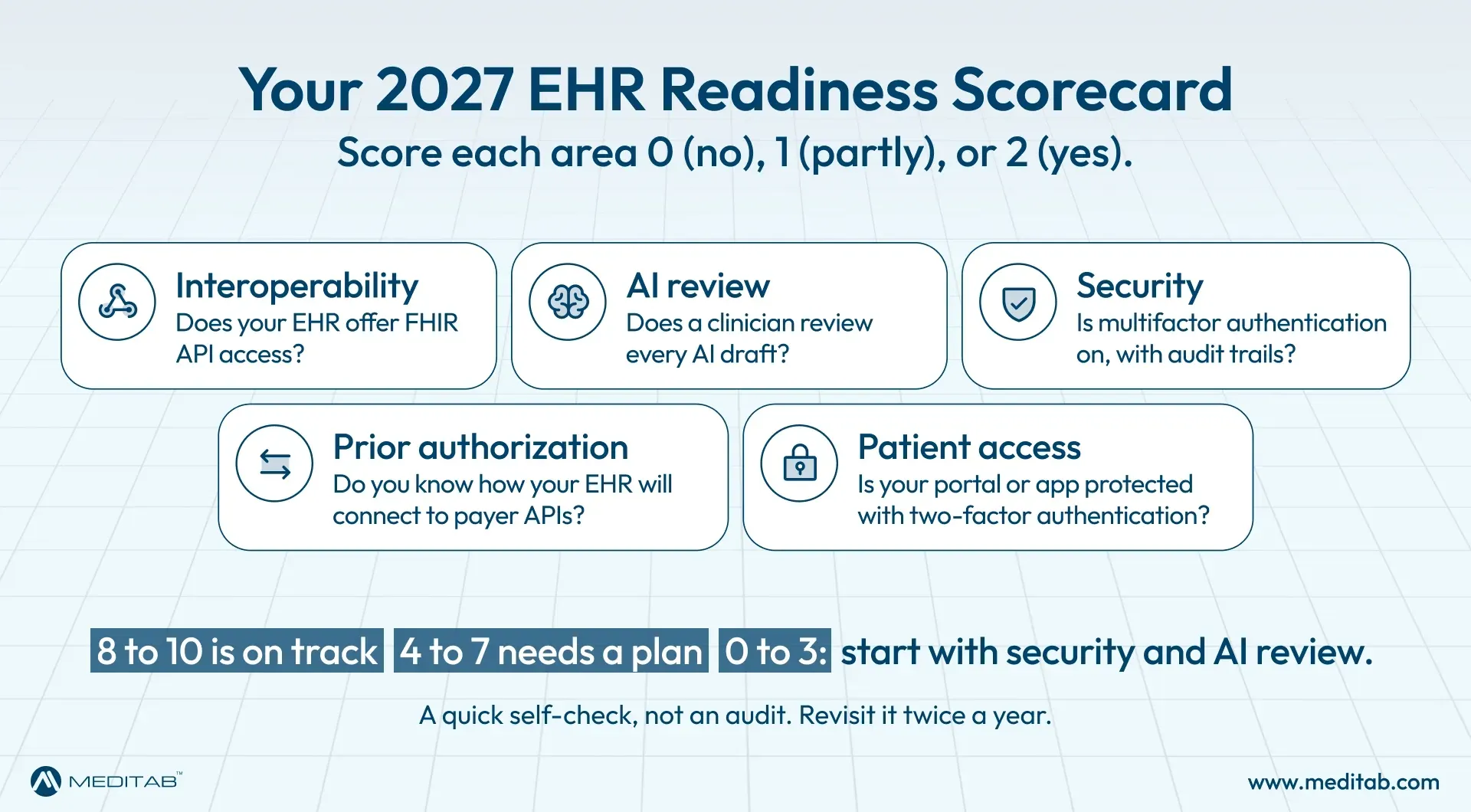
3. FHIR APIs move to the center
HTI-5, published October 26, 2026, removes 14 of 60 certification criteria and revises seven, steering certification toward FHIR-based APIs.
In plain terms, API access is becoming the standard way systems connect. Meditab IMS offers secure
FHIR APIs for third-party integrations, and
IMS Build 43 added FHIR enhancements.
4. Leaner certification puts AI vetting on you
The same rule eliminates HTI-1’s model card requirements for predictive decision support tools. Clinician groups warned that this shifts the work of vetting AI onto providers. Ask vendors how their AI was tested, what data it uses, and who reviews its output.
5. Electronic prior authorization gets real
Under CMS-0057-F, impacted payers must generally comply with the API requirements by January 1, 2027, including a FHIR-based Prior Authorization API. Payers do the building, but your EHR vendor’s plan for connecting to those APIs is worth a direct question. Prior authorization is a daily headache for many specialty practices, so even small workflow gains add up.
Meditab IMS also includes an AI assistant for clinical staff that offers template-based patient summaries and instant checks for pre-authorization requirements.
6. National exchange networks keep growing
TEFCA, the federal framework for nationwide health data exchange, keeps adding participants. For referral-heavy specialties, that can mean less fax chasing. Ask your vendor whether it connects to TEFCA, directly or through a network partner. Also ask how incoming external records land in the chart, because data that arrives but can’t be found quickly doesn’t help anyone.
7. Patients expect secure digital access
Patients want to check in, message, and view records from their phones. That raises the security bar, too.
IMS Care, the Meditab patient app and portal, has achieved and maintains two-factor authentication on web and app.
8. Telehealth settles into routine care
Virtual visits have become part of regular practice, though coverage rules still vary by payer. Keep video visits in the same chart as everything else.
Meditab IMS Televisit supports remote consultations, and the AI Scribe can generate notes during those visits as well.
9. Security becomes a daily habit
Multifactor authentication, role-based access, and audit trails are turning into baseline expectations. Choose an EHR that records who changed what, and when. Meditab IMS contains timestamps that show who entered a reminder note, and exactly when it was entered.
10. Specialty workflows beat generic templates
A one-size template rarely fits allergy, orthopedic, cosmetic, ophthalmology, or fertility workflows. Meditab IMS is tailored for 40+ specialties, and its fertility EHR includes AI-supported ovulation tracking and trigger-shot timing recommendations.
Where AI Fits in a Custom EHR (and Where It Shouldn’t)
A configurable EHR gives AI a better starting point. When templates and note formats reflect how your specialty works, drafts need fewer edits. Still, practices need clear boundaries for how AI-generated information is reviewed and used.
AI can draft notes, organize incoming information, and flag potential issues. Clinicians are the ones who decide on it, sign, and own the record. Meditab’s AI scribe guidance has the clinician review and edit documentation before it’s saved.
Before you roll out any AI tool, check three things:
- Who reviews AI output before it reaches the chart?
- Where does patient audio and data go, and who can access it?
- Does your state require patient consent to record visits?
What These Trends Mean for Your Strategy
Start with one pain point, not ten. If documentation chips away at your evenings, pilot an AI scribe with a single provider. If denials pile up, look at coding support first. If your schedule has gaps, no-show prediction may be the better first step. Set simple measures before you begin, such as time to close notes, no-show rate, or denial rate.
Then, involve the people who will use the tool. Providers, front-desk staff, billers, and your office manager, as each sees different problems. A short feedback huddle every week during the pilot will tell you more than any vendor brochure.
Expect some friction. Staff will need training, vendors will move at different speeds, and AI will occasionally get details wrong. Rules will keep changing, as well. ONC is already working on HTI-6, so more updates may follow.
That’s another reason to favor a vendor that provides regular updates, such as quarterly IMS builds offered by Meditab, over one that treats upgrades as a once-in-a-while event.
How to Future-Proof Your EHR Investment
Electronic Health Record trends shift fast, so build flexibility into every decision.
- Get the roadmap in writing. Ask about FHIR APIs, AI features, security updates, and regulatory support.
- Test integrations early. Ask for a demo of API access using your real workflows.
- Pilot before you scale. One provider, one workflow, a few weeks.
- Keep your data portable. Confirm export formats and exit terms.
- Budget for training, not just licenses. New tools only help when people actually use them.
- Review your setup at regular intervals. Software builds, payer rules, and federal requirements keep moving, so a quick check-in with your vendor keeps surprises small.
Plan for 2027 Smartly
You don’t need every new feature. You need an EHR that keeps documentation lighter, data connected, and security tight while the rules keep moving. Pick the two or three digital health trends that hit your biggest pain points and start there. If AI documentation tops your list, see how Meditab’s IMSGo and IMS Care handle your specialty.
A vendor that provides regular build updates with specific feature requests is usually the one you can safely ask for a demo, as Meditab IMS does. For specialized guidance or insight, we’re just a phone call away.
Curious how AI fits into a specialty EHR?
Frequently Asked Questions
What are the biggest EHR trends in 2027?
Ambient AI documentation, FHIR-based interoperability, electronic prior authorization, stronger security, and specialty-specific workflows lead the list. AI governance is the newest challenge, because some federal AI transparency requirements for certified EHRs were removed.
What does HTI-5 mean for my practice?
HTI-5 trims certification criteria for EHR developers and points the program toward FHIR APIs. You won’t file anything, but you may need to vet AI tools more closely.
Do prior authorization APIs affect small practices?
The CMS rule requires impacted payers to build them, primarily by January 1, 2027. Practices don’t build the APIs, but ask your EHR vendor how it plans to connect.
How can I future-proof my EHR?
Look for FHIR API support, a clear AI and security roadmap, specialty-specific workflows, portable data, and solid training. Then pilot new tools with one provider first.
Share this post: