Minimizing Medical Errors With AI-Powered EHR Software
Patient safety is the absolute cornerstone of independent clinical practice. In a fast-paced ambulatory care setting, a single misread handwritten note, an overlooked drug allergy, or an unlogged lab report can compromise patient health and expose an independent practice to severe legal liabilities. Across the United States, medical errors remain a critical systemic challenge that clinicians must actively combat. Reports explained ~10% of the variation in safety performance, and medication safety problems as they remain "unacceptably high" despite EHR optimization.
Fortunately, independent practices no longer have to rely on fragmented paper charts or legacy systems to protect their patients. Modern clinical technology serves as a powerful protective barrier against clinical oversights. This comprehensive guide details exactly how using
Meditab’s IMS, a robust, custom-tailored EHR system, helps reduce medical errors, streamline clinical documentation, and safeguard your clinical operations.
Understanding What Counts as Medical Errors
Medical errors are preventable adverse effects of care, whether or not they are evident or harmful to the patient. They are not just isolated events but often result from a complex interplay of system flaws, communication breakdowns, and human factors. Such errors can occur at any point in the care continuum, from diagnosis and treatment to prescribing and follow-up. For ambulatory practices, even a minor oversight can lead to significant consequences for a patient's health.
Common Medical Errors
Common medical errors occur in many forms, but several issues recur in ambulatory practices. These include:
- Incorrect medication or dose.
- Missed allergy warnings.
- Duplicate prescriptions.
- Incorrect patient chart selection.
- Incomplete or unclear documentation.
- Missed follow-up instructions.
- Care and communication gaps between staff members negatively impact patient health
Medication errors are especially important because they can immediately affect patient safety. Preventing medication errors requires more than staff awareness alone. Practices need tools that help catch mistakes before they reach the patient. That is where an EHR can make a major difference. When practices review medical errors in healthcare, medication issues often stand out because they are so common and preventable. Many teams are also beginning to enhance their documentation structure by utilizing alerts and access to patient data to reduce medical errors in daily operations
Various Ways EHRs Reduce Medical Errors
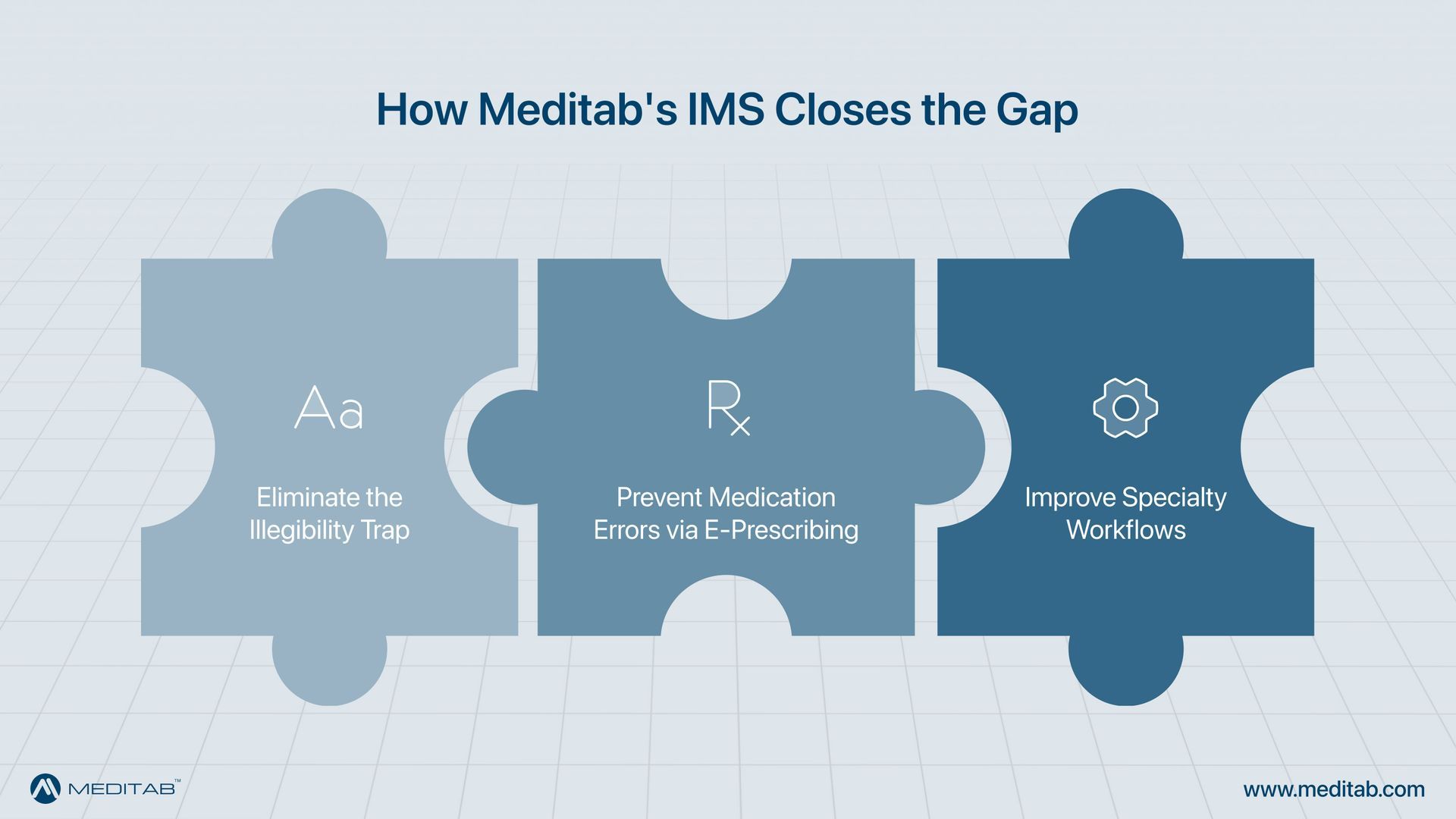
Upgrading from fragmented legacy tracking to a high-performance, unified platform changes how your ambulatory practice manages patient safety markers. EHR reduces medical errors daily in the following manner-
Eliminating the Illegibility Trap
By transitioning your clinical charting, pick-lists, and documentation macros into a structured digital framework, your team removes handwritten data errors. Every provider, medical assistant, and biller views identical, pristine text, ensuring flawless clarity across your entire organization.
Preventing Medication Errors via E-Prescribing
One of the most immediate ways EHR can reduce medical errors is through automated medication safety. Using an advanced
e-prescription solution introduces computerized provider order entry (CPOE) into your workflow. The platform cross-references the patient’s complete medical history with dynamic databases to instantly flag potential adverse reactions.
Improving Specialty Workflows
A specialized, adaptive platform ensures clinicians rarely miss mandatory diagnostic steps. To learn how to select and scale a platform built explicitly for complex multi-provider clinics, explore our comprehensive guide on
EHR software for organizations.
Minimize EHR Errors to Expand Your Practice
Fewer errors mean happier patients, smoother operations, and better reviews. That translates directly into growth. The clinics that master how EHRs reduce medical errors see:
- Lower malpractice risk
- Higher patient retention
- Stronger reputation in their community
- Easier growth and expansion
Reliable EHR software for clinical practices gives you the confidence to grow without increasing risks.
Advanced AI Integration in EHRs
The next evolution in patient safety comes from AI-powered systems. AI is transforming how EHR systems reduce medical errors by adding predictive and automated capabilities.
1. AI-Powered Clinical Insights
AI analyzes patient data to identify risks before they become errors. The AI model's predictive alert features flag high-risk conditions. In fact, AI enables pattern recognition in patient histories to identify subtle, high-dimensional correlations, detect disease early, prevent diagnostic errors, and personalize treatment plans.
2. Automated Documentation
AI-driven scribes listen to natural patient-provider clinical conversations and automatically draft accurate, highly structured encounter notes, eliminating manual transcription errors.
3. Smart Scheduling and Workflow Optimization
AI tools help analyze historical data to predict no-show risks. It triggers personalized, multi-channel reminders and enables automated rescheduling. This helps clinics identify at-risk patients, resolve logistical barriers, and proactively fill canceled slots to optimize appointment capacity efficiently through
patient engagement software.
4. Continuous Learning Systems
AI improves over time by continuously learning and evolving to adapt to your practice patterns and enhance accuracy. These advancements show how an EHR reduces medical errors not just reactively but proactively.
Conclusion
Preventing medical errors is a continuous process, not a one-time fix. While your EHR is a powerful tool, its effectiveness depends on proper implementation, regular configuration, and ongoing staff training. By embracing the safety features of
Meditab’s IMS, from ePrescription tools to clinical decision support, you create a safer environment for your patients and a more resilient practice.
FAQs
How does EHR reduce medical errors?
EHR systems reduce billing errors by improving documentation accuracy, providing clinical decision support, and automating workflows.
Why is a specialty-tailored EHR solution superior at preventing common medical errors?
Generic platforms feature rigid, one-size-fits-all layouts that force clinicians to skip fields or click through irrelevant screens, leading to documentation fatigue and oversights. A specialty-configured system mirrors your exact ambulatory clinical workflows, ensuring critical safety checkpoints, diagnostic logs, and screening protocols are naturally completed every single time.
How does e-prescribing reduce medication errors?
E-prescribing minimizes errors by using digital, legible orders that automatically check for drug interactions, allergies, and proper dosing at the point of care, reducing reliance on manual transcription and memory.
What are the most common medical errors in clinics?
Medication mistakes, documentation errors, and missed follow-ups are among the top issues in clinics.
How can EHR reduce medical errors in ambulatory practices?
EHRs streamline processes like ePrescribing, patient communication, and data management, minimizing human error.
Share this post: