Top EHR Software Companies for Ambulatory Practices in 2026

The healthcare landscape for ambulatory practices has transformed rapidly over the last few years. Operating an independent clinic or multi-specialty outpatient facility requires balancing high patient volumes, tight reimbursement cycles, and complex clinical documentation. Modern clinicians spend a substantial portion of their day tethered to screens, facing burnout from rigid, clunky user interfaces. According to reports, Primary care clinicians spend substantially more time on EHR activities, receiving
15 times as many medication-related messages, 5 times as many patient messages, and more than twice as many team-derived messages as their surgical peers.
In response, the electronic health records software companies leading the market in 2026 have shifted their focus toward intelligent automation, modular designs, and interoperability. Choosing the right partner means finding a platform that eliminates documentation fatigue while optimizing the clinic's financial performance. This comprehensive guide reviews the top EHR companies in 2026, explores how to run a rigorous vendor evaluation, and outlines what independent practices must look for to find their perfect software match.
Best Electronic Health Records Software Companies in 2026
Choosing the right Electronic Health Records (EHR) software company is one of the most important decisions for ambulatory practices in 2026. With growing regulatory demands, rising operational costs, and the need for better patient engagement, the EHR you select can significantly impact efficiency, revenue, and provider satisfaction.
1. Meditab (IMS)
Best For: Independent multi-specialty and single-specialty ambulatory practices looking to eliminate rigid software constraints through tailored
AI-powered EHR.
Key Features:
- Specialty-specific workflows adaptable to your practice
- AI-powered documentation that minimizes manual charting time
- Real-time data exchange across labs, pharmacies, and third-party systems
- Structured onboarding with dedicated training and hands-on implementation support
- Integrated e-prescribing (IMS Hub Rx) for error-free prescriptions
- An ONC-certified platform ensuring standardized interoperability and compliance
- HIPAA-compliant infrastructure with robust data security and audit controls
- Patient portal that enables communication, scheduling, and engagement in one place
- Built-in billing and revenue cycle workflows to streamline claims, payments, and collections
Why Choose Meditab
Meditab’s IMS is one of the best electronic health records software companies. Backed by 27+ years of clinical innovation, it treats your EHR as a dynamic, highly responsive extension of your practice's physical workflow. Meditab enables prioritizing granular customization, intuitive layout mechanics, and dedicated, localized client care. This benefits clinics to optimize their unique operations, protect clean claim rates, and successfully reclaim valuable clinical hours.
2. PrognoCIS
PrognoCIS by Bizmatics is a scalable, cloud-based platform popular among mid-sized to large independent practices. Known for its extensive customization options and multi-specialty templates, PrognoCIS has invested heavily in its native AI architecture, PrognoAI. This technology includes built-in ambient listening tools that serve as automated medical scribes, drafting clinical notes directly from natural patient-provider conversations.
The platform also offers reliable practice management and medical credentialing options to support organizations as they scale.
3. Praxis EMR
Praxis has always been the “thinking different” choice. It uses artificial intelligence to learn your practice patterns. The more you use it, the faster it gets. For physicians tired of template-driven nightmares, Praxis remains a top contender among EHR companies this year.
4. eClinicalWorks
A widely recognized name among EMR EHR companies, eClinicalWorks offers strong population health tools, telehealth capabilities, and AI-driven documentation. It is best for multi-provider ambulatory clinics focused on data-driven care.
5. Athenahealth
Best For: Mid-sized ambulatory practices wanting cloud-based EHR + RCM.
Key Features:
- Cloud-native platform
- Built-in billing and claims management
- Network-wide data insights
- Strong mobile app
Limitations
As one of the electronic health records software companies, it offers less customization than Meditab and others. It can also be costly for solo practices.
6. Epic (EHR in Practice)
Best For: Large physician groups and health systems with complex interoperability needs.
Key Features:
- Enterprise-grade scalability
- Strong patient portal (MyChart)
- Extensive specialty templates
- Robust HIE (Health Information Exchange) capabilities
Limitations
High cost, long implementation time, and less ideal for small independent practices.
7. AdvancedMD
AdvancedMD combines EHR, billing, and practice management into a single platform. It’s particularly strong in financial analytics and workflow automation.
Best for:
Practices prioritizing revenue cycle visibility.
8. Elation Health
Elation Health is built specifically for independent primary care, family medicine, and Direct Primary Care (DPC) clinics. It features a clean, highly intuitive user interface that prioritizes the clinical encounter over complex administrative data entry. Boasting a massive ecosystem of over 300 third-party integrations, Elation is an excellent choice for lean ambulatory clinics looking for a fast learning curve and straightforward charting capabilities.
9. Advaa Health
Advaa focuses heavily on behavioral health and smaller ambulatory teams. Their 2026 release includes improved patient engagement tools and a cleaner telehealth module. A solid choice if your practice is mental-health focused.
10. NextGen Healthcare
NextGen is a strong EHR integration company with deep customization options for specialty practices.
Best for:
Specialty-focused ambulatory clinics.
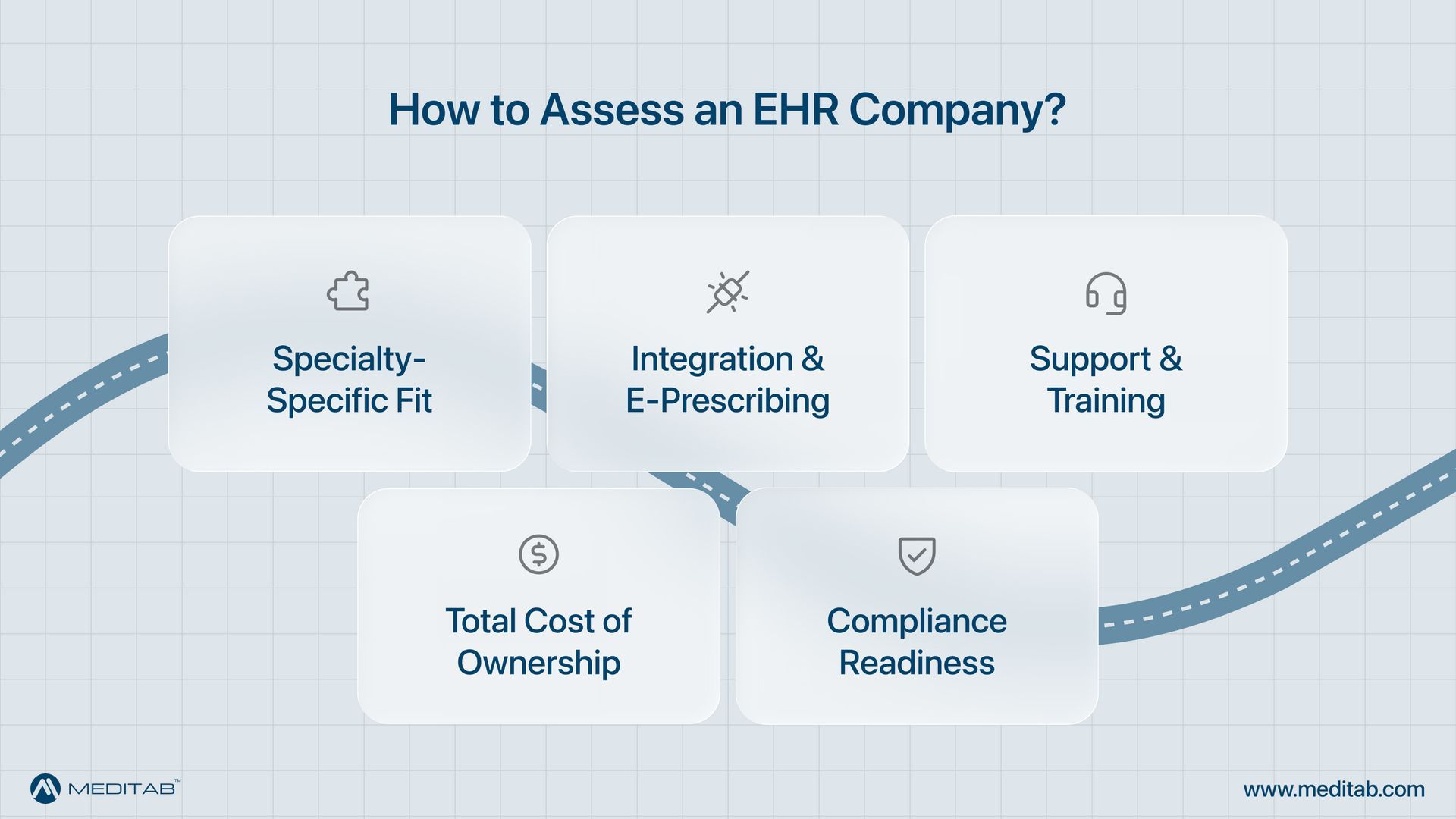
How to Conduct an Effective EHR Company Assessment
Evaluating top EHR companies requires more than watching a demo. Use this structured approach:
- Assess Specialty Fit :
Does the system offer templates and workflows specific to your specialty? - Review Integration Capabilities :
Strong medical billing integration and e-prescribing solutions are essential. - Examine Support and Training :
How responsive is the vendor during implementation and ongoing use? - Analyze Total Cost :
Look beyond the sticker price. Consider implementation, training, and maintenance costs. Learn more about EHR costs in 2026. - Check Compliance Readiness:
Ensure the platform supports current regulatory requirements.
How to Know Which EHR Software Best Fits Your Practice
Even among the best electronic health records software companies, the “best” choice depends on your practice’s unique needs. Ask these key questions:
1. Does it match your workflow?
Your EHR should adapt to your practice, not the other way around.
2. Is it scalable?
As your practice grows, your system should grow with you.
3. How user-friendly is it?
A complicated system leads to staff burnout and inefficiency.
4. Does it support patient engagement?
Tools like patient portal software improve communication, appointment scheduling, and satisfaction.
5. Does it streamline prescriptions?
Integrated tools, such as e-prescribing solutions, reduce errors and save time.
TL;DR
Finding the best electronic health records software companies in 2026 doesn’t have to feel like a second job. Focus on ambulatory-first vendors like
Meditab, Praxis, and Advaa. Run a ruthless assessment. Match the software to your practice, not the other way around. And remember: the perfect EHR won’t fix bad workflows. But the right one will make your good workflows effortless. Your patients deserve your attention, not your frustration with software. Go find the EHR that gives you back your time.
FAQs
What is the main difference between an EHR and an EMR?
EMR (Electronic Medical Record) is typically a digital version of a single practice’s charts. EHR (Electronic Health Record) is designed to share information across different providers. Most EMR EHR companies now offer hybrid solutions for ambulatory practices.
What are the best Electronic Health Records (EHR) software companies in 2026?
Some of the top EHR companies for ambulatory practices include Meditab (IMS), eClinicalWorks, athenahealth, NextGen, and Elation Health. Meditab stands out for its strong specialty focus, seamless medical billing integration, and excellent support tailored to independent practices.
What is the best EHR for small ambulatory practices?
For small outpatient clinics, Meditab IMS and Practice Fusion offer affordability, ease of use, and good customization.
How do I choose the right EHR software company?
Focus on your specialty needs, practice size, billing requirements, and budget. Evaluate usability, integration capabilities, customer support, and total cost of ownership. Our guide on EHR selection tips can help you make an informed decision.
How long does a typical ambulatory EHR implementation take?
For small to mid-sized outpatient practices, a standard implementation timeline ranges from 2 to 4 months. This duration accounts for workflow mapping, data migration from legacy software, system integrations, and staff training.
Share this post: