The Ultimate EHR Cost Guide for 2026
In the rapidly evolving landscape of healthcare technology, one question dominates the minds of practice administrators, physicians, and CFOs alike: What is the actual cost of EHR software in 2026? If you have recently started reevaluating your existing Electronic Health Record (EHR), you know that getting a straight answer on price is like pulling teeth. Vendors often advertise a low "per-provider" fee, only to bury the real expenses in the fine print.
Software Finder suggests that entry-level EHR solutions for solo practitioners typically start around $300/month. At the same time, larger practices and health systems can expect to pay considerably more for advanced, enterprise-grade platforms. At
Meditab, we believe in transparency. As the manufacturers of Intelligent Medical Software (IMS), we have helped thousands of practices navigate this journey. This guide will dissect the EHR implementation cost breakdown, uncover hidden fees, and show you how to maximize your EHR investment without breaking the bank.
Understanding EHR Cost Components
As we navigate 2026, the market is shifting toward AI-driven automation, but that innovation comes with a complex pricing structure. For a solo practitioner looking for the cheapest EHR software for neurology in 2026 or a multi-specialty clinic seeking enterprise-grade solutions, understanding the Total Cost of Ownership (TCO) is critical.
When evaluating the cost of EHR software, it is important to look beyond the initial sticker price. A true EHR investment comprises two phases: upfront acquisition and long-term sustainability. The cost of EHR systems generally includes software licensing, hardware upgrades, data migration, staff training, and go-live assistance, either at your elbow or remotely.
Factors Influencing EHR Costs
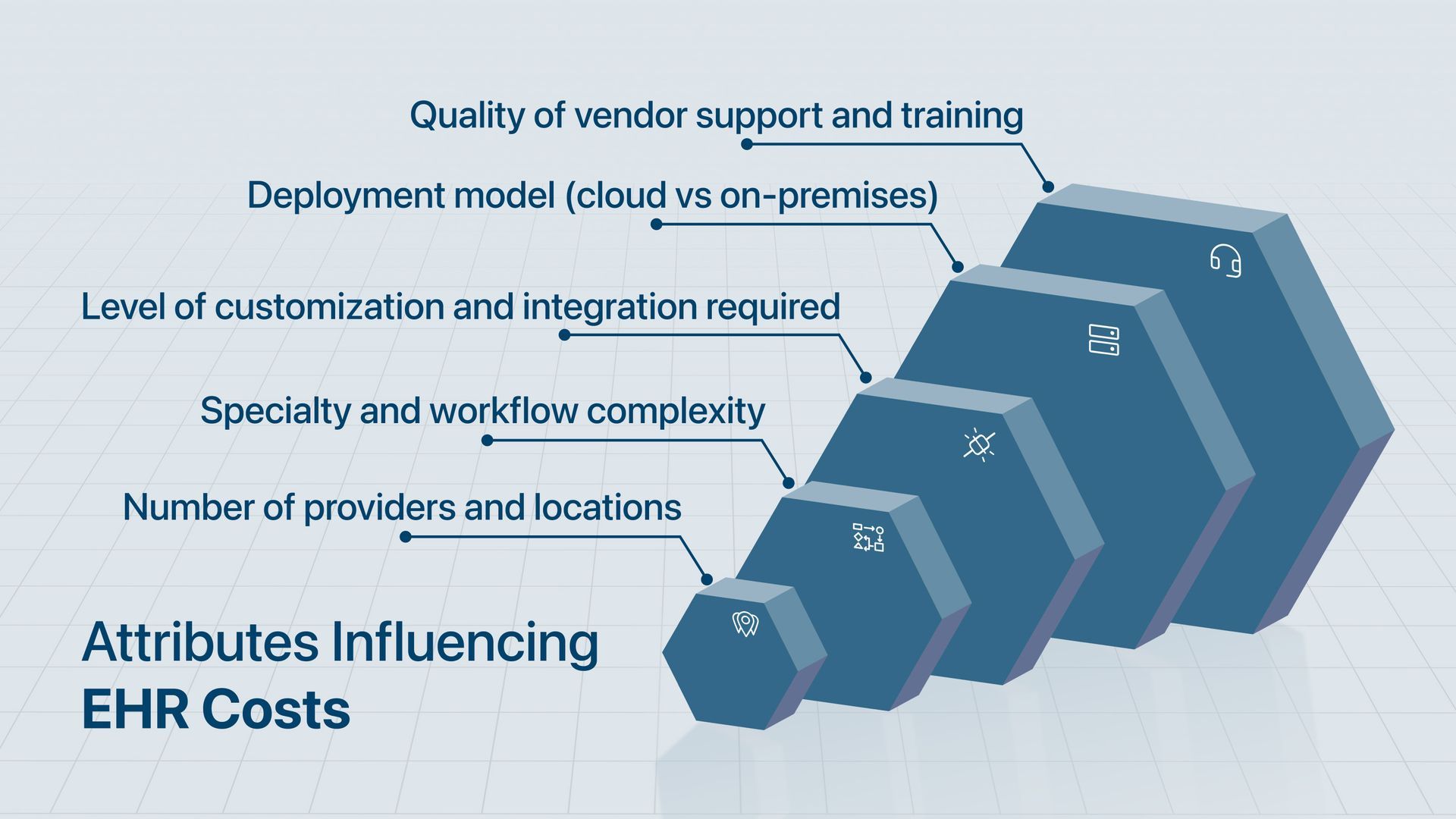
Industry reports depict that 9 in 10 U.S. office-based physicians used an EMR/EHR system in 2021. However, choosing the most effective EHR is not a "one-size-fits-all" financial commitment. Because every practice faces unique clinical demands and patient volumes, your final EHR software cost will vary based on your organization's infrastructure and operational depth. Understanding these variables, from the physical scale of your practice to the technical intricacies of your specialty, is essential for building an accurate budget and avoiding unexpected expenditures during implementation. Your final EHR software cost will depend on:
- Number of providers and locations
- Specialty and workflow complexity
- Deployment model (cloud vs premises)
- Level of customization and integration required
- Quality of vendor support and training
EHR Pricing Models Explained
CDC observed that 88.2% of U.S. office-based physicians used an EHR system in 2021, and 77.8% had a certified EHR. As for EHR vendors, they typically offer two pricing structures:
1. Subscription-Based (Cloud-Based EHR Software)
- Monthly or annual fee per provider
- Lower upfront investment
- Includes updates and maintenance
2. One-Time License (On-Premises EHR System)
- High upfront cost
- Additional expenses for upgrades and support
Most practices today prefer cloud-based models due to lower EHR costs and greater scalability.
EHR Costs by Practice Size
The EHR costs for a small practice look very different from those of a large practice. Here is the breakdown for 2026:
Solo and Small Practices
- Definition: 1-5 providers.
- Number of Locations Impact: High impact. While cloud-based SaaS reduces per-location IT costs, on-site go-live fees multiply by the number of locations. A solo practice with 3 locations will pay significantly more for deployment (multiple team members traveling/training) than a single-location solo practice, even with the same number of providers.
- Typical Cost: $15,000 – $30,000 in Year 1.
- Strategy: These practices benefit most from Cloud-based SaaS to avoid IT staff costs. Look for bundled solutions (EHR + PM + Billing). The cheapest EHR software options may start at $199/month, but ensure they include e-prescribing and patient engagement tools.
Medium Practices
- Definition: 6-25 providers.
- Number of Locations Impact: Moderate to high impact. With 6–25 providers spread across multiple sites, on-site go-lives require deploying multiple team members for each location. Pricing increases linearly with each additional location due to travel, lodging, and on-site trainer costs.
- Typical Cost: $40,000 – $150,000 in Year 1.
- Strategy: Focus on integration. You need robust reporting and revenue cycle management (RCM). At this size, investing in specialty-specific templates (like for Allergy or Orthopedics) saves money long-term by reducing documentation time.
Large Practices and Health Systems
- Definition: 26+ providers.
- Number of Locations Impact: Very high impact. Large systems often have 10+ locations. Each location adds on-site go-live costs (multiple team members deployed per site). Enterprise deployments may require staggered go-lives, with location-based fees for project management, travel, and extended support.
- Typical Cost: $100,000 – $500,000+ in Year 1.
- Strategy: Large systems often prefer on-premises or hybrid deployments for data control. Total cost of ownership over 5 years can exceed $1 million, but the ROI comes from population health management and economies of scale.
Specialty-Specific Cost Considerations
A general practice EMR won't work for a surgeon or a psychiatrist. Specialty-specific cost considerations include:
- Fertility (IVF & REI): Requires high-cost integrations for Stimsheet management, embryology lab interfaces, and sophisticated DICOM loop tags for multiple pregnancy tracking.
- Ophthalmology: Demands specialized device integration (OCTs, visual fields) and drawing tools for anatomical eye mapping, which often require higher hardware performance.
- Cosmetic & Plastic Surgery: Prioritizes robust before-and-after photo management, HIPAA-compliant image storage, and complex inventory tracking for neurotoxins and fillers.
- Dental: Necessitates 3D charting, periodontal mapping, and specific dental imaging (PACS) integrations that are vastly different from standard medical coding.
- Rheumatology: Requires complex infusion documentation.
- Orthopedics: Needs robust imaging and E&M coding tools.
- Allergy/Immunology: Demands specific environmental and reaction tracking.
Trends show that EHR adoption in behavioral health is gradually expanding, though fewer than 25% of facilities report using EHR exclusively. Meditab’s IMS supports 40+ specialties, meaning you don't pay for "custom development" of templates; they are built-in.
Key Barriers to EHR Adoption Related to Cost
The most frequently cited barriers to EHR adoption remain cost-related:
- Initial implementation cost is the primary barrier for many organizations
- Ongoing maintenance and operational costs are often underestimated during planning
- Technical support expenses are critical for sustained system performance
- Staff training costs are necessary for effective utilization
- Policy makers have recognized cost as a significant deterrent, particularly for FQHC clinics in rural areas, which often have lower adoption rates due to financial constraints.
EHR Cost-Benefit Analysis
Spending money on an EHR system is easy to justify when the sticker price is the only number in the room. The real test is whether that investment pays back and by how much. The U.S. EHR market is projected to grow at a
CAGR of 2.55% from 2025 to 2030, indicating that providers aren't just buying software. They're betting on measurable returns. Here's how to run that math for your own practice.
ROI Calculation Methodology
ROI = (Financial Gains – Total EHR Costs) ÷ Total Costs
Quantifiable Benefits
- Faster reimbursements
- Reduced billing errors
- Improved operational efficiency
Intangible Benefits Valuation
- Better patient satisfaction
- Improved care coordination
- Enhanced provider experience
Strategies to Reduce EHR Implementation Costs
Today, as practices face rising subscription fees and unexpected integration expenses, reducing the total cost of EHR implementation requires strategic planning rather than simply choosing the lowest-priced vendor. The following proven strategies can help you lower your EHR implementation cost without sacrificing functionality or patient care quality.
- Prioritize "Must-Haves" vs. "Nice-to-Haves": Start with core clinical and billing functions. Add advanced analytics or patient engagement tools in Year 2.
- Negotiate Multi-Year Contracts: Vendors are more likely to waive implementation fees if you sign a 3-5 year deal.
- Leverage Training Resources: Use the vendor's train-the-trainer model to build internal expertise rather than paying for expensive on-site consultants for weeks at a time.
Selecting the Right EHR Solution Within Your Budget
When comparing EHR system costs, look at the value for money ratio. Meditab's Intelligent Medical Software (IMS) is consistently rated highly for features relative to cost. IMS offers:
- A designated team focused on your success and adaptation from setup to go live, and everything in between.
- Specialty-specific templates (Allergy, Orthopedics, Pain Management, etc.).
- Integrated Telehealth and Patient Portal.
- e-Prescribing (EPCS) and Lab Integration.
- Cloud or On-Premise deployment.
Pro Tip: Use an
EHR Checklist before signing a contract. Ask specifically about data extraction fees (what happens if you leave?) and training caps.
In a Nutshell
EHR software costs in 2026 are not a single number. It's a financial commitment that spans software, infrastructure, implementation, training, ongoing maintenance, and the productivity impact of transitioning a clinical workflow. Practices that take a complete picture of all those components into consideration make better decisions, negotiate smarter contracts, and get more value from their EHR investment. The questions to ask aren't just "how much does it cost?" but "what am I getting for that cost, and will it still be the right fit in five years?"
A system that costs 20% more upfront but reduces billing errors, fits your specialty workflows, and comes with a dedicated implementation team behind it is almost always a better EHR investment than the bargain that creates three years of workarounds.
At Meditab, we've been helping practices navigate this decision for 27+ years. We're happy to show you exactly what IMS costs for your practice and what it could be worth to you.
Modernize your practice without the hidden fees, but with a transparent quote for your specialty.
Frequently Asked Questions (FAQs)
What is the average EHR cost in 2026?
On average, excluding initial setup, a cloud-based EHR can cost between $3,000 and $10,000 per provider, annually.
What is the average EHR implementation cost for a small practice?
EHR implementation cost includes software licensing or setup fees, data migration from legacy systems, integration with labs and billing platforms, hardware purchases, staff training, and professional services. Practices commonly underestimate implementation costs by 20% to 30%.
What is the cheapest EHR software for small practices?
Cloud-based solutions with predictable subscription pricing are usually the most affordable for small practices.
What is the EHR maintenance cost?
Typically includes support, updates, and hosting fees.
What is the most expensive part of EHR implementation?
Usually, it involves data migration, interface development, and a temporary loss of productivity during the go-live phase. Data migration involves moving years of historical patient records from legacy systems into the new platform — a process that becomes significantly more expensive the messier or more complex the source data is. Interface development — building the connections between your EHR and external systems such as labs, pharmacies, imaging centers, and billing platforms — adds costs that many practices underestimate at the outset, with each interface ranging from $1,000 to $20,000 depending on complexity. And then there's the go-live productivity dip: providers who normally see 20 patients a day may see only 14 to 16 in the first few weeks of transition, creating a revenue impact that, while temporary, is very real. Together, these three factors are responsible for the bulk of unplanned EHR implementation costs.
Does Meditab charge hidden fees for integration?
Meditab focuses on transparent pricing. While complex third-party integrations may have associated costs, our Intelligent Medical Software (IMS) is designed with an open API to minimize integration headaches and unexpected "integration nightmare" fees.
What are the hidden costs of EHR implementation?
Common hidden costs include productivity loss during transition (10% to 20% reduction in patient volume for 30 to 90 days), data migration complexity charges, third-party integration fees, compliance and security upgrades, and ongoing staff retraining as the system and regulations evolve.
How much does EHR cost for a small practice?
EHR costs for a small practice of 1 to 3 providers typically range from $300 to $1,500 per month for cloud-based solutions. First-year all-in implementation costs, including setup and training, typically range from $15,000 to $40,000, depending on complexity and the scope of data migration.
Does Meditab offer flexible pricing?
Yes, Meditab provides transparent, scalable pricing tailored to your practice size and needs.
What is the best option for small practices?
Cloud-based systems offer the lowest EHR cost for a small practice.
Are there free EHR systems?
Yes, but they often come with hidden costs, such as ad-supported interfaces, limited data security, or high fees for data exporting.
How can I reduce EHR maintenance costs?
Opt for a cloud-based subscription model where EHR maintenance costs are bundled into the monthly fee. Also, regular internal audits to deactivate unused user licenses can lower your annual bill.
What is the difference between EHR cost and EMR cost?
EMR (Electronic Medical Records) software is generally less feature-rich and designed for use within a single practice. EHR systems are designed for interoperability and broader data sharing. EHR software costs tend to be higher due to greater functionality, integration capabilities, and compliance requirements.
How can practices reduce EHR implementation costs?
Negotiate training and migration costs as part of the total package. Clean your legacy data before migration begins. Use vendor-provided training resources. And ask specific questions about what's included versus what triggers additional billing before you sign.
How long does it take to see ROI on EHR investment?
Most practices see positive ROI within 12–24 months when the system is properly implemented and adopted.
Share this post: