How to Solve the Most Frequent Reimbursement Challenges in Healthcare

Every medical practice owner knows the feeling of a job well done after a successful patient visit. However, that satisfaction often fades when the focus shifts to the back office. The complexity of modern billing means that providing excellent care is only half the battle.
Securing payment through a complex healthcare reimbursement process is an entirely different challenge. The Centers for Medicare & Medicaid Services reported a 6.55% improper payment rate in Medicare Fee-for-Service in FY 2025, nearly $29 billion, underscoring how billing complexity can impact practice revenue.
In today’s landscape, revenue cycle management in healthcare has become a high-stakes balancing act. Between shifting regulations and the administrative burden of different healthcare reimbursement models, many practices struggle with cash flow.
When claims are denied or delayed, it isn't just a clerical error; it is a sign of underlying reimbursement issues that threaten a practice’s sustainability and its ability to invest in better patient solutions.
By identifying where the bottlenecks occur, you can transform your healthcare reimbursement cycle from a source of stress into a streamlined engine for growth.
Reimbursements made smooth
Understanding Reimbursement Hurdles in Healthcare
The path from seeing a patient to receiving a final payment is rarely a straight line. It involves a complex web of coding, payer rules, and documentation requirements. Most healthcare reimbursement issues occur when this process breaks down, usually resulting in denied claims, partial payments, or significant delays.
Most practices deal with a mix of
Fee-for-Service and value-based healthcare reimbursement models. Each has its own set of rules. While Fee-for-Service requires meticulous documentation of every single action, value-based models demand proof of outcomes. This duality often creates a "documentation fatigue" that leads to the very errors that trigger denials.
The Hidden Challenges of Healthcare Reimbursement
The impact of billing friction goes beyond the bank account. When a claim is rejected, it often leads to a ripple effect throughout the office. Staff members spend hours on the phone with payers, diverting their attention from patient care.
Furthermore, a poorly managed healthcare reimbursement cycle can damage the provider-patient relationship. If a claim is denied due to an administrative error, the patient may receive an unexpected bill. This creates confusion and frustration, ultimately lowering patient engagement and trust. A practice that struggles with its finances often finds it harder to implement the latest health care solutions, creating a cycle of stagnation.
Common Causes of Healthcare Reimbursement Challenges
Understanding why claims get stuck is the first step toward fixing them. Most reimbursement issues stem from a few predictable areas:
1. Inaccurate Patient Information
Simple data entry errors, such as misspelled names or incorrect insurance IDs, are leading causes of initial denials.
2. Lack of Eligibility Verification
If a practice fails to confirm that a patient’s insurance is active before the visit, the healthcare reimbursement process fails before it even begins.
3. Coding Complexity
With thousands of ICD-10 and CPT codes, it’s not uncommon to mistakenly select a code that doesn't quite match the clinical documentation.
4. Missing Prior Authorizations
Many payers now require "permission" before certain procedures. If this isn't documented upfront, the claim is almost guaranteed to be rejected.
5. Timely Filing Limits
Every payer has a window for claim submission. If the back-office workflow is slow, those windows can close, making the revenue unrecoverable.
Strategies to Resolve Healthcare Reimbursement Issues
Fixing a broken healthcare reimbursement cycle requires a combination of better technology and smarter workflows.
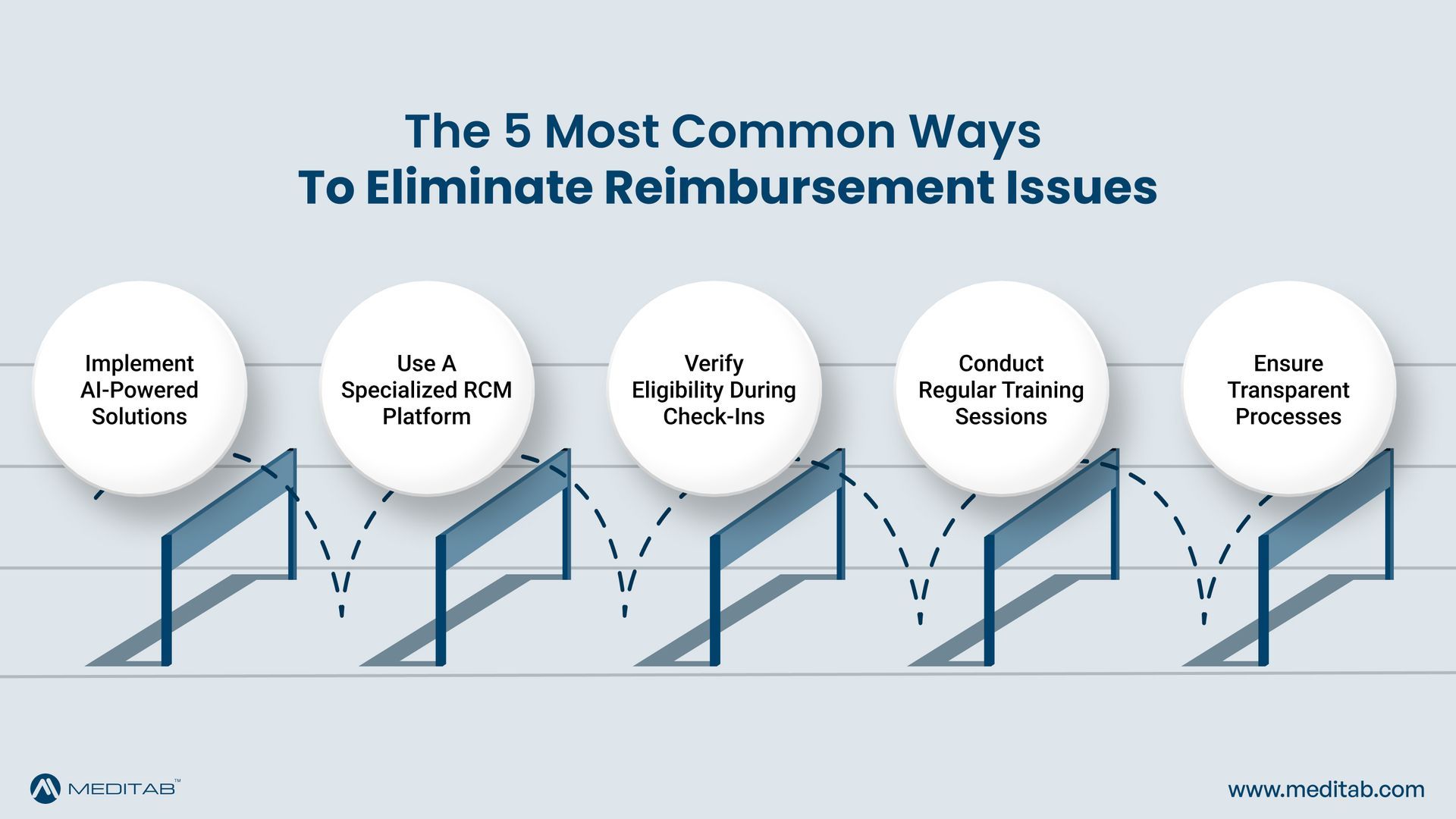
1. Leverage AI and Automation
The introduction of AI in healthcare has revolutionized the back office. Modern software can now "scrub" claims before they are sent, catching potential errors that a human might miss.
2. Prioritize Eligibility at Check-In
The most effective way to improve the healthcare reimbursement process is to verify insurance before the patient ever sees the doctor.
Automated tools can check eligibility in real-time during scheduling.
3. Invest in Specialized Medical Revenue Cycle Management
Sometimes, the best solution is to use a platform that integrates clinical and financial data seamlessly. When your EHR and billing software speak the same language, the risk of "lost" data decreases. Using a comprehensive system like
Meditab’s IMS helps ensure that every clinical action is captured and coded correctly.
4. Continuous Staff Training
Payer rules change constantly. Regular training sessions for your billing team on the nuances of different healthcare reimbursement models can prevent recurring errors and improve your clean-claim rate.
5. Enhance Transparency for Patients
To maintain high levels of patient engagement, be upfront about costs. When patients understand their financial responsibility early on, they are more likely to pay their portion on time, reducing the burden on your collection efforts.
Conclusion
Healthcare reimbursement challenges are a reality for nearly every medical practice, but they do not have to be a permanent obstacle. By identifying the root causes of denials and implementing modern healthcare solutions, you can protect your practice’s financial health. Whether through the adoption of AI or a more rigorous approach to the reimbursement cycle, the goal remains the same: ensuring you are paid fairly and promptly for the essential care you provide.
Boost Your Revenue Today
Frequently Asked Questions
Why is revenue cycle management so difficult for small practices?
Small practices often lack the dedicated billing staff that large enterprises have. This means clinical staff are often multitasking, leading to more errors in medical revenue cycle management.
How can AI help with my practice’s billing?
The use of AI in healthcare allows for automated claim scrubbing, predictive denial analysis, and faster eligibility checks, all of which reduce the manual workload on your team.
Does a high denial rate impact patient care?
Yes. High denial rates lead to financial instability, which may limit a practice's ability to hire staff or purchase new medical equipment. It can also hurt patient engagement if billing disputes arise.
How often should we review our billing performance?
Practices should ideally review their healthcare revenue cycle metrics monthly. Key indicators to watch include your clean claim rate, days in accounts receivable (AR), and denial rate.
Share this post: