Reduce Patient No-Shows With AI: 6 Strategies That Fit Your Workflow

Sending more reminders isn’t solving the no-show problem for many practices. A poll found that 32% of medical groups reported higher no-show rates, and only 10% saw rates decrease compared to 2025. Even those using reminders, confirmation calls, and no-show fees saw rates rise. While reminders help some forgetful patients, they don't address all barriers to attendance.
AI-based risk scores can help staff identify appointments that need earlier outreach or alternative scheduling options. This guide discusses the causes of missed visits, how AI can integrate into scheduling workflows, and six strategies for improving no-show rates in your practice.
What Causes Patient No-Shows?
Forgetting appointments is common, but it often isn’t the whole story. Leaders noted that rising patient costs, economic pressures, transportation issues, work conflicts, and weather
contributed to missed visits. Even with additional reminders, some couldn’t pinpoint specific causes. Higher deductibles and coverage changes can deter patients from seeking care, leading to postponed appointments.
Timing also plays a crucial role. A study found that
longer lead times between booking and visits increased the likelihood of no-shows, especially for appointments scheduled over 60 days in advance.
Additionally, cancellation friction can lead to missed appointments; if patients have to wait on hold, they may not cancel. Simplifying the cancellation process through text or patient portals can help save slots that would otherwise be lost.
How AI Can Help Reduce Missed Appointments
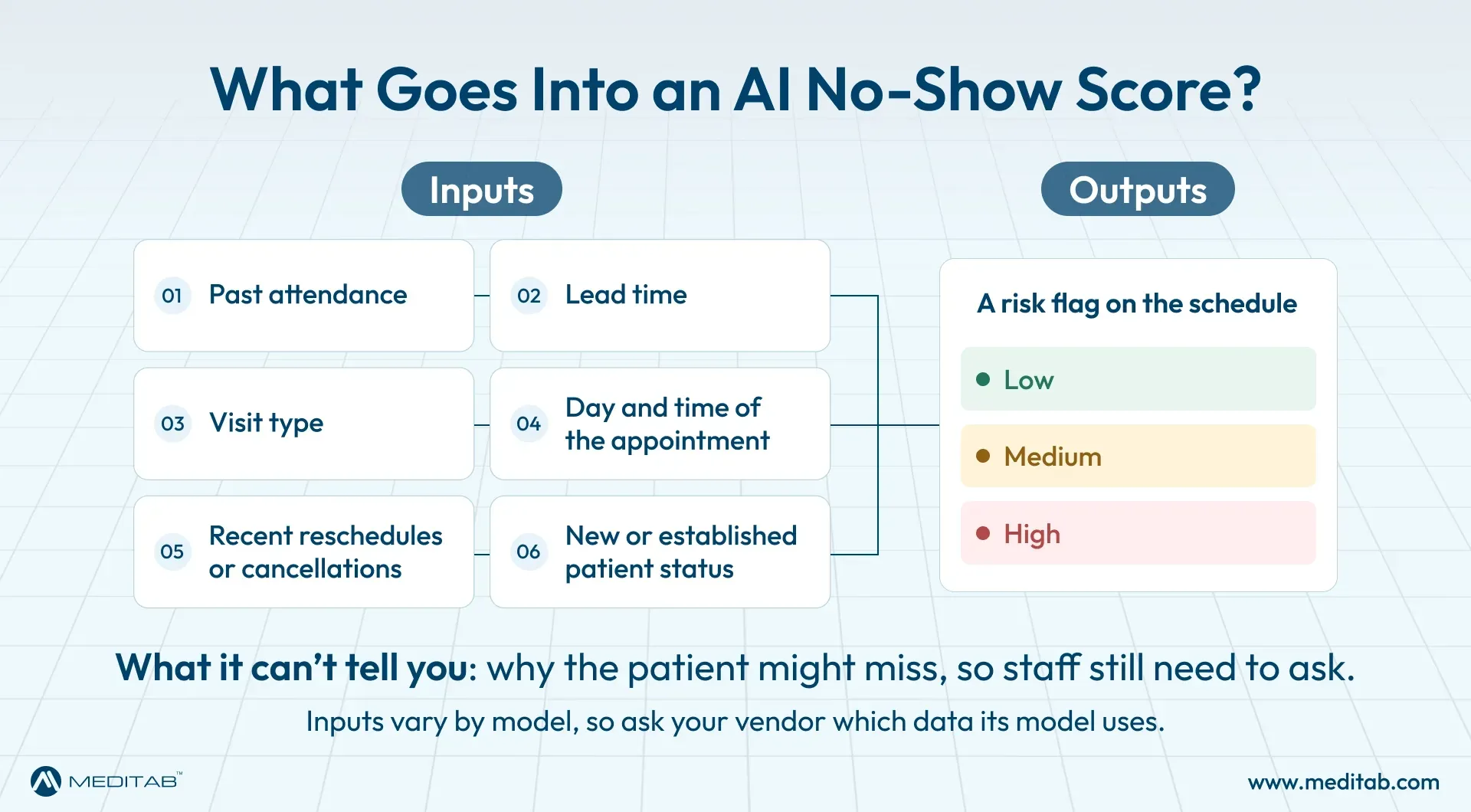
Standard reminder systems operate on a fixed schedule, while AI appointment management can use appointment-specific risk estimates to help staff prioritize outreach. AI no-show prediction models analyze historical scheduling patterns to estimate the likelihood that a patient will miss an appointment.
Research indicates promising results, with the top model achieving an AUROC (a measure of predictive performance, where 1.0 is perfect) of
0.85 for no-shows and 0.92 for late cancellations. However, prediction alone isn’t enough. Studies show that identifying likely no-shows requires not only robust models but also effective patient outreach. Risk scores should be visible during scheduling to prompt appropriate action.
In
Meditab IMS, the no-show prediction feature displays likelihood scores in the scheduling view. This enables teams to prioritize outreach, strategically double-book, fill at-risk slots, and minimize potential revenue loss.
6 AI-Driven Strategies to Reduce Patient No-Shows
A patient no-show can happen for different reasons, so the response needs to depend on the situation. Here are six ways your staff can address potential no-shows at different stages of the scheduling process.
1. Flag Risk at the Moment of Booking
Capture and address risk factors while the patient is actively engaged on the phone or logged in on your portal. When a scheduler sees a high score, they can offer an earlier date, confirm the best callback number, and ask whether work hours, childcare, or transportation might get in the way.
Note any barriers in the chart so the next person who contacts the patient has context. Use the booking conversation to identify potential barriers early enough to offer a workable appointment.
2. Scale Outreach to the Level of Risk
Low-risk patients usually need one well-timed reminder. High-risk patients may need more touchpoints, sent earlier and across more channels. With
IMS InTouch, you can send text and email reminders tied to the visit type and receive patient responses in Meditab IMS in real time, so staff can see patient responses and identify appointments that need additional follow-up.
Meditab IMS also offers AI-powered patient confirmation, which automatically calls patients to confirm upcoming appointments and updates the status in the system. That lets staff dedicate their time to calls requiring personal attention. Whatever channel you use, let patients confirm, cancel, or reschedule without picking up the phone.
3. Shorten the Wait Time for Patients Most Likely to Miss
Longer gaps between appointment lead times are associated with a higher risk of missed appointments. Consider offering high-risk patients the nearest suitable appointment. Keep a waitlist of patients who want to come in sooner, release held slots on a set schedule, and protect some same-day or next-day capacity where demand supports it.
Risk scores can help identify appointments for which additional scheduling flexibility may be useful. Use double-booking selectively, based on your practice's historical attendance data and available capacity, and monitor how often both patients arrive.
4. Bring Cost and Coverage Questions Forward
When a patient is concerned about the cost of a visit, another reminder won't resolve the underlying issue. Verify coverage days in advance, provide cost estimates when you can, and guide patients on payment contacts before check-in. AI can take some of the legwork out of that.
Meditab IMS includes insurance eligibility verification to help staff check coverage before appointments. Its AI assistant for clinical staff can also provide patient summaries and check pre-authorization requirements. These checks help identify coverage and authorization issues early, although patients may still need a separate cost estimate and information about payment options.
5. Offer a Virtual Visit When Getting There Is the Barrier
For follow-ups that can be handled remotely, offering a televisit may remove transportation or work-schedule barriers that could otherwise prevent a patient from attending. Make the option available when clinically appropriate and permitted by applicable coverage requirements. This is especially useful when transportation, gas prices, or work schedules are the obstacle.
Ambient AI Scribe in Meditab IMS supports both in-person encounters and telehealth visits, generating transcripts and structured summaries to help providers document virtual consultations. Clinicians can review and edit the resulting notes before saving them.
Meditab IMS also gives practices the flexibility to choose from top AI scribe options on the market, such as Nabla, Suki, and Medora.
6. Move Referrals From Fax to the Schedule Faster
Referred patients can be overlooked while paperwork sits in a fax queue, delaying the first patient contact and appointment scheduling.
Meditab IMS uses AI to identify key information in faxed referrals and automatically populate entry ticket fields in Lead Management. Your team can review incoming referrals and contact patients sooner, reducing the time between receiving a referral and scheduling the appointment.
What to Consider Before Implementing AI for Patient No-Show
Before relying on no-show predictions, make sure your practice can act on the scores and monitor the results.
- Consistent appointment records: Make sure staff records no-shows, late cancellations, and reschedules consistently across all providers and locations. Inconsistent records can affect prediction accuracy.
- Fair use of scores: Use risk scores to add support, such as an extra call, an earlier appointment slot, or a transportation resource. Never use them to limit access. Review outcomes by patient group regularly.
- Ongoing monitoring: Patient behavior, payer mix, and your templates change over time. Ask how the model is updated and how its accuracy is checked.
- Clear ownership: Decide who works the high-risk list each day, how quickly they act, and when an issue gets escalated.
- Workflow fit: A score buried in a separate dashboard gets ignored. Predictions should appear where staff actually schedule.
- Patient preferences: Respect each patient’s preferred channel and any opt-outs.
Measuring the Impact
Start with a six-month baseline, then track the same measures after launch:
- No-show rate by visit type, provider, location, and lead time
- Late cancellation rate, tracked separately from no-shows
- Slot refill rate for canceled and missed appointments
- Share of canceled appointments rescheduled within 30 days, and how many result in a completed visit
- Share of no-show patients who rebook within 30 days, and how many complete the subsequent visit
- Show rate for the high-risk group you targeted
Rebooking deserves more attention; a report found only 27.40% of canceled visits were rescheduled within 30 days. This figure includes both patient- and practice-initiated cancellations, making it a benchmark for rebooking rather than no-shows. It underscores the importance of tracking outcomes after an appointment cancellation.
Compare each location against its own history rather than a national average. Published no-show estimates vary widely by definition, specialty, patient population, and setting.
Practice Analytics in Meditab IMS lets you build custom reports and dashboards, so these numbers are easy to review in a weekly huddle.
Conclusion
No algorithm can fix a transportation gap or a high deductible on its own. AI can flag appointments that may need attention earlier, giving staff more time to identify potential barriers and decide how to respond.
Start with the location or visit type with the highest no-show rate. Pilot risk scoring there and assign a specific follow-up action to each risk category. Then track the results for a full quarter. Review the results after a quarter to determine whether targeted outreach is improving attendance and which barriers still need attention.
Discover AI in Meditab IMS
Frequently Asked Questions
What is a normal no-show rate for a medical practice?
It depends on specialty, patient population, visit type, and how your practice defines a no-show. Instead of chasing a national number, compare each location to its own baseline over the same time period.
How does AI no-show prediction work?
The model analyzes historical visit data and patient behavior patterns to estimate the likelihood that a patient will miss an upcoming appointment. In Meditab IMS, the resulting score appears directly in the scheduling window so staff can determine which appointments need additional attention.
Will AI replace our front desk staff?
No, AI can handle specific tasks such as automated appointment confirmation calls and extracting information from faxed referrals. Your front-desk team is still needed to address patient concerns, resolve scheduling issues, and help patients who need to change their appointments.
Can Meditab IMS work with other AI scribe tools?
Yes. Meditab IMS offers its own Ambient AI Scribe, and practices can also choose from top AI scribe options on the market, such as Nabla, Suki, and Medora.
Share this post: