Everything Healthcare Providers Need to Know About EHR Software
Healthcare today runs on data, and managing that data efficiently is critical. That’s where electronic health record (EHR) software comes in. According to research, the U.S. EHR market was valued at $23.74 billion in 2022. It has been predicted to rise exponentially to $30.84 billion by 2030. This growth highlights how widely EHRs are being adopted across practices of all sizes and specialties.
An EHR software system helps healthcare providers store, manage, and access patient information digitally. From clinical notes to lab results, everything is centralized, secure, and accessible in real time.
In another report, most physicians with EHRs reported that it improved patient care by 78%, with up to
81% of these providers benefiting from remote access to a patient’s chart. Additionally, the EHR system alerted them to potential medication errors 65% of the time and critical lab values 62% of the time. Therefore, whether you're a small clinic or a large hospital, adopting the right EHR system can significantly improve both operational efficiency and patient care.
What is an Electronic Health Record (EHR) Software?
Electronic Health Record (EHR) software is a digital system that securely stores, manages, and shares comprehensive patient health information across providers, settings, platforms, and time. Unlike paper charts or basic digital records, a modern EHR system captures everything, including medical history, diagnoses, medications, allergies, lab results, imaging, immunizations, visit notes, and billing data, in one centralized, real-time platform.
The future looks hopeful, with
Grand View Research predicting that the EHR market will grow at a CAGR of 5.10% from 2026 to 2033. The software provides an accurate, up-to-date patient record that travels with them, improves coordination, reduces errors, and supports better clinical and financial outcomes. EHR systems are designed to be shared across different healthcare platforms, making collaboration easier and more effective.
Core Functions of the EHR Software
Historically speaking, before major incentive policies, EHR prevalence among small practices was under 1% in 1991. As the adoption increased, a truly effective EHR software solution became more than just a digital chart. It's an integrated platform with numerous functions to manage your entire practice.
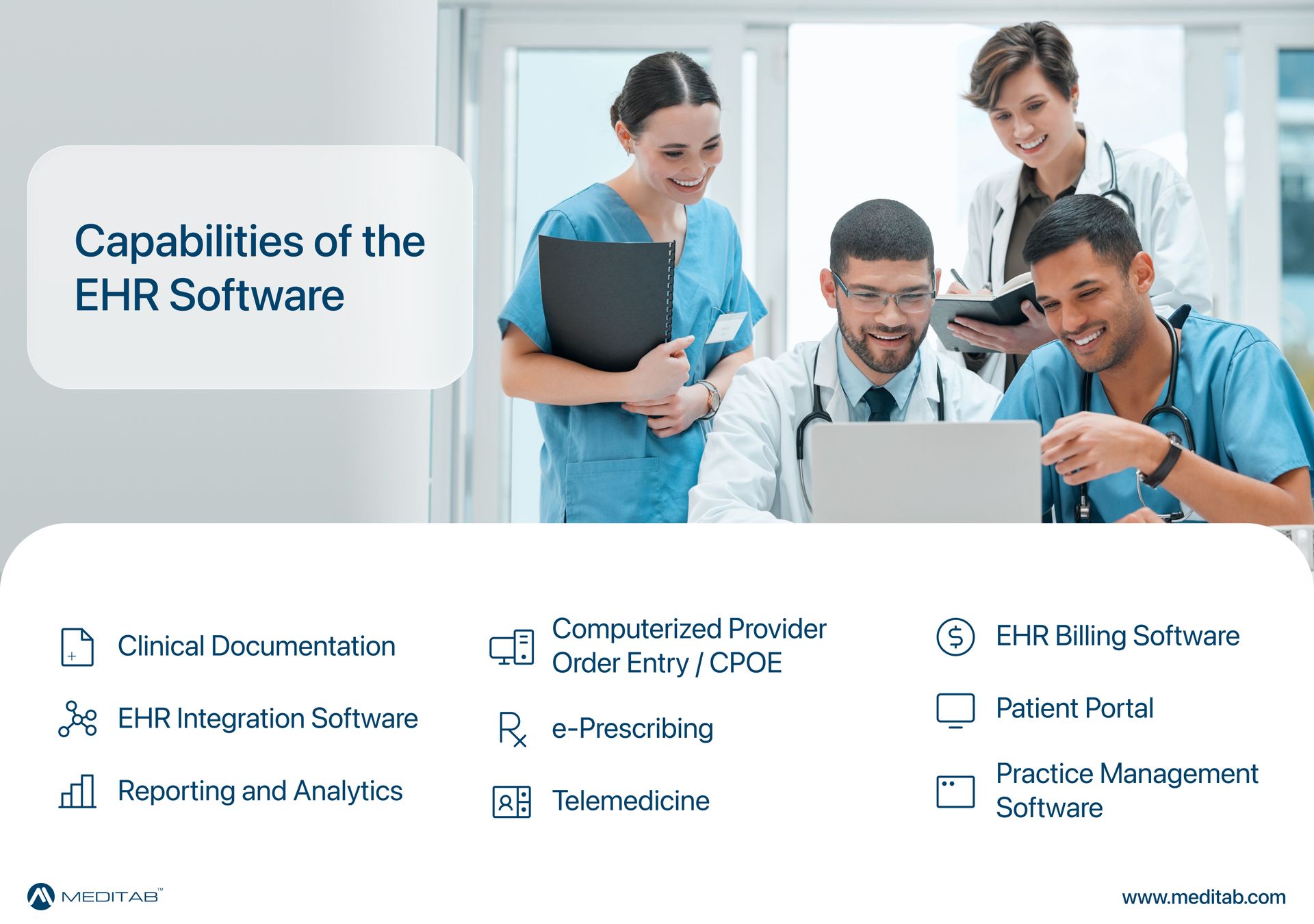
Modern Electronic Health record software platforms are feature-rich and often categorized into different types of EHRs, from those designed for small practices to enterprise-level solutions. The key features include:
- Clinical Documentation
Efficient tools for creating and managing patient encounters, including SOAP notes, with customizable templates.
- Computerized Provider Order Entry (CPOE)
Enables providers to enter orders for prescriptions, labs, and diagnostic tests directly into the system, reducing errors and delays.
- e-Prescribing
Securely transmit prescriptions electronically to pharmacies while reducing errors associated with handwritten scripts. Integrated checks for drug interactions, allergies, and dosage ensure safer, faster, and more accurate medication management.
- Patient Portal
Secure, user-friendly access that allows patients to view health records, schedule appointments, communicate with providers, and manage their care anytime, anywhere.
- EHR Integration Software
Seamless EHR integration software connects your EHR with labs, pharmacies, and other external systems to ensure smooth data flow.
- EHR Billing Software
Integrated EHR billing software simplifies the revenue cycle by connecting clinical documentation directly to medical coding and claims submission.
- Reporting and Analytics
Powerful tools that allow practices to track key performance indicators, monitor population health, and identify areas for improvement.
- Telemedicine
Built-in telehealth capabilities that allow for virtual visits, with the encounter note automatically populating in the patient's record. In Meditab, we make this functionality come to life via IMSGo Transcript to save valuable time.
- Practice Management Software
Organize administrative workflows, including appointment scheduling, patient registration, insurance verification, and billing coordination for smooth front-office operations and improved patient flow.
At Meditab, our
Intelligent Medical Software (IMS) combines all the elements of an EHR, practice management software, and medical billing software into a single, powerful platform.
EHR vs. EMR: How Are They Different?
A common point of confusion is the difference between an EHR and an EMR. While often used interchangeably, they serve different purposes.
- EMR software (Electronic Medical Record): An EMR is a digital version of a patient's paper chart from a single practice. It is primarily used by providers for diagnosis and treatment within that one office. EMRs are a good start, but they generally don't travel well outside the practice.
- EHR software (Electronic Health Record): An EHR takes a broader view. It’s designed to contain a more comprehensive patient record and, crucially, to be shared across different healthcare settings. An EMR and EHR software solution, when fully realized, combines the depth of the clinical record with the breadth of shareable health information.
For a deeper dive into this topic, check out our dedicated blog post.
Why EHR Software Is Essential for Healthcare Providers
Modern healthcare demands speed, accuracy, and coordination. The robust medical EHR software solution helps providers:
- Improve patient data accessibility
- Reduce paperwork and manual errors
- Enhance care coordination
- Support compliance and reporting
With features such as EHR integration, providers can seamlessly connect labs, diagnostic centers, pharmacies, and billing systems.
Physician-Hosted vs. Remotely Hosted EHR Software
Not all EHR systems are deployed the same way. Your hosting model determines who manages your data, how your team accesses it, and what your IT costs look like over time. Here's a straightforward breakdown of both options to help you decide.
Physician Hosted (Web-Based EHR Systems)
- Installed on local servers
- Greater control over data
- Requires in-house IT management
Remotely Hosted (Cloud-Based EHR Systems)
Also known as cloud-based EHR software
- Accessible from anywhere
- Lower maintenance and IT costs
- Automatic updates and backups
Today, many providers prefer cloud-based solutions for flexibility and scalability. At Meditab, we provide
stress-free cloud-based migration. Read the blog to know how we make it possible.
EHR Software: Advantages and Disadvantages
Modern EHR software delivers powerful clinical and operational benefits, backed by strong evidence, while a few common drawbacks can be effectively minimized with a highly customizable system and support.
Advantages
1. Clinical Quality and Safety
EHR software has demonstrated measurable improvements in healthcare quality. Meta-analytic evidence shows that EHRs are associated with reduced medication errors (risk ratio 0.46), lower rates of adverse drug events (risk ratio 0.66), and higher guideline adherence (risk ratio 1.33). EHRs also improve documentation completeness and enable clinical decision support through integrated alerts and reminders.
2. Operational Efficiency
EHR software eliminates manual chart retrieval, enables simultaneous multi-user access, and dramatically accelerates data retrieval by approximately 58 seconds via electronic query, compared with 10.3 minutes for manual chart review. Documentation time decreases by approximately 22.4% with proper EHR implementation.
3. Data-Driven Decision Making
EHR software enables hospitals to make data-based decisions more reliably than manual processes. Computer-based tools for data query improve the speed, reliability, reproducibility, and scalability of data retrieval.
4. Population Health and Surveillance
EHR software facilitates surveillance, preventative care, and population health management by aggregating data across patient populations. This capability supports disease prevention, quality improvement initiatives, and research.
Disadvantages and How Meditab’s IMS Minimizes Them
We have listed down challenges of the EHR software below, along with how we resolve them at Meditab.
1. Interoperability Issues
A significant barrier to EHR software effectiveness is the lack of standardization and interoperability among different vendor systems. This impairs swift information exchange and fragments the clinical information environment. In fact, this limitation compromises care coordination, particularly for complex patients managed across multiple healthcare settings.
At Meditab, we mitigate the steep initial learning curve with intuitive design and expert training.
2. Data Quality and Accuracy
While EHR software improves documentation compared to paper records, manual data abstraction from EHRs yields error rates averaging 10%, with transcription errors occurring at 9.19% per patient encounter.
At Meditab, we resolve data accuracy issues with proven, stress-free, and error-free migration services.
3. Clinician Burden
According to Coherent Market Insights, web-based EHRs are expected to account for 55.8% of the market between 2025 and 2032. Despite intended efficiency gains, many clinicians report that EHR software increases administrative burden through excessive alerts, cumbersome workflows, and time-consuming documentation requirements.
But, not with Mediatb’s IMS. With proven workflows to save time for healthcare workers, Meditab offers flexible pricing and a fast ROI for EHR implementation.
Implementation and Optimization Strategies
Reports from Technavio indicate that 45% of the growth in advanced EHR will occur in North America between 2024 and 2029. A successful EHR software deployment requires strategic planning and ongoing optimization:
- Clear communication
Leadership should articulate a clear rationale for implementation and frequently repeat the messaging to all stakeholders.
- Staff training
Comprehensive training helps identify productivity gaps and ensures effective utilization of system features.
- Workflow integration
EHR clinical support should be "invisible" yet integrated within clinician workflows to enhance care delivery without adding burden.
- Inbox management delegation
Assigning inbox management to support staff rather than physicians can reduce administrative burden.
- Alert optimization
Periodic review and removal of unnecessary alerts reduces alert fatigue and improves clinician responsiveness.
- Data leverage
Using EHR-generated data on clicks, keystrokes, and workflow patterns can identify opportunities to improve systems and implement shortcuts.
- Vendor collaboration
Physicians should actively participate in EHR design and advocate for meaningful changes to address workflow issues.
How EHR Software Improves Patient Care & Safety
The ultimate goal of any EHR system is to improve patients' health and well-being. Here’s how it achieves that:
- Reducing Medication Errors: EHRs with e-prescribing and decision support can alert providers to potential drug allergies or harmful interactions before a prescription is sent to a pharmacy.
- Improving Accuracy of Diagnoses: With a complete view of the patient's history, including past encounters, lab, and diagnostic results from EHR integration software, and medications, providers can make more accurate and timely diagnoses.
- Facilitating Preventive Care:
EHRs can automatically generate reminders for patients due for screenings, vaccinations, or other preventive services, helping practices keep their patient populations healthy.
- Supporting Evidence-Based Care:
By providing access to the latest clinical guidelines and research at the point of care, EHRs empower providers to make decisions based on the best available evidence.
- Enhancing Communication: Secure patient portals and direct messaging between providers ensure that critical information is shared quickly and efficiently, closing the loop on referrals and test results.
Meditab’s IMS With 40+ Specialties
Meditab’s IMS has been in use for over 25 years and is not a general-purpose EHR software retrofitted for healthcare, but a purpose-built platform designed around the daily workflows of medical practices across 40+ specialties.
IMS is Meditab's flagship EHR system, which combines clinical documentation, practice management software, EHR billing software, AI-powered tools, and telemedicine into a single integrated platform. There's no switching between systems, no manual data re-entry, and no third-party tools that may or may not talk to each other on any given day.
The depth that IMS holds is what makes it stand out from other EHR softwares in addition to its features. In Meditab’s IMS, specialty-specific templates actually fit how your specialty documents. The EHR integration software is built on FHIR APIs that connect to the tools your practice already relies on.
There is an AI medical scribe that transcribes notes while you focus on your patient. An IMS reporting and analytics tool gives you visibility into both clinical and financial performance from a single dashboard. If you're evaluating the best EHR software for your practice, whether you're a solo provider, a growing group, or a multi-specialty organization, IMS is worth a closer look.
Conclusion
EHR software is not just a digitization project. It's the operational backbone of a modern healthcare practice, and the difference between a practice that runs efficiently and one that runs on controlled chaos. The highest-quality EHR systems connect clinical documentation to billing, support your providers without adding to their administrative burden, and keep patient data secure and shareable. This helps increase the scalability of your practice as it grows. Those EHRs with lower performance do none of those things, regardless of how many features they list on a brochure.
If you're in the market for medical EHR software, or wondering whether your current EHR system is actually serving your practice, the questions to ask are simple:
Does it reduce work or add to it?
Does it connect your care team or isolate them?
Does it improve your patient experience, or just make it different?
At Meditab, we've been answering those questions for 25+ years. From
improving workflows to enhancing patient safety, a modern Electronic Health Record (EHR) software system empowers providers to do more with less effort. Choosing a reliable solution like Meditab ensures your practice stays future-ready.
Frequently Asked Questions (FAQs)
What is EHR software used for?
EHR software is used to store, manage, and share patient health information digitally.
Is cloud-based EHR software secure?
Yes. Most cloud providers use bank-level encryption and high-level security protocols that often exceed what a small practice can maintain on its own.
How is EHR software different from practice management software?
While often integrated, they serve different functions. EHR software focuses on the clinical side, including patient charts, diagnoses, and treatments. Practice management software handles administrative tasks such as scheduling, registration, patient insurance eligibility, and billing. Meditab's IMS is a modern system that combines both!
How long does EHR implementation take?
Depending on the size of the clinic, we have narrowed our implementation process to as short as 4 weeks, with mutual coordination and the client's commitment to achieving the goal. Typically, billing takes 6 weeks or longer for Medicare and some other insurance plans.
What are the types of EHR systems?
The main types of EHR are physician-hosted (on-premise) and remotely hosted (cloud-based) systems. Within those categories, EHRs vary by specialty focus, deployment model, and integration capabilities. Most modern practices choose cloud-based EHR software because of its flexibility and lower total cost of ownership.
Can I customize my EHR for my specialty?
Absolutely. The best systems, such as Meditab’s IMS, offer specialty-specific templates (e.g., for allergy, podiatry, cardiology, and many other specialties) to ensure the workflow aligns with your clinical needs.
Share this post: