Is an AI Medical Scribe Worth It? 5 Questions Providers Ask Most
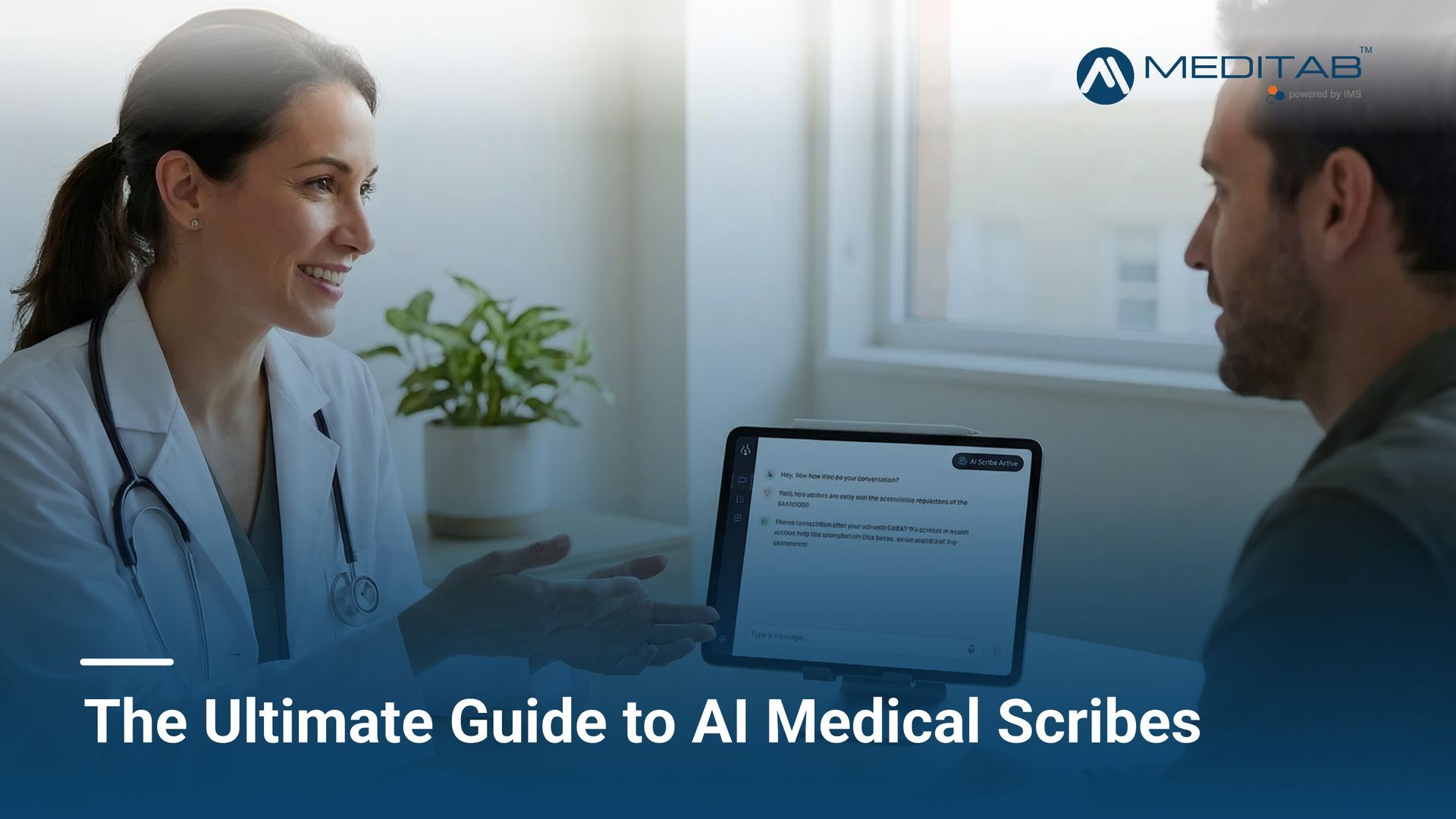
The healthcare industry is currently facing a documentation crisis. Amid endless charting and administrative hurdles, many providers feel more like data-entry clerks than clinicians. This is why the rise of the AI medical scribe tool has become such a hot topic. These systems promise to listen to patient encounters and draft clinical notes in real time, saving practitioners’ valuable time every day.
However, with new AI technology comes a fair share of skepticism. Is it secure? Is it accurate? Will it eventually replace the human touch in medicine? At Meditab, we believe in transparency and trust. To help you navigate this shift, we are providing honest answers to the five most common questions about the AI medical scribe tool.
Try Meditab’s IMSGo AI Scribe
1. Will AI Replace Human Medical Scribes
The short answer is no. While AI technology in healthcare is advancing rapidly, it is designed to be a co-pilot, not the pilot. A human scribe or a physician brings clinical judgment,
empathy, and a deep understanding of a patient's history that an algorithm cannot replicate.
Think of an AI scribe as an assistant that handles the heavy lifting of transcription and initial drafting. It captures the raw data, but the provider remains the final authority. At Meditab, our AI healthcare solutions focus on augmentation. We use a hybrid approach in which the AI generates the draft, while the clinician maintains full oversight, ensuring that the final notes reflect their specific clinical voice and expertise.
2. Is Patient Data Safe with AI Scribes?
Security is the most significant hurdle for any AI healthcare platform. Physicians are rightly worried about how Protected Health Information (PHI) is handled. When you use a reputable AI medical software, security isn't an afterthought. Rather, security is the very foundation.
Meditab ensures that all patient data is protected through strong encryption and remains compliant with HIPAA and SOC 2 standards. Our
IMSGo AI Scribedoes not use patient data to "train" public models. Instead, information is processed in secure cloud environments with strict access controls and audit trails. Your conversations are transcribed, converted into a note, and stored in your EHR, maintaining the same level of privacy you expect from any medical record.
3. How Accurate Are AI Medical Scribes?
In the early days of voice recognition, accuracy was a major frustration. However, modern artificial intelligence in healthcare has moved far beyond simple "speech-to-text”. Today’s systems use
Natural Language Processing (NLP) to understand context, medical terminology, and even different accents.
Accuracy significantly improves when using specialty-specific models. An orthopedic note looks very different from a pediatric note. By using an AI medical scribe tool trained on your specific field, the system understands the nuances of your exams. While no system is 100% perfect, these tools allow for real-time corrections, meaning the more you use them, the more they adapt to your specific charting style.
4. Will AI Slow Down My Workflow?
Many clinicians fear that "new technology" just means "more work." The reality is quite the opposite. The primary goal of AI in healthcare is to reduce the number of clicks and the time spent on a computer.
Instead of typing throughout the visit, the AI scribe captures the conversation while you focus on the patient. By the time the visit is over, a structured SOAP note is often already waiting for your review. This eliminates the extra time many doctors spend finishing charts at home. By integrating these healthcare AI solutions directly into your EHR, like Meditab’s IMS, you can finalize notes in minutes.
5. Is AI Hard to Use or Complicated to Learn?
You don't need to be a tech expert to adopt an AI medical scribe tool. The best tools are designed to be invisible. Most providers find that they can start using the system with minimal training because it simply involves "pressing record" and speaking naturally with the patient.
Meditab’s AI technology is built with an intuitive interface that integrates seamlessly with our EHR. We provide step-by-step onboarding and support to ensure a smooth transition. Most users find that within a few days, the tool becomes a natural part of their exam room routine.
Why Meditab’s IMSGo AI Scribe Stands Out
While many options exist, Meditab offers a unique advantage by bridging the gap between clinical conversation and your EHR. Our scribe "listens" to natural patient encounters in real-time, eliminating the need for manual dictation.
- Deep EHR Integration: Your generated notes flow directly into the patient record; no tedious copy-pasting required.
- Specialty-Specific Accuracy: The AI is trained to understand the complex terminology and nuances of your specific practice area.
- Combat Burnout:
Reclaim your day by letting our AI healthcare solutions handle the administrative burden while you focus on patient care.
Conclusion
The transition toward AI innovations in healthcare is not about replacing the human element of medicine; it is about protecting it. By automating the most tedious parts of the visits, AI scribes allow you to look your patients in the eye again. While concerns about security and accuracy are valid, choosing a proven AI medical scribe tool, such as the one offered by Meditab, helps ensure your practice remains efficient, secure, and human-centered.
IMSGo AI Scribe in Action
Frequently Asked Questions
What exactly does an AI medical scribe do??
An AI scribe listens to the clinician-patient conversation and uses NLP to filter out small talk and organize relevant clinical information into a structured SOAP note.
Is an AI scribe better than a human scribe?
AI is more cost-effective, available 24/7, and doesn't require extra space in the exam room. However, it works best when a provider performs the final review.
Can AI scribes work in any medical specialty?
Yes, but AI Scribes are most effective when using specialty-specific training. Whether you are in cardiology, fertility, or primary care, the AI can be tailored to your specific terminology.
How long does it take to fully adopt an AI medical scribe?
Most providers feel comfortable within 3 to 5 days of use. Because the system learns from your edits, it becomes more efficient the more you use it.
Share this post: