How to Choose the Best EHR Software in 2026
The EHR software market is growing increasingly complex as it matures year after year. In 2024, the U.S. ambulatory EHR market was estimated at USD 5.49 billion and projected to grow at a
CAGR of 5.57% from 2025 to 2030. With over 1,200 certified EHR systems available, ambulatory practices face a high-stakes decision. The correct electronic health records system improves clinical workflows, patient satisfaction, and revenue cycle performance.
For practices, selecting the correct EHR medical software is even more critical. Unlike large institutions, outpatient clinics require flexible, scalable, and specialty-driven EHR systems that can adapt to dynamic workflows without adding complexity. Whether you are implementing a new EHR for the first time or replacing an existing system, this guide will help you understand why Meditab’s IMS is an EHR medical software that fits your practice today and scales with you for tomorrow.
Core Factors for EHR Selection
According to Fortune Business Insights, the global ambulatory EHR market size was valued at USD 9.47 billion in 2025 and is projected to grow from USD 9.94 billion in 2026 to USD 15.93 billion by 2034. Amidst this boom, practices cannot afford to make mistakes such as choosing a generic EHR software that doesn’t understand their practice. Different medical specialties have unique documentation, billing, and compliance needs. When evaluating EHR systems, consider how well the solution supports the following factors specific to your practice:
1. Specialty Workflows
- Allergy & Immunology - Needs detailed allergy tracking, immunotherapy management, and environmental data inputs.
- Orthopedics & Pain Management - Requires robust imaging integration, procedure templates, and E&M coding tools.
- Mental Health & Psychiatry - Requires secure telepsychiatry, therapy note templates, and privacy-focused psychiatric screen tools.
- OB/GYN - Benefits from ACOG-aligned documentation, prenatal templates, and specialty-specific workflows designed for comprehensive women’s health care.
- Fertility - Benefits from specialized tools including cycle tracking, stimsheets, ART calendars, and dedicated modules for embryology, andrology, and cryopreservation.
- Multi-Specialty Practices - Should offer swift switching between specialties without multiple logins or fragmented systems.
The best EHR software for your practice will have specialty-specific templates, clinical decision support, and workflow tools designed for ambulatory care.
2. Key EHR Features
When evaluating EHR features, focus on functionality that enhances both clinical and operational performance.:
- Clinical documentation tools (SOAP notes, templates)
- e-Prescribing and Medication Management
- Integrated scheduling and billing
- Patient engagement tools (portals, reminders, live chat)
- Reporting and analytics
Modern EHR medical software should also include automation capabilities to reduce manual work and improve accuracy.
3. Deployment Model
Today, between on-premises and cloud-based solutions, most practices prefer remote-hosted EHRs for their flexibility and lower upfront costs. The key benefits of this setup include:
- Automatic updates for continuous improvement
- Remote accessibility
- Minimal IT infrastructure requirements
4. Integration Capacity
Your EHR system should be able to integrate with:
- Practice management systems
- Billing and revenue cycle tools
- Labs, diagnostic centers, and pharmacies
- Patient engagement platforms
Lack of integration can lead to data silos, which, in turn, increase administrative burden.
5. Compliance and Security
With increasing regulatory requirements, your EHR vendor must ensure:
- HIPAA compliance
- Secure data storage and transmission
- Regular system updates for compliance changes
- Quality and Registry reporting
Security is non-negotiable when dealing with sensitive patient data.
6. Scalability for Practices
As your practice grows, your new EHR should scale with you. Ensure that your EHR supports your practice in the following ways:
- Multi-location support
- Role-based access controls
- Customizable workflows
A scalable system ensures long-term value from your EHR investment.
The EHR Selection Process
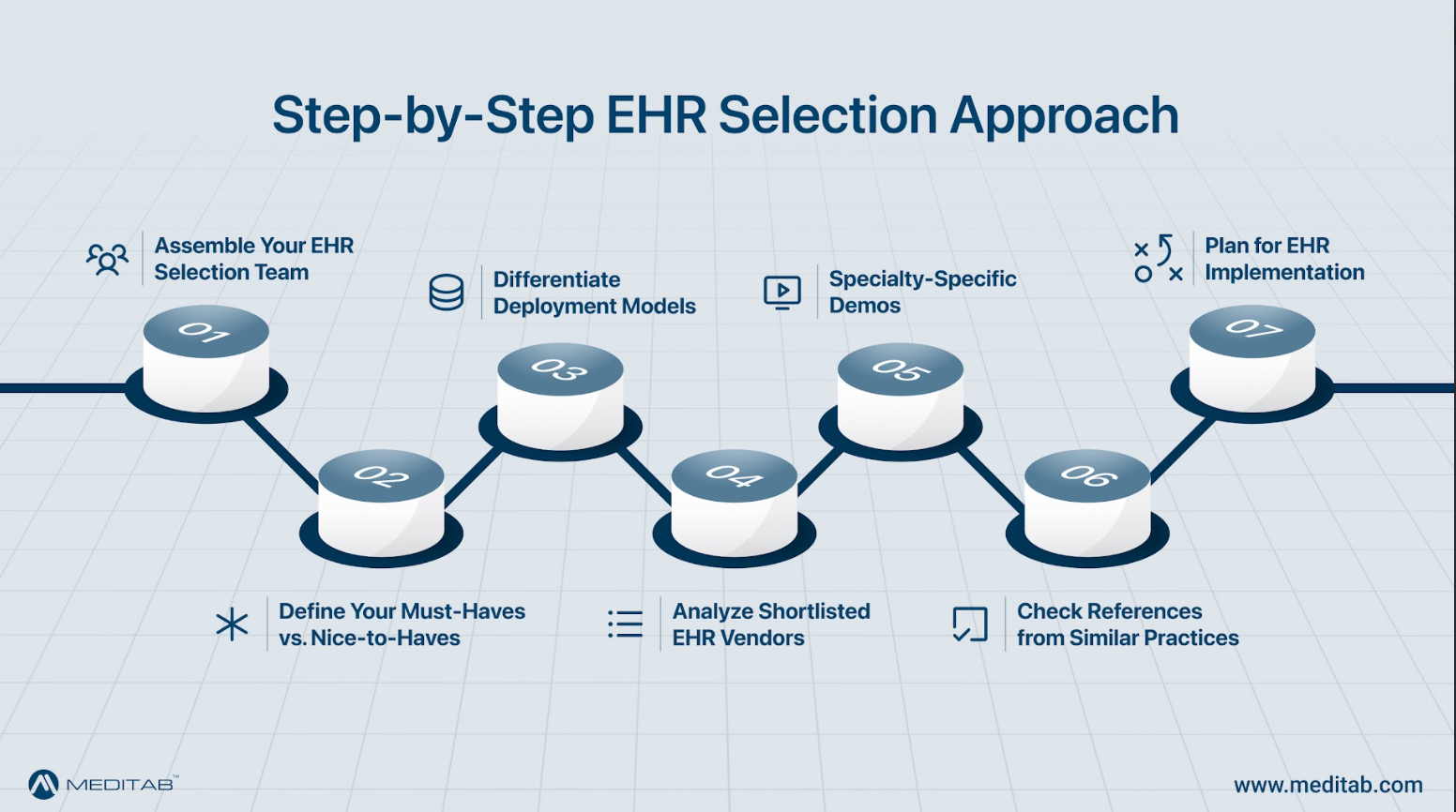
1. Assemble Your EHR Selection Team
Your EHR selection team should include:
- Lead medical assistant or nurse.
- One or more practicing providers
- Office manager or practice administrator
- Billing Manager
- IT Resource
A team such as this ensures that EHR features are evaluated from every angle, be it clinical, operational, financial, or technical.
2. Define Your Must-Haves vs. Nice-to-Haves
Start with a list of non-negotiable EHR features for your ambulatory practice. Common must-haves include:
- Specialty-specific templates
- ePrescribing with real-time benefit check
- Patient portal and bill pay
- Integrated EHR medical software with billing
- Reporting for MIPS, PQRS, or other quality programs and registries
- AI-powered tools are essential for reducing burnout and improving efficiency
3. Differentiate Deployment Models
Published reports suggest that cloud-based solutions led the ambulatory
EHR market with 77.12% share in 2025. This also means that the cloud segment is expanding at a 6.09% CAGR through 2031, largely driven by its lower upfront costs, minimal IT overhead, automatic updates, and scalability, making it the preferred choice for most ambulatory practices.
For ambulatory practices, EHR systems come in three main deployment models:
| Deployment Model | Description | Best For |
|---|---|---|
| Cloud-based / SaaS | Vendor hosts data; subscription pricing | Most practices; minimal IT overhead |
| Remote-hosted EHRs | Vendor hosts a dedicated instance | Practices needing customization control |
| On-premise | Practice owns servers | Rare today; legacy or high-security needs |
Remote-hosted EHRs offer a middle ground, where the vendor manages the infrastructure while giving you more control than multi-tenant SaaS.
4. Analyze Shortlisted EHR Vendors
Create a scorecard of your EHR vendors. Evaluate each EHR vendor on:
- Clinical fit: Do templates match your daily documentation needs?
- Usability: User-friendly for staff and providers alike.
- Interoperability: Does it connect to labs, diagnostic centers, registries, and data exchanges?
- Support: Is 24/7 support available?
- Financial stability: How long has the EHR vendor been in business?
5. Specialty-Specific Demos
Do not accept generic demos. Require the EHR vendor to show you:
- A complete patient encounter from scheduling to billing.
- Specialty-specific documentation for your top three visit types
- Reporting for your key quality metrics
6. Check References from Similar Practices
Ask the EHR vendor for three ambulatory practices similar to yours (size, specialty, geographic region). Ask those references:
- How long was the EHR implementation?
- Did the promised EHR features work?
- What do they wish they had known before signing the contract?
7. Plan for EHR Implementation
EHR implementation is not automatic. A successful rollout requires:
- A dedicated Implementation Specialist for your practice
- Data migration strategy
- Staff training plan (initial + ongoing)
- Go-live support from the EHR vendor (on-site or virtual)
- Budget both time and money for EHR implementation, typically 3 to 6 months from contract signing to stability.
Mistakes to Avoid During EHR Selection
When looking at EHR systems, be wary of:
- Hidden Costs: Training, data migration, and third-party integrations can add up.
- Complexity Overload: If the software is too hard to use, your providers will revert to paper or experience burnout.
- Lack of Scalability: Ensure the software scales with you, especially if you plan to use an EHR for a multi-location practice.
Here’s how
Meditab’s IMS does it differently. Read more to find out.
Wrap Up
Choosing the optimal EHR software in 2026 is a strategic decision. It will shape how your practice operates for years to come. The right choice creates compounding efficiency gains that free your providers to do what they trained for. For ambulatory practices specifically, the decision comes down to specialty fit, alignment with deployment models, implementation quality, and vendor partnerships.
Generic electronic health records rarely serve specialty practices well in the long term. The workflows are too different, the billing requirements too specific, and the documentation patterns too nuanced for a one-size-fits-all platform to handle effectively. Meditab's Intelligent Medical Software (IMS) has been built for ambulatory specialty practices for over 25 years, with genuine specialty depth across 40+ specialties, a structured implementation process, and a support model that stays with practices through go-live and beyond.
If you're beginning your EHR selection process, we'd be glad to show you what the right fit actually looks like for your specialty.
Frequently Asked Questions (FAQs)
What should I look for when choosing EHR software in 2026?
Focus on specialty-specific features, ease of use, strong integration capabilities, reliable support, and transparent pricing.
What are the key EHR features to look for?
Essential EHR features include clinical documentation, e-prescribing, patient engagement tools, reporting, and easy integration capabilities.
Can I switch EHR vendors after a few years?
Yes, but data migration is complex. That is why getting the EHR selection process right the first time is critical. Choose an EHR vendor with transparent data export policies.
How do I choose the most optimal EHR vendor?
Evaluate EHR vendors based on specialty expertise, support services, structured implementation and integration capabilities, and long-term value rather than just pricing.
What are the most important EHR features to look for?
Top EHR features that improve workflows include AI scribing, integrated billing, a robust patient portal, and automated chronic care management tools.
Is a cloud-based or on-premise EHR better for small practices?
Cloud-based EHR systems are usually the better choice for small and medium practices due to lower upfront costs and easier maintenance.
Discover Meditab’s multi-location EHR solution.
Can I switch EHR vendors after implementation?
Yes, but careful planning and data migration support are essential. Choose an EHR vendor with a strong reputation for smooth transitions.
How do I know if an EHR vendor will support my practice long-term?
Check the EHR vendor's financial stability, customer turnover rate, product roadmap transparency, and whether they serve only ambulatory or also hospitals. Meditab focuses exclusively on ambulatory EHR solutions.
How important is specialty-specific functionality?
Extremely important. Generic EHR software often forces workarounds, while specialty-focused solutions improve documentation speed and accuracy.
Share this post: