EMR vs EHR vs HIS: What Healthcare Providers Need to Know

Health care organizations depend more and more on digital systems to manage patient information, clinical workflows, and operational processes. Nonetheless, terms such as EMR, EHR, and HIS are often used with a lot of confusion. As intertwined as these technologies are, each plays a separate role within modern health care solutions.
Understanding the differentiation in medical EMR, EHR systems, and Hospital Information System platforms can help healthcare providers make better technology decisions to avoid costly mismatches and plan for long-term growth. This guide aptly breaks down the differences, explains where each system fits, and offers practical guidance for choosing the right platform.
See How IMS Supports Smarter Clinical Workflows
Difference Between EMR, HIS, and EHR
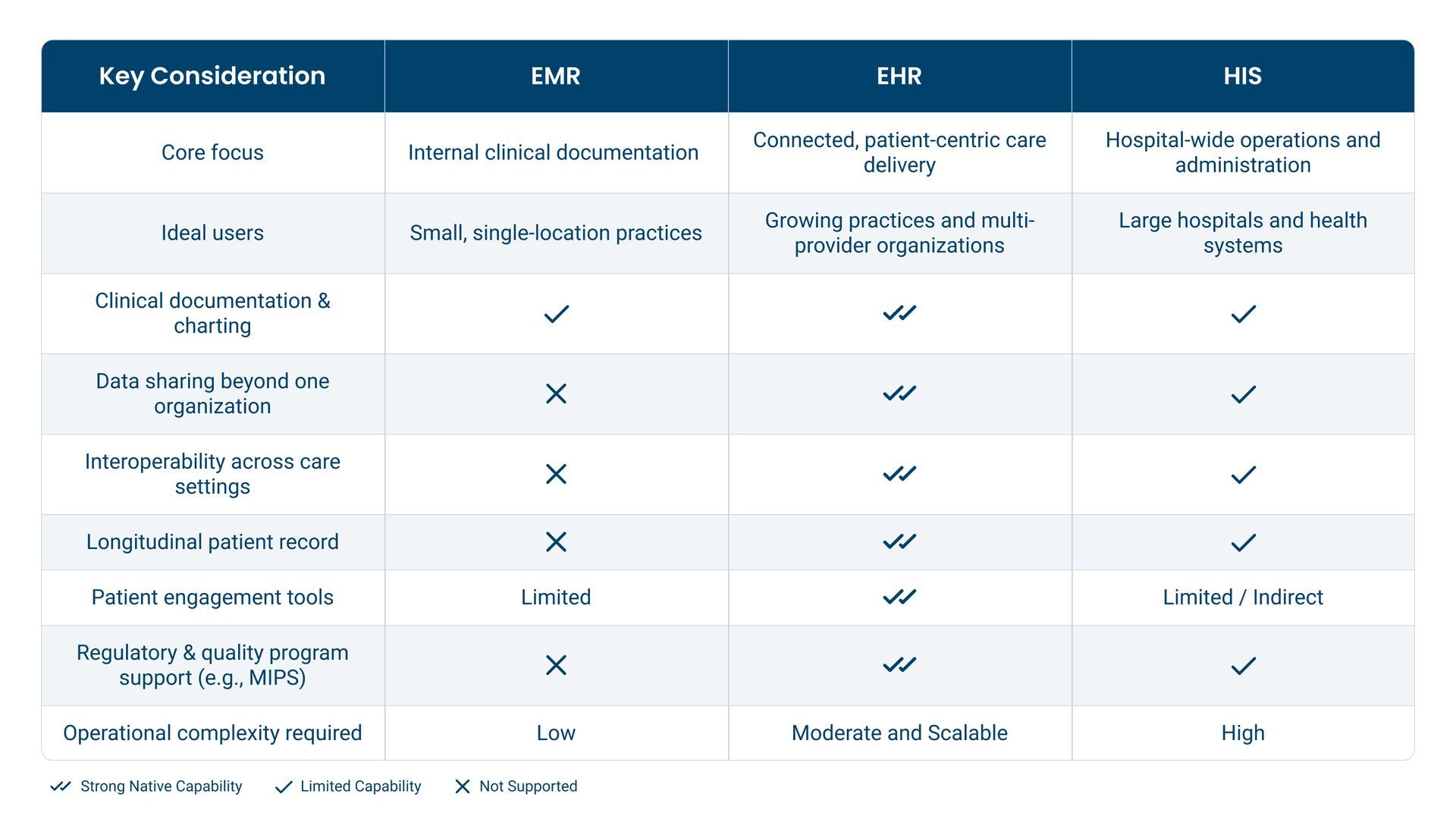
At a high level, the difference comes down to scope and data sharing.
EMR: An EMR focuses on clinical documentation within a single practice.
EHR: An EHR expands that data across care settings and providers.
HIS: An HIS manages hospital-wide clinical, administrative, and financial operations.
Each system builds on the previous one, moving from isolated electronic medical charting to fully connected EHR systems in healthcare.
What Is an EMR (Electronic Medical Record)?
An example of this would be a medical electronic records system offered for use in one health care facility. The system would be used for the purpose of storing patient records, diagnoses, prescriptions, and treatment plans developed by practitioners while attending to patients.
Clinical EMR systems are meant to enhance the precision and ease of creating medical records. The systems are employed by healthcare providers in documenting patient encounters, monitoring patient progress, and maintaining their internal patient records.
However, the scope of EMR software is restricted. The information is retained within the same practice, and thus, sharing information externally is not an easy task. Because of this, it has been observed that various EMR software in the medical field often transform into EHR systems.
What Is an EHR (Electronic Health Record)?
An electronic health record goes beyond the walls of a single practice. EHR medical records are designed to be shared securely across different healthcare platforms, including labs, pharmacies, specialists, and hospitals.
A modern EHR system includes comprehensive electronic patient record data such as clinical notes, lab results, imaging, medications, and care plans, all accessible in real time. Interoperability standards allow EHR providers to exchange information efficiently, improving care coordination and reducing duplicate testing.
Many EHR systems in healthcare also integrate artificial intelligence in healthcare features that support clinical decision-making, automate documentation, and surface actionable insights at the point of care.
What Is an HIS (Hospital Information System)?
A Hospital Information System, or HIS, is a broad platform designed specifically for hospital environments. EMR and EHR systems are designed to support clinical documentation and patient care activities, whereas HIS platforms provide a framework for integrating clinical systems with administrative and financial processes within an enterprise.
An HIS typically includes modules for admissions, bed management, billing, inventory, staffing, and reporting. It often incorporates EHR functionality but extends further into enterprise-level hospital administration.
In short, HIS platforms support hospital-wide operations, while EMR and EHR systems focus more directly on clinical care delivery, with the potential to extend into other domains such as billing and revenue cycle management.
EHR, HIS, and EMR Usage Trends
Trends in adoption reveal an obvious drift towards the use of holistic EHR systems. This is in the wake of organizations that had earlier adopted EMRs finding the need for greater interoperability, regulatory, and patient-centric support.
Smaller practices begin with EMR systems, while larger practices and healthcare systems begin using EHR systems to enhance collaboration and scalability, while hospitals continue to use HIS systems in combination with EHR systems to manage their complex functional needs.
Cloud hosting, mobility solutions, and AI capabilities are fueling the adoption of EHR systems.
Advantages of EMR, EHR, and HIS Systems
Each system has its own value in terms of usage in its corresponding setting. EMRs assist practices in improving their in-house documentation and workflow processes.
EHRs assist in managing various practices related to patient information and updated regulatory requirements. HIS system supports hospitals in better managing their operations, finances, and reporting purposes on an enterprise level.
All these systems work towards assisting healthcare organizations in their efforts to provide safer healthcare services and make better decisions.
How to Choose the Best EHR for Your Practice
The main advantage of EHR systems is the centralization of patient data and improved accessibility, resulting in more time for providers to interact with patients and less time trying to find the patient’s records.
Patient engagement tools such as portals, automated reminders, and educational materials can also help. If patients can communicate effectively with healthcare providers and understand their care plans, they can improve their outcomes.
Not Sure Which EHR System to Implement? We Can Help!
Meditab’s IMS is designed to support practices at every stage of growth. It combines robust EHR systems in healthcare functionality with integrated practice management, billing, MIPS quality reporting, and patient engagement tools.
IMS supports secure data exchange, configurable workflows, and advanced reporting, all within a single, unified platform built for real-world clinical environments.
Conclusion
The roles of the EMR, EHR, and HIS systems cannot be overemphasized in the modern electronic environment of the health industry. Though the main concern of the EMR system is internal documentation, and the HIS system deals with the entire operations of the hospitals, the vital part is played by the EHR system.
These distinctions help the selection and adoption of technology that addresses the current and future needs and requirements. After implementing the right EHR solution in an organization, medical teams and practitioners can achieve better outcomes.
Ready to Modernize Your Medical Records System?
Frequently Asked Questions
What is the main difference between EMR and EHR systems?
EMRs are used within a single practice, while EHRs are designed to share patient information securely across multiple healthcare organizations.
Can an EHR replace an HIS?
EHRs often integrate with HIS platforms but do not fully replace practice-wide administrative and operational systems.
Are EHR systems secure?
Yes. Certified EHR platforms use encryption, access controls, and audit trails to protect sensitive patient data.
Do EHR systems support mobile access?
Most modern EHR platforms offer secure mobile access for clinicians and patients, supporting on-the-go workflows and engagement.
Share this post: