9 Critical Questions To Help You Evaluate an AI-Powered EHR Solution
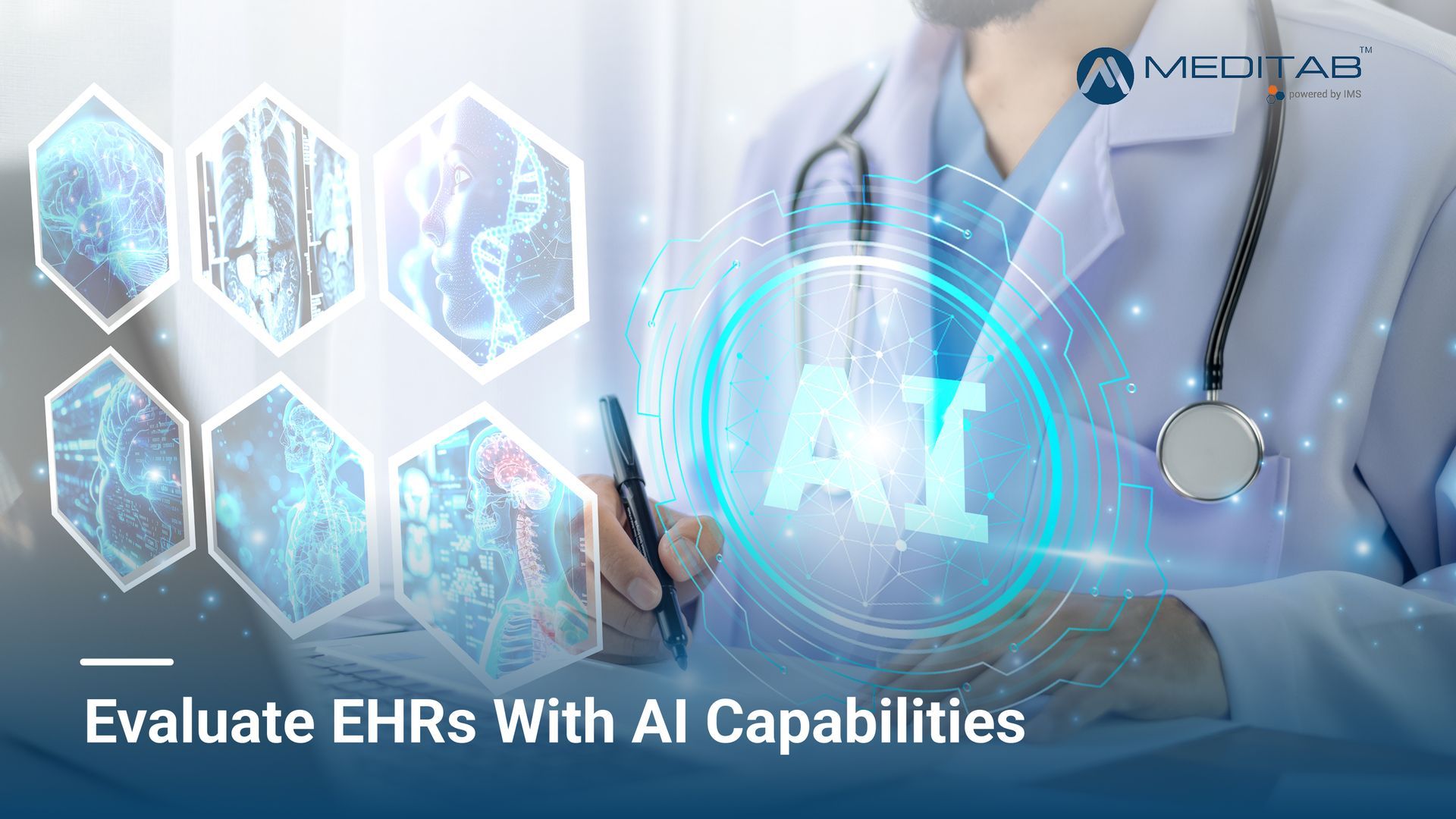
Artificial intelligence is not something that the healthcare field is working on implementing in the coming years. Today,
utilizing AI in healthcare is the way to go for handling every aspect of operations, irrespective of the practice size and scale.
At the forefront of this transition are current EHR systems with enhanced AI capabilities. Although these solutions offer efficiency and intelligence, it should be noted that not all EHR solutions that use AI offer a significant advantage in value.
Given the wide range of options available, how would you know that your EHR investment will make a difference in improving efficiency and patient care?
This guide is intended to help healthcare professionals ask the right questions before investing in an AI EHR system.
Explore EHR Solutions by Meditab’s IMS
Understanding AI EHR Solutions
An AI-powered EHR goes beyond simply providing robust digital patient record-keeping. It uses AI software capabilities to analyse data, automate tasks, and support decision-making across clinical and administrative workflows.
Unlike traditional EHR technology, AI-enabled platforms can assist with documentation, surface relevant clinical insights, streamline
scheduling software, and support more coordinated care delivery.
Key benefits of having an AI-powered healthcare software include:
- Automation that reduces administrative burden
- Increased accuracy and consistency in documentation
- Improved efficiency of clinical workflows
- Deeper Insights into operational and clinical data
As healthcare organizations plan for the future of healthcare, AI-driven EHR platforms are increasingly seen as foundational healthcare technology solutions, rather than just optional upgrades.
9 Critical Questions to Ask Before Investing
As you evaluate the available options, consider which features typically define a robust, AI-powered Electronic Health Record (EHR) solution. Here are a few essential points to guide your review.
1. Does the AI-enabled EHR align with your clinical workflow?
AI capabilities in an EHR should support existing care delivery, not disrupt it. An effective EHR fits naturally into your existing clinical workflows, minimizing extra steps and reducing documentation fatigue.
Choosing an AI-enabled EHR that offers custom features and workflows
tailored to your specialty needs is the way to go.
2. How robust is the AI functionality
AI functionalities are available in many forms. Some offer surface-level automation, while others come with deeper capabilities like predictive
insights, clinical decision support, and seamless integration with AI-enabled medical devices.
So, evaluate whether the AI features actually address your organization’s needs rather than merely serving as marketing buzzwords.
3. What data security and compliance measures are in place?
The protection of patient data is non-negotiable. A capable and reliable EHR with AI functionality must support HIPAA requirements through encryption, role-based access, audit trails, and regular security updates.
Transparency around how AI models use and process data is equally important for long-term trust and data transparency.
4. How easy is the system to use?
Even the most advanced healthcare AI platforms fail to deliver competent care if their navigation is difficult for users. Choosing an intuitive design that supports users, whether clinical or administrative, is what a practice should go for.
5. What level of training and support are provided?
Look for vendors offering structured onboarding, role-based training, and continuous support. A successful implementation depends on more than the software; it is about ease of use and implementation.
It is up to you whether you want months of frustration or a smooth transition, which can only be provided by a responsive team.
6. What are the costs and Return on investment expectations?
While it is common to look for affordability and rebates, what matters more is long-term value. An EHR with AI-driven automation can improve productivity, reduce errors, and support
enhanced billing processes.
Look for how systems contribute in terms of measurable outcomes, not just cost savings.
7. Is the solution scalable and future-ready?
The healthcare landscape in this competitive economy is prone to frequent changes. So, you should look for an AI-powered EHR solution that scales with your growth, adapts to
regulatory changes, and receives regular updates.
Solutions that support specialty-specific AI features and workflows, such as Meditab’s IMS, are better positioned for long-term success.
8. Does the vendor provide patient-centric AI features?
Not everyone sees AI as revolutionary or feels they must have it. It is very crucial to know your patient’s opinion on AI in healthcare. Meditab’s IMS excels at this by providing mobile apps and telemedicine functionality directly to patients, so they can use them firsthand and let their provider know exactly how they feel.
Healthcare was, is, and will always remain profoundly personal. Hence, keeping the patient perspective in mind while deciding on an ideal EHR solution with AI capabilities is what providers or organizations need to be mindful of.
9. How frequently does the vendor provide updates, and are new integrations offered in those updates?
Ensuring the vendor provides version updates and the frequency of those updates becomes crucial when choosing the right AI-powered EHR. It does not end with regular updates; one should also look for an EHR vendor that offers
intelligent integrations with labs and specialty-specific software.

Additional Tips for Choosing the Right AI-Powered EHR
In addition to product feature sheets, decision-makers should also:
- Review real-world case studies
- Request a 'live demo' of the available AI functionalities
- Involve clinicians, IT teams, and administrators early in the process
Moreover, making sure that the system meets both clinical and administrative purposes is an integral part of having an effective implementation of EHR.
Conclusion
AI is rapidly reshaping how healthcare organizations document care, manage operations, and plan for the future. But technology alone can not be the solution.
By asking the right questions and evaluating how AI-powered EHRs fit into real-world workflows, providers can make informed decisions. Thus, improving both patient care and efficiency.
Choose the right AI for healthcare today and set a rock-solid foundation for sustainable growth tomorrow.
Ready for AI-enabled EHR solutions?
Frequently Asked Questions
What is an AI-powered EHR system?
An AI-powered EHR uses artificial intelligence to automate tasks, analyze clinical data, and support decision-making beyond basic record storage.
How does AI improve traditional EHR systems?
AI enhances documentation, surfaces relevant insights, and streamlines workflows, reducing administrative and clinical burdens.
What should I prioritize when evaluating an AI EHR?
Focus on workflow alignment, usability, security, interoperability, and long-term scalability.
Is training required to use an AI EHR system?
Yes, structured onboarding and training help ensure smooth adoption and effective use.
Share this post: